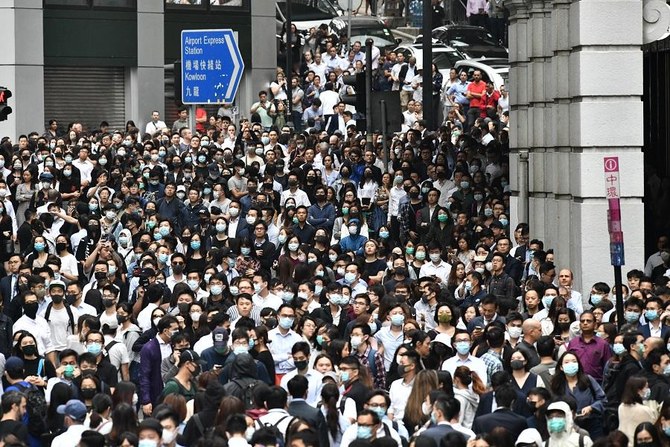
HONG KONG: Visitor numbers to Hong Kong fell by nearly 40% in the second half of last year amid clashes between police and anti-government protesters.
The Hong Kong Tourism Board on Wednesday said the numbers of those visiting the Asian financial hub started to drop off in July as protests against proposed legislation allowing extradition to China gathered pace.
For the last six months of 2019, visitor numbers fell by 39% against the same period a year before. Overall, arrivals were off by 14% for the entire year. The protests have lost momentum amid mass arrests by police and since major opposition wins in district council elections in November.
Hong Kong’s economy fell into recession, its reputation as one of the world’s safest cities tarnished by the violence driven largely by anger over China’s perceived encroachments over rights retained by the former British colony when Beijing took control in 1997. The extradition legislation was withdrawn, but the protest movement morphed to include demands for greater democracy and an investigation into police tactics.
Financial Secretary Paul Chan told a forum Monday that the government estimated economic growth for 2019 would fall to -1.3 percent, a stark loss for the center of trade, travel and finance.
Tourism, catering and retail industries suffered the biggest losses, with store receipts falling by 26% in October and November against the same months in 2018.
However, the tourism board’s Chairman Y.K. Pang was quoted as saying in a Wednesday news release that he had “every confidence” in Hong Kong’s resilience and appeal as a world-class travel destination. The board said it has launched promotional events and special offers covering hotels, flights, shopping and attractions.

Protests take toll on Hong Kong tourism
Industry leaders highlight Riyadh’s Metro, infrastructure as investment catalysts
RIYADH: Saudi Arabia’s capital, Riyadh, is experiencing a transformative phase in its real estate sector, with the construction market projected to reach approximately $100 billion in 2025, accompanied by an anticipated annual growth rate of 5.4 percent through 2029.
The Kingdom is simultaneously advancing its data center capacity at an accelerated pace, with an impressive 2.7 GW currently in the pipeline. This expansion underscores the critical role of strategic land and power planning in establishing national infrastructure as a cornerstone of economic growth.
These insights were shared by leading industry experts during JLL’s recent client event in Riyadh, which focused on the city’s macroeconomic landscape and emerging trends across office, residential, retail, hospitality, and pioneering sectors, including AI infrastructure and Transit-Oriented Development.
Saud Al-Sulaimani, Country Lead and Head of Capital Markets at JLL Saudi Arabia, commented: “Riyadh is positioned at the forefront of Saudi Arabia’s Vision 2030, offering unparalleled opportunities for both investors and developers. National priorities are continuously recalibrated to ensure strategic alignment of projects and foster deeper collaboration with the private sector.”
He added: “Recent regulatory developments, including the introduction of the White Land Tax and the rent freeze, are designed to stabilize the market and are expected to drive renewed focus on delivering premium-quality assets. This dynamic environment, coupled with evolving construction cost considerations in select segments, is fundamentally reshaping the market landscape while accelerating progress toward our national objectives.”
The event further underscored the transformative impact of infrastructure initiatives. Mireille Azzam Vidjen, Head of Consulting for the Middle East and Africa at JLL, highlighted Riyadh’s transit revolution. She detailed the Riyadh Metro, a $22.5 billion investment encompassing 176 kilometers, six lines, and 84 stations, providing extensive geographic coverage, with a depth of 9.8 km per 100 sq. km. This strategic development generates significant TOD opportunities, with properties in proximity potentially commanding a 20-30 percent premium. JLL emphasized the importance of implementing climate-responsive last-mile solutions to enhance mobility and accessibility, particularly given Riyadh’s extreme temperatures.
Gaurav Mathur, Head of Data Centers at JLL, emphasized the rapid expansion of the Kingdom’s AI infrastructure, signaling a critical area for technological investment and innovation.
Focusing on the construction sector, Maroun Deeb, Head of Projects and Development Services, KSA at JLL, explained that the industry is actively navigating complexities such as skilled labor availability, material costs, and supply chain dynamics.
He highlighted the adoption of Building Information Modeling as a key driver for enhancing operational efficiency and project delivery.



