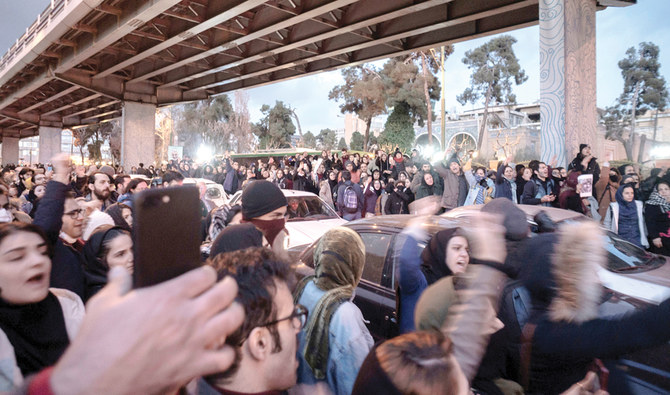
LONDON: Iranian protesters gathered for a third consecutive day at sites across Tehran and other cities to mourn the deaths of 176 people killed in the downing of a Ukrainian passenger plane, and to protest the government’s handling of the incident.
What began as an exercise in grief is rapidly turning into an expression of anger.
Iran downed the plane following its missile attacks on US military bases in Iraq. The attacks, revenge for the US killing of Iranian Maj. Gen. Qassem Soleimani in an airstrike in Baghdad, were met with no immediate response from the US.
Meanwhile, Iranian state-run media say the British ambassador to Iran has left the country after being arrested and briefly detained.
The state-run IRNA news agency said Robert Macaire left after being given prior notice. The report did not elaborate.
Macaire had been held after attending a candlelight vigil Saturday in Tehran over Iran shooting down a Ukrainian jetliner, killing 176 people.
As the truth finally emerged about the downing of the plane, after days of denial and obfuscation from Tehran, protesters’ anger at the US quickly turned against the regime itself.
This has boiled over into demonstrations at universities and other sites across Tehran and multiple other cities.
Video footage has emerged of protesters tearing down pictures of Soleimani, calling him a murderer, and chanting that the Basij — the domestic militia of the Islamic Revolutionary Guard Corps — should “go to hell.”
Protesters at Sharif University in Tehran, where many of those in the downed plane had studied or graduated, have been recorded chanting: “They killed our elites and replaced them with mullahs.”
Videos from within Iran appear to have shown the use of live ammunition and teargas against protesters. The recent scenes stand in stark contrast to those that emerged in the wake of Soleimani’s death. Funerals for him were held in cities across Iran, with people coming out in their thousands to mourn.
Writing for the BBC, Dr. Anisah Bassiri Tabrizi, a research fellow at the Royal United Services Institute, highlighted the “unprecedented level of unity and popular support” on display during Soleimani’s funeral.
She said this initially appeared to show that “when faced with the external threat of military confrontation, Iranians from different political and economic backgrounds could come together.”
However, Tabrizi added, the regime’s reaction to the downing of the plane made it likely that the unrest that erupted in November and resulted in the deaths of at least 300 people would re-emerge. Footage that continues to surface from protests in Iran appears to confirm this trajectory.
The regime has breathed new life into the public opposition that had been quelled through violence and a near-total internet shutdown.
Dr. Mahsa Rouhi, a research fellow at the International Institute for Strategic Studies, said the situation is already directly impacting Iranian politics.
The Guardian Council, the body responsible for approving parliamentary candidates, has just disqualified many moderate and reformist candidates who intended to run in February’s elections.
This, Rouhi said, means that hard-line voices are now more likely to dominate the next Parliament.


![]()

Downing of Ukrainian plane breathes new life into Iranian protests
Short Url
https://arab.news/9vzcg
Downing of Ukrainian plane breathes new life into Iranian protests
- As the truth finally emerged about the downing of the plane, protesters’ anger at the US quickly turned against the regime itself


Latest updates


© 2026 SAUDI RESEARCH & PUBLISHING COMPANY, All Rights Reserved And subject to Terms of Use Agreement.