

Amid threats to UK staff, Iran International TV offers alternative to Tehran's narratives

1 / 6
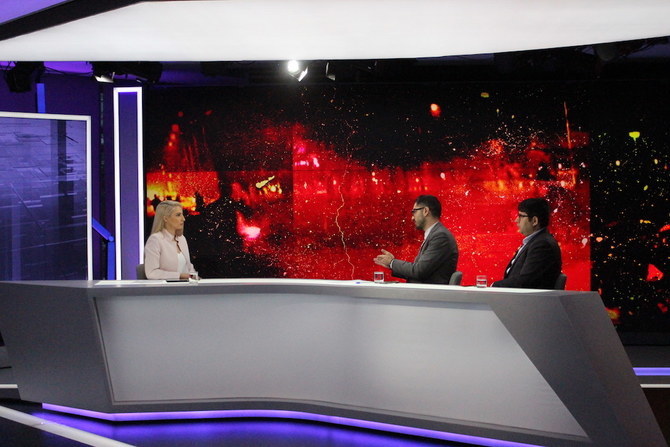
Iran International TV is a privately funded channel based in west London and was established in May 2017. (Supplied)
2 / 6
Sadeq Saba, editor and presenter at Iran International TV, says the channel has been very successful in covering the November fuel hike protests in Iran. (Supplied)
3 / 6
Iran International TV is the first 24-hour Persian news channel and already it has covered major events in Iran. (Supplied)
4 / 6
The channel is very strong in sports for their younger audiences and they cover stories which Iranian channels usually do not touch. (Supplied)
5 / 6
Within three years, Iran International has become number one channel among all other Persian language broadcasters. (Supplied)
6 / 6
The channel mainly broadcast to Iran, but it is available everywhere in the world via major satellites and is streamed live on the Internet. (AN Photo/Sarah Glubb)
Short Url
Updated 14 January 2020
Follow

Amid threats to UK staff, Iran International TV offers alternative to Tehran's narratives

  • Staff at Iran International TV have received threats to resign and their family members have been threatened and harassed
  • The channel has several bureaus around the world, except in Iran

LONDON: Iran is well known for suppressing protests and silencing critics within the country, but the regime is now extending its “distressing” abuses to Iranians living abroad.
Staff at Iran International TV, a news broadcaster based in west London, claim that not only have they personally faced a campaign of threats, but pressure has been applied on their families in Iran.
The station, which launched in May 2017, has quickly grown to become the most viewed Persian-language international broadcaster, tapping into a thirst for news from the Islamic Republic untarnished by the regime’s censors.
In particular, the channel has drawn audiences looking for coverage of the vast protests against clerical leaders last year that have now resumed in response to the shooting down of a Ukrainian passenger plane by the Iranian military.


“Of course, we are the victim of our success as well, in a way,” Sadeq Saba, editor and presenter at the channel told Arab News. “We have been very successful in covering the protests in Iran, after the Iranian regime brutally suppressed them.”
Problems for the TV station’s staff began when demonstrations erupted in hundreds of cities across Iran in November last year over a hike in petrol prices. Reuters reported that 1,500 protesters were killed, and thousands arrested.
“The Iranian intelligence ministry, which is a notorious organization, summoned families of my colleagues in Iran,” Saba said. “Within a few days, more than a dozen colleagues were affected, their mothers, fathers, siblings were summoned to intelligence ministry offices in Tehran and other cities.”


The veteran journalist said the authorities put pressure on his colleagues and told them “if you don’t resign from Iran International, they will make sure that they bring us back to Iran by force. I don’t think this is something they can do, but this is my opinion sitting in the safety of London, but if you are an elderly mother in a remote part of Iran and intelligence ministry officials tell you ‘if your loved one does not quit Iran International we will bring her or him back to Iran by force from anywhere in the world,’ you would be very distressed.”

Saba added that both he and his colleagues “strongly condemned” what the regime had done to their families, who were “innocent and should be left alone. We are not hostile to the Iranian regime, we are not their enemies, we are just a news channel, and we are professional journalists, and we believe in our principles and ethics of journalism and we are doing a simple job.”
The channel, which is privately funded, was set up as the first 24-hour Persian news channel and already it has covered major events in Iran.
It employs about 200 staff and has several bureaus around the world except, of course, in Iran.

“We would have loved to have a bureau and have correspondents there, but the Iranian authorities, obviously, don’t permit Persian-language channels to have bureaus in Iran,” Saba said.
The channel uses “citizen journalists” in Iran to aid with their coverage of major events. During the protests in November, they received thousands of videoclips and material, some with content so “heartbreaking and demoralizing” they could not be aired.
“The Iranian authorities do not talk to us, but we make sure that their point of view is also aired,” added Saba, who hosts the weekly arts and culture program “Weekend with Sadeq Saba.”
However, he noted that due to the regime’s policies, its hostilities with the US, and “for many other reasons,” the Iranian population was very politicized.


“Even boys and girls from a young age become willy-nilly interested in politics,” Saba said, adding that they particularly wanted to know what the opposition and analysts were saying.
Saba, who formerly served as the head of BBC Persian, said that the reason for the broadcaster’s success was because it had gone someway to filling this vacuum.
“Within three years, Iran International has become the number-one channel among all other Persian-language broadcasters, from BBC Persian service, Voice of America Persian, and Radio Free Europe Persian service, which is called Radio Farda,” Saba added.
It also operates on all social media platforms, and according to data provided by the channel, its followers are significantly greater in number than competitor channels.


During the protests, the Iranian regime shut down Internet services in the country. Saba said that over the same period Iran also jammed Iran International’s satellite signal, forcing the broadcaster to make a complaint with the UK’s communications regulator.
In response, the channel set up a radio station as well to reach those who lived in remote areas or during times of blackouts.
Since its launch, the channel has had a string of major stories involving Iran to get its teeth into, providing extensive coverage of the attacks on Saudi Arabia’s oil refineries and oil tankers, the death of top Iranian commander Qassem Soleimani, as well as Iran’s involvement in Syria, Lebanon, Iraq and Yemen.
The coverage has brought recognition, with Iran International recently nominated for the Best International Channel of the Year award by the Association for International Broadcasting (AIB).

“This is a forum for everybody, if you want to know what is happening about Iran and you are a Persian speaker, you watch this channel, and we would like to continue that,” he said.
The channel also has plans to expand its services to include more English and Arabic content.


Sweeping US defense bill passes Congress, including real of Syria sanctions

Updated 8 sec ago
Follow

Sweeping US defense bill passes Congress, including real of Syria sanctions

WASHINGTON: The US Senate voted overwhelmingly on Wednesday to advance a $901 billion bill setting policy for the Pentagon, sending the massive piece of legislation to the White House, which has said President Donald Trump will sign it into law. The fiscal 2026 National Defense Authorization Act, or NDAA, is a compromise between separate measures passed earlier this year in the House of Representatives and Senate. It authorizes a record $901 billion in annual military spending, with a 4 percent pay raise for the troops. It also authorizes reforms to the system for acquiring military equipment and includes efforts to boost competitiveness with US archrivals China and Russia.
The Senate backed the bill by 77 to 20, with strong support from both parties. Two of the “no” votes were from Republican senators Mike Lee and Rand Paul.
“This will be the 65th year in a row, the 65th consecutive year, that Congress has come together across the aisle and across two chambers to send the president a bill designed to sustain and strengthen the national defense,” said Senator Roger Wicker of Mississippi, the Republican Senate Armed Services Committee chairman. The House passed the bill last week, by 312 to 112, also with broad bipartisan support. In a break with Trump, whose fellow Republicans hold majorities in both the House and Senate, this year’s NDAA includes several provisions to boost security in Europe, despite Trump’s release earlier this month of a National Security Strategy seen as friendly to Russia and a reassessment of the US relationship with Europe.
The fiscal 2026 NDAA provides $800 million for Ukraine — $400 million in each of the next two years — as part of the Ukraine Security Assistance Initiative, which pays US companies for weapons for Ukraine’s military.
It also authorizes the Baltic Security Initiative and provides $175 million to support Latvia, Lithuania and Estonia’s defense. And it limits the Department of Defense’s ability to drop the number of US forces in Europe to fewer than 76,000 and bars the US European Commander from giving up the title of NATO Supreme Commander.

WINS FOR BOTH PARTIES
Members of Congress take great pride in having passed the NDAA every year for more than six decades.
The measure’s record price tag is $8 billion more than Trump had requested. This month a handful of Republicans and Democrats called for the addition of a provision to strengthen military helicopter safety rules, following a fatal crash between an Army Black Hawk and an American Airlines passenger jet that killed 67 people.
Anger over that issue was not strong enough to derail the NDAA. Senate leaders have promised to address it in upcoming legislation. The NDAA also repeals the tough “Caesar” sanctions imposed on Syria under its former leader Bashar Assad. And it has a provision to withhold a chunk of Defense Secretary Pete Hegseth’s travel budget if he does not provide Congress with unedited videos of military strikes on boats in the southern Caribbean and eastern Pacific. The Trump administration has said the strikes are directed at Venezuelan drug-traffickers. The Senate vote came a day after Trump ordered a blockade of all sanctioned oil tankers entering and leaving Venezuela, his latest move to increase pressure on Venezuelan President Nicolas Maduro’s government.
It repeals the 1991 and 2002 Authorizations for the Use of Military Force (AUMFs) against Iraq, an attempt to reassert Congress’ role in deciding to send troops into combat.
During his first term, Trump said the 2002 AUMF provided legal authority for the 2020 killing in Iraq of senior Iranian military commander Qassem Soleimani.
The NDAA does not include funding to change the name of the Department of Defense to the Department of War, an idea championed by Trump but a change that cannot be formalized without congressional approval.
However, it includes some of the “culture war” efforts popular with politicians on the US right. One measure bars transgender women from participating in athletic programs designated for women at US military academies.
It also codifies into law executive orders by Trump ending diversity, equity and inclusion efforts at the Pentagon.