

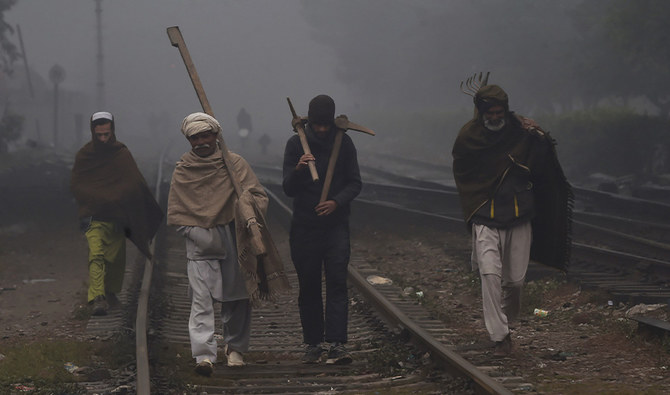

LAHORE: As Lahore’s wealthy attend glitzy winter soirees, toasty bonfires and weddings in the cold months, the wave of bitterly low temperatures in Pakistan’s eastern Punjab province this season has affected a huge number of people living life on the fringes.
These are people like Bilqees Bano, who lives on the banks of the River Ravi in a small, sparse hut with her three young children and husband, a daily wage earner who suffers from chronic asthma-- a condition that has deteriorated in the cold and smoggy weather.
“We live here in our one-room home. We collect wood, plastic bags and papers from the road to burn and warm our hut. When we burn wood to warm the room, it creates smoke which further hurts the health of my husband,” Bano said, holding back tears.
“He is unable to work and it has become difficult to feed our children because we have not stored any rations,” she said.
On Monday, most parts of the country came under the grip of severe cold, rain and snowfall, with eleven people killed due to heavy rain in Punjab. In southwestern Balochistan province, 25 people were killed in snow-related accidents.
Punjab’s laborers say, as a result of the cold wave, their businesses have shrunk and it has become increasingly difficult to find jobs.
“The trader is not coming to buy goods due to cold weather. We do loading and unloading and earn money. Our work has stopped,” Aman Elahi, a laborer, told Arab News.
“We search for work in the morning and gather at this place in the evening, light a bonfire and sit around it to save ourselves from the cold,” he added.
To escape the cold, some laborers working in Lahore city take refuge in government built shelter homes at night.
“We have 166 beds, and since the recent cold wave hit the city... all our beds are taken by the evening,” Asif Rasheed, who manages a Railway Station shelter home told Arab News.
Sitting by the road at Lahore’s old Mochi gate in the bitterly cold afternoon, Muhammad Boota Dholchi, a drummer, is unhappy with work prospects-- but the dreary weather has failed to muzzle his spirits.
“I am from Okara. I come here at 11 in the morning and wait for clients to take me to beat my drum on wedding functions,” he said, and added: “It’s the third day now without a job in sight. I haven’t earned a single rupee.”
He looked out at the grey, wet day, his drum sitting by his side. Mochi gate was replete with its usual bustle but everyone moved, it seemed, in slow, frozen motion.
“And then these people have the gall to accuse me of being in a bad mood!” Boota said with a wink, and broke out into a big smile.


