

Taal Volcano forces evacuation of thousands in Philippines

1 / 2
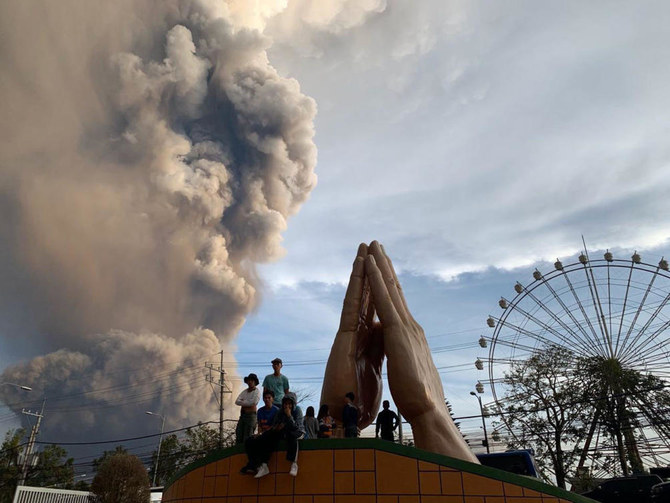
People watch as Taal Volcano erupts Sunday Jan. 12, 2020, in Tagaytay, Cavite province, outside Manila, Philippines. (AP)
2 / 2
People watch as the Taal volcano spews ash and smoke during an eruption in Tagaytay, Cavite province south of Manila, Philippines on Sunday. Jan. 12, 2020. (AP)
Short Url
Updated 13 January 2020
Follow

Taal Volcano forces evacuation of thousands in Philippines

  • Eruption possible within weeks as alert level raised

MANILA: Thousands of people are being evacuated from a southwestern province in the Philippines after a volcano began spewing ash plumes as high as 100 meters.

As of Sunday afternoon Taal Volcano had escalated its eruptive activity generating an eruption plume one-kilometer high accompanied by volcanic tremor and felt earthquakes in Volcano Island and villages of Agoncillo, Batangas, according to the Philippine Institute of Volcanology and Seismology (Phivolcs), which raised the alert level to three, indicating a high level of volcanic unrest. 

The maximum alert level is five, which is a hazardous eruption in progress. 

The institute said ashfall was being showered on the southwest sector of Taal and that the volcano had shown increased steaming activity in at least five spots inside the main crater.

The largest activity was a steam-driven eruption that generated a plume approximately 100 meters high.

The institute recommended that residents and tourists should be evacuated from Taal Island, Agoncillo and Laurel due to the possible threat of searing hot flows of ash, gas and rocks that whoosh down the sides of a volcano during an eruption, and a volcanic tsunami.

National Disaster Risk Reduction and Management Council spokesman Mark Timbal said residents from nine towns near the volcano were being moved to safer grounds.

Parts of the province are already experiencing a power outage, but no casualties have been reported so far.

Taal is the second most active volcano in the Philippines, with 33 recorded eruptions. The last major eruption happened on Oct. 3, 1977.

It is also considered one of the most dangerous in the world. In 1911, Taal caused one of the worst volcano disasters in history when it erupted and killed 1,334 people.

FAST FACTS

• The largest activity was a steam-driven eruption that generated a plume approximately 100 meters high.

• Residents from nine towns near the volcano were being moved to safer grounds.

Phivolcs Officer-in-charge Renato Soldium said that Taal was inside a bigger crater or basin or bowl, which is why people would have to evacuate horizontally and away from the crater.

“There is water that would be hindering the rapid evacuation and that is why people need to get out of the island as soon as possible,” he added.

Communities around the shore of Taal Lake have been advised to take precautionary measures and be vigilant of possible lakewater disturbances related to the ongoing seismic unrest.

Phivolcs said that the volcano had maintained a moderate to high level of seismic activity since last March. Some of these earthquakes were felt with intensity levels ranging from one, scarcely perceptible, to three, weak shaking, in the surrounding villages.

These earthquakes were often accompanied by rumbling sounds, it added. Three earthquakes were recorded on Sunday and a seismic swarm was ongoing. 

Phivolcs said that raising the alert level from two to three meant there was a “magmatic intrusion”  that was likely driving the current activity. Alert level three also meant that eruption was possible within weeks.

It reminded the public that the entire island was a permanent danger zone and that entry onto the island, as well as nearby villages, was prohibited.


Afghan polio survivor’s sock factory provides hope by employing disabled workers

Updated 6 sec ago
Follow

Afghan polio survivor’s sock factory provides hope by employing disabled workers

HERAT: In a tiny room in the center of Herat, Afghanistan’s westernmost city, Shahabuddin uses his hands to propel himself along the floor to a freshly-made pile of socks waiting to be sorted and packaged.
A double amputee since a roadside bomb took both his legs a decade ago, when Afghanistan was mired in conflict between US-led forces and Taliban insurgents, the 36-year-old father of four had struggled to find work. Unemployed for the last decade, he had been forced to rely on relatives for his family’s survival.
But a new sock production workshop in Herat employing only disabled workers has given him new hope.
“I became disabled due to the explosion. Both my legs were amputated,” Shahabuddin, who like many Afghans goes by only one name, said during a brief pause in his work in early December. “Now I work here in a sock factory, and I am very happy that I have been given a job here.”
The workshop is the brainchild of Mohammad Amiri, 35, a former grocery shop worker who started the business about a month ago. Amiri, himself disabled by childhood polio, wanted to create jobs and help provide income for other people with disabilities, particularly as many of them were injured during the conflict and have no other means of income.
He teamed up with another polio survivor to start the sock factory with a workforce of men disabled either through traumatic injuries or because of congenital issues or other reasons. They make four types of socks: long and short, for winter and summer.
“The factory, which is funded and supported by people with disabilities, began operations last month and currently employs around 50 people with disabilities,” Amiri said. “They are busy in the production, packaging and sale of socks in the city.”
A combination of decades of conflict, a weak health care system and struggling economy have contributed to high levels of disability in Afghanistan. Data from a 2019 Model Disability Survey conducted by The Asia Foundation nonprofit organization indicates that nearly 25 percent of adults live with a mild disability, while 40 percent have moderate and about 14 percent have severe disabilities.
“These figures compel us to act with greater urgency and commitment,” the UN Assistance Mission in Afghanistan said in a statement released on the International Day of Persons with Disabilities on Dec. 3, quoting the same figures. “Persons with disabilities must not be treated as an afterthought; they must be fully integrated into every stage of planning, decision-making, and service delivery.”
Meanwhile, Afghanistan is one of only two countries — along with neighboring Pakistan — where wild poliovirus remains endemic. The infectious disease can cause flu-like symptoms, but can also cause severe reactions, including paralysis, disability and death.
The Afghan Ministry of Martyrs and Disabled Affairs says 189,635 disabled people across the country are registered and receiving financial support from the government.
Amiri said his business faces serious competition from cheap imports of textiles, and expressed the hope that the government would stop imports from abroad. He has hopes of getting a contract to provide the Afghan security forces with socks, and wants to expand his workforce to 2,000 people.
His current employees include former refugees who have recently returned to Afghanistan after spending years abroad.
One such man is Mohammad Arif Jafari, 40, an economics graduate and polio survivor who lived in Iran for years. Returning to Afghanistan has been hard, he said.
“I suffered a lot due to unemployment. But fortunately, now I produce several types of socks,” he said while selling his wares from a stall on the streets of Herat. “I am happy that I am working here and earning an income.”