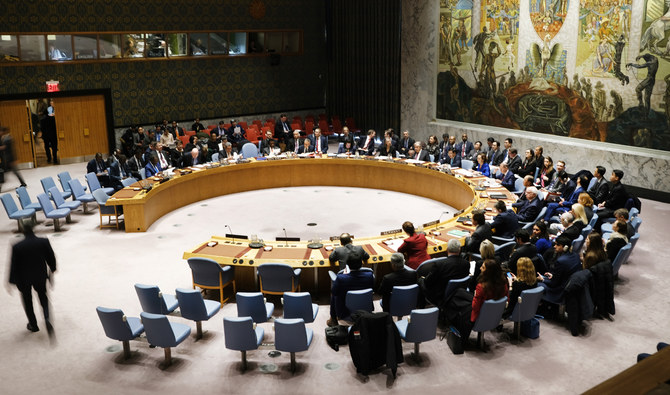
UNITED NATIONS: The UN Security Council voted Friday to renew cross-border aid to Syria but under pressure from Russia scaled back the program, which has been helping millions in the war-ravaged country since 2014.
The assistance is being prolonged for only six months, whereas it had been extended yearly previously.
And deliveries will now be made from only two points, which are along Syria’s border with Turkey, down from four.
After a series of concessions by Western countries since late December, the resolution extending the aid was passed by 11 votes in favor and four abstentions which came from Russia, China, the United States and Britain.
The existing mandate was to expire Friday.
Belgium and France expressed disappointment over the scaling back of the aid.
“Eleven million Syrians need humanitarian assistance,” said Belgian Ambassador Marc Pecsteen de Buytswerve.
The US ambassador, Kelly Craft, meanwhile said “Syrians will die with this resolution.”
Russia, a key backer of Syrian President Bashar Assad, saw international authorization of cross-border aid shipments as a “breach of sovereignty” a western diplomat said.
The diplomat said Russia wanted to force recognition that Damascus had largely retaken control of territory inside Syria a year ago, admitting that Moscow was in a “strong position” in the face-off with western countries.
The western concessions to Russia keep the program alive but on a reduced scale.
The aid is vital for almost three million Syrians living in the northern Idlib region, where fighting and bombardments have increased in recent weeks.
The resolution extends cross border aid until July 10. It does away with two entry points, one along the border with Turkey and the other on the frontier with Iraq. The latter helped 1.3 million people in northeast Syria.
At the insistence of Germany and Belgium, the council asked Secretary General Antonio Guterres to compile a report by the end of February on finding an alternative to the aid point on the Iraqi border, which is the town of Al Yarubiyah.
On December 20, Russia — backed by China — vetoed a proposal to extend aid for a year from three border spots: two along the border with Turkey and the Iraqi one.
US Secretary of State Mike Pompeo described the Russian and Chinese veto as “shameful” and told Moscow and Beijing “you have blood on your hands.”
Washington’s negotiating position had been less than subtle however, one diplomat told AFP, starting out with a demand for five crossing points that could be bargained down to its desired number of three, then two.
The United States also wrongly assessed that Moscow would not resort to a veto, which it did, the same source said.
The British ambassador to the UN, Karen Pierce, said the council’s vote Friday let down the people of Syria.
“It’s an inadequate response for the Syrian people. And it’s an inadequate response to what the UN have been asking for,” she said.
The UN Office for the Coordination of Humanitarian Affairs said Friday four million Syrians are being supported by cross-border operations, 2.7 million of them in the northwest and another 1.3 million in the northeast.


![]()

Under Russian pressure, UN approves scaled back aid for Syria
Short Url
https://arab.news/9ct3u
Under Russian pressure, UN approves scaled back aid for Syria


Latest updates


© 2026 SAUDI RESEARCH & PUBLISHING COMPANY, All Rights Reserved And subject to Terms of Use Agreement.