ROME: Italy scrambled to salvage diplomatic credibility on Thursday after its bid to play a central role in resolving Libya’s long-running conflict came off the rails, revealing failures at the heart of the government.
Libya has been in a state of violent flux since a NATO air campaign in 2011 led to the downfall of its strongarm leader Muammar Qaddafi. Italy was most directly impacted by the resulting chaos, which triggered a wave of migration to its shores, and has sought to lead subsequent stabilization efforts.
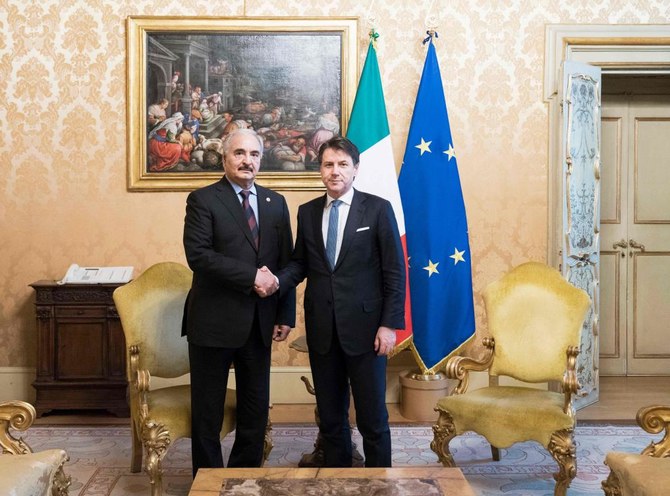
But in an embarrassing snub for Prime Minister Giuseppe Conte, Libya’s internationally recognized leader Fayez Al-Serraj refused to see him on Wednesday after discovering that his great rival General Khalifa Haftar had also been invited to Rome.
At the same time, Italian Foreign Minister Luigi Di Maio found himself isolated at a meeting of counterparts from France, Egypt, Greece and Cyprus, refusing to sign a final communique on Libya because he felt it was biased in favor of Haftar.
The twin developments left the Italian coalition government looking both forsaken on the international stage and divided internally, dealing a potentially fatal blow to diplomatic efforts by Rome to impose peace on a largely lawless Libya.
“What happened yesterday was frankly embarrassing,” said Arturo Varvelli, director of the Rome office of the European Council on Foreign Relations think tank.
“Our politicians don’t pay enough attention to foreign policy and they are paying the price for it.”
Conte and Di Maio, neither of whom had any diplomatic experience when they first entered government in 2018, met on Thursday to try to plot a way forward.
But foreign policy experts said Rome had lost the initiative to more pro-active countries, such as France, Turkey and Russia, while opposition parties accused the government of ineptitude.
“Conte really is dangerous and incompetent,” said far-right League leader Matteo Salvini, accusing the prime minister of making a simple error of protocol by receiving Haftar before first meeting Serraj. “We have amateurs on the loose,” he said.
In July 2018, US President Donald Trump gave Conte the nod to oversee efforts to stabilize Libya, saying he recognized “Italy’s leadership role.”
But even with this clear backing, Rome failed to secure universal support for its favorite Serraj, as France, Egypt and the United Arab Emirates instead backed Haftar in a proxy conflict driven by divergent economic and strategic interests.
Italy subsequently sought to build its own ties with Haftar, hoping to safeguard its energy concerns in Libya should he win out in the end. But Conte was blindsided when Turkey unexpectedly announced last month it would send military advisers and possibly troops to bolster Serraj in Tripoli.
“The process by which Turkey and Russia are taking the diplomatic space is ruthless and largely irreversible. Italy is improvising alone and it is failing miserably,” said Jalel Harchaoui, a research fellow at the Clingendael Institute, an independent, Dutch think tank.
Conte denied on Thursday any government inconsistency over Libya, while Di Maio acknowledged in a letter to la Repubblica daily that politicians had not always known how to harness the expertese of their diplomats and intelligence agency.
Speaking off the record because of the sensitivity of the issue, officials expressed frustration over the political line they had been asked to follow in recent months.
“The order was to maintain contact with everyone, but in an open conflict you need to position yourself clearly,” said one intelligence source, complaining that Rome had tried to be friends with everyone, and had lost influence as a result.
Diplomats fear Rome is losing influence beyond just Libya.
That was noticeable last week when US Secretary of State Mike Pompeo called officials worldwide after the US killing of Iranian military commander Qasem Soleimani in Baghdad, but did not get in touch with Rome, despite the fact that Italy has the largest Western troop presence in Iraq after the US.
Varvelli said Italy was suffering the consequences of inconsistent policy-making and poor political preparation.
“Our political leaders are making blunders on the international stage,” he said, adding that Rome would have to stop trying to lead the way on Libya and instead seek European consensus. “We don’t have any more cards to play.”

Italian foreign policy flounders amidst Libyan blunders
https://arab.news/2x5cb
Italian foreign policy flounders amidst Libyan blunders
- In an embarrassing snub for Prime Minister Giuseppe Conte, Libya’s internationally recognized leader Fayez Al-Serraj refused to see him
- Italian Foreign Minister Luigi Di Maio found himself isolated at a meeting of counterparts from France, Egypt, Greece and Cyprus
Trump takes unconventional approach to communicating to the public about war in Iran
- The communications strategy opened Trump to criticism that he hadn’t done enough to explain the rationale and objectives of the war
Typical of an unconventional presidency, the Trump administration waited more than 48 hours to make any live, public communication to the American people about why it had decided to go to war with Iran.
President Donald Trump discussed why he launched the attack prior to a White House ceremony honoring military heroes on Monday but took no questions from reporters. Earlier in the day, Defense Secretary Pete Hegseth and Joint Chiefs of Staff Chairman Dan Caine briefed journalists at the Pentagon.
The two days previous, Trump delivered two pretaped statements that were released on Truth Social, the social media site owned by the president’s media company, and granted telephone interviews to more than a dozen journalists — several of which produced fragmented responses that, to some, clouded as much as they cleared up.
The communications strategy opened Trump to criticism that he hadn’t done enough to explain the rationale and objectives of the war, even as the American military suffered its first casualties. By contrast, Israeli Prime Minister Benjamin Netanyahu, who has teamed with the US against Iran, delivered two statements the day the war began and addressed reporters Monday at the site of a missile attack that killed nine people. The Israeli military has held multiple press briefings each day.
“The American people need a commander in chief, and he has been absent in that role,” Rahm Emanuel, White House chief of staff under President Barack Obama, said on CNN Monday. Emanuel, a Democrat, is contemplating a run for the presidency in 2028.
An unconventional strategy leads to criticism
Peter Baker, chief White House correspondent for The New York Times, wrote on social media that “after Trump launched a new war on Iran, he did not rush back to the White House to make an Oval Office address to rally the nation as other presidents have done. He stayed at Mar-a-Lago to attend a glitzy political fundraiser.”
That post provoked a response from Steven Cheung, White House communications director. “Imagine being a reporter so consumed with Trump Derangement Syndrome that he wants President Trump to mimic the failed policies of the past. The truth is that President Trump spent the majority of his time monitoring the situation in a secure facility, in constant contact with world leaders, and made multiple addresses to the nation that garnered hundreds of millions of views. He also took dozens of calls with reporters.”
The calls included one with Baker’s colleague at The Times, Zolan Kanno-Youngs. Trump’s mobile phone number is known to many of the reporters who cover him, and the president often takes their calls for on-the-spot interviews. Besides The Times, he spoke in the aftermath of the attack to journalists for ABC, CBS, NBC, CNN, CNBC, Fox News Channel, The Atlantic, The Washington Post, Axios, Politico and an Israeli television station.
Most of the calls were brief and marginally illuminating; Politico’s Dasha Burns said Trump answered but said he was too busy to talk. The public couldn’t hear what Trump said in the interviews and was dependent upon what the journalists chose to report on the conversations.
“I spoke to President Trump today and he told me that the operation in Iran is going to go very fast,” Libby Alon, a reporter for Channel 14 News in Israel, wrote about her interview on X. “It’s doing very well, and (will) make the people of Israel very happy, and the people of the world very happy.”
The Times reported that in its six-minute chat, Trump “offered several seemingly contradictory visions of how power might be transferred to a new government — or even whether the existing Iranian power structure would run that government or be overthrown.”
In one of his two conversations with Trump, ABC News’ Jonathan Karl said when he asked about the death of Iranian Ayatollah Ali Khamenei, the president said: “I got him before he got me. They tried twice. Well I got him first.” CNN’s Jake Tapper went on the air minutes after his conversation Monday, saying Trump told him “the big one is coming soon,” an apparent reference to a future attack.
Asked for comment, White House spokeswoman Anna Kelly said: “President Trump is the most transparent and accessible president in American history. The American people have never had a more direct and authentic relationship with a president of the United States than they have with President Trump.”
Hegseth briefing concentrates on friendly reporters
Pentagon reporters learned late Sunday about Hegseth’s briefing. Reporters from The Associated Press, Reuters, ABC, CBS, NBC, CNN, Fox News Channel and Stars & Stripes were permitted into the briefing room, but Hegseth did not call on them. Instead, he took questions from NewsNation and Trump-friendly outlets like the Daily Caller, Daily Wire, One America News and the Christian Broadcasting Network. Most mainstream news outlets left their regular stations at the Pentagon last fall rather than agree to Hegseth’s rules restricting their work.
Hegseth denounced the “foolishness” of people wanting to know details of the operation in advance, such as whether Americans would commit to more than air power, and said the operation would continue as long as it took to achieve objections. He initially ignored NBC News’ Courtney Kube when she called out a question: “President Trump put a four-week time limit on it. Are you saying he’s wrong?”
Later, Hegseth denounced Kube for asking “the typical NBC sort of gotcha-type question. President Trump has all the latitude in the world to talk about how long it might take — four weeks, two weeks, six weeks, it could move up, it could move back. We’re going to execute at his command the objectives he set out to achieve.”
Unlike Pentagon briefings in past administrations, reporters were given assigned seats, with the Trump-friendly outlets seated in front. Jennifer Griffin, Hegseth’s former colleague at Fox News Channel who left the Pentagon with other reporters after not accepting his new rules, was seated in the last row.


