Teenage British neo-Nazi jailed for planning terrorism attack

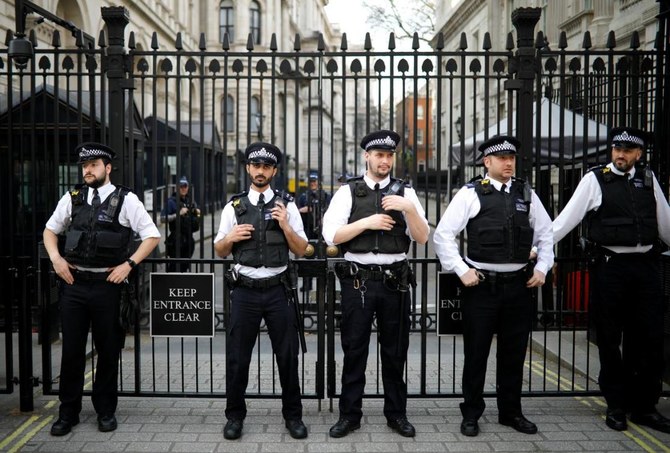
Police officers stand guard outside Downing Street in London, Britain, March 30, 2019.(Reuters)
Short Url
Updated 07 January 2020
Follow

Teenage British neo-Nazi jailed for planning terrorism attack

LONDON: A British teenager who described himself as a neo-Nazi was sentenced to almost seven years in prison on Tuesday for planning a terrorism attack from his bedroom.
The 17-year-old, who cannot be named for legal reasons, had carried out extensive online searches for extreme race-hate and right-wing material, encouraging others to share the banned material he found.
He was arrested in March 2019 when police found a handwritten list of possible areas to attack and a list of "firearms I would buy" at his home in Durham, northern England.
In November, he was found guilty of six offences, including preparing to commit an act of terrorism, which the BBC said made him the youngest person to be convicted in Britain of plotting to carry out such an attack.
"Cases such as this highlight the dangers our young people face today online," said Detective Chief Superintendent Martin Snowden, head of Counter Terrorism Policing North East.
"The negative influence and powerful manipulation that takes place by those who seek to radicalise them cannot be underestimated."
The teenage boy, who was sentenced to six years and eight months in jail at Manchester Crown Court, had researched details of recent mass killings in the United States and Europe, police said.


Zuckerberg says Meta no longer designs apps to maximize screentime

Updated 3 sec ago
Follow

Zuckerberg says Meta no longer designs apps to maximize screentime

  • Meta Platforms CEO faces questioned at a landmark trial over youth social media addiction
  • It was the billionaire Facebook founder’s first time testifying in court on Instagram’s effect on the mental health of young users
LOS ANGELES: Meta Platforms CEO Mark Zuckerberg pushed back in court on Wednesday against a lawyer’s suggestion that ​he had misled Congress about the design of its social media platforms, as a landmark trial over youth social media addiction continues.
Zuckerberg was questioned on his statements to Congress in 2024, at a hearing where he said the company did not give its teams the goal of maximizing time spent on its apps.
Mark Lanier, a lawyer for a woman who accuses Meta of harming her mental health when she was a child, showed jurors emails from 2014 and 2015 in which Zuckerberg laid out aims to increase
time spent on the app by double-digit percentage points. Zuckerberg said that while Meta previously had goals related to ‌the amount of ‌time users spent on the app, it has since changed its ​approach.
“If ‌you ⁠are trying ​to ⁠say my testimony was not accurate, I strongly disagree with that,” Zuckerberg said.
The appearance was the billionaire Facebook founder’s first time testifying in court on Instagram’s effect on the mental health of young users.
While Zuckerberg has previously testified on the subject before Congress, the stakes are higher at the jury trial in Los Angeles, California. Meta may have to pay damages if it loses the case, and the verdict could erode Big Tech’s longstanding legal defense against claims of user harm.
The lawsuit and others like it are part of a ⁠global backlash against social media platforms over children’s mental health.
Australia has prohibited access ‌to social media platforms for users under age 16, and ‌other countries including Spain are considering similar curbs. In the US, ​Florida has prohibited companies from allowing users under age ‌14. Tech industry trade groups are challenging the law in court.
The case involves a California woman ‌who started using Meta’s Instagram and Google’s YouTube as a child. She alleges the companies sought to profit by hooking kids on their services despite knowing social media could harm their mental health. She alleges the apps fueled her depression and suicidal thoughts and is seeking to hold the companies liable.
Meta and Google have denied the allegations, and ‌pointed to their work to add features that keep users safe. Meta has often pointed to a National Academies of Sciences finding that research does not ⁠show social media changes ⁠kids’ mental health.
The lawsuit serves as a test case for similar claims in a larger group of cases against Meta, Alphabet’s Google, Snap and TikTok. Families, school districts and states have filed thousands of lawsuits in the US accusing the companies of fueling a youth mental health crisis. Over the years, investigative reporting has unearthed internal Meta documents showing the company was aware of potential harm.
Meta researchers found that teens who report that Instagram regularly made them feel bad about their bodies saw significantly more “eating disorder adjacent content” than those who did not, Reuters reported in October.
Adam Mosseri, head of Instagram, testified last week that he was unaware of a recent Meta study showing no link between parental supervision and teens’ attentiveness to their own social media use. Teens with difficult life circumstances more often said they used Instagram habitually ​or unintentionally, according to the document shown at ​trial.
Meta’s lawyer told jurors at the trial that the woman’s health records show her issues stem from a troubled childhood, and that social media was a creative outlet for her.