






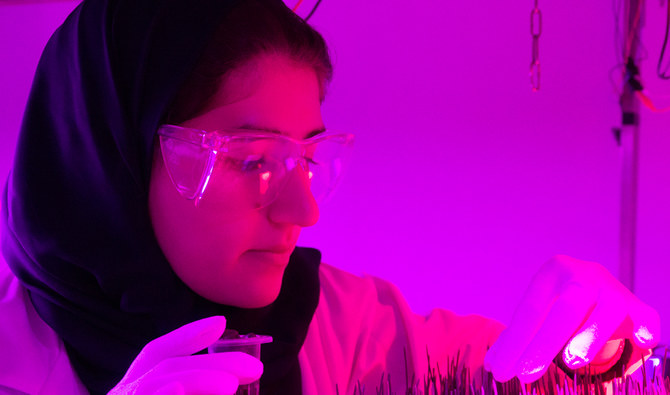

JEDDAH: A Saudi startup is aiming to shed new light on food production using the latest laser technology.
Oaesis was established by entrepreneurs Vasiliki Kordopati and Robert Werfelmann with the support of the King Abdullah University of Science and Technology’s (KAUST) new-business accelerator program, to help solve the global problem of food scarcity by harnessing light to grow items sustainably.
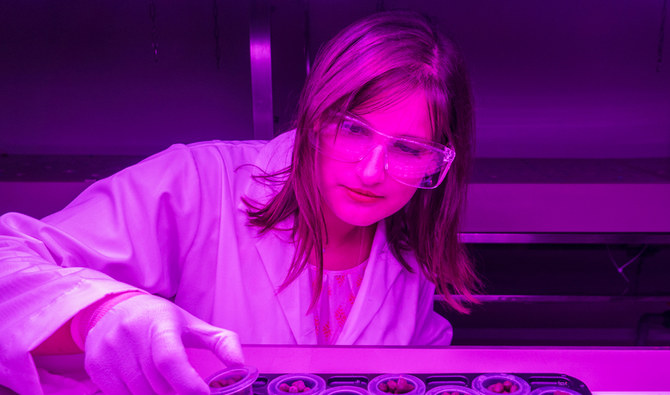
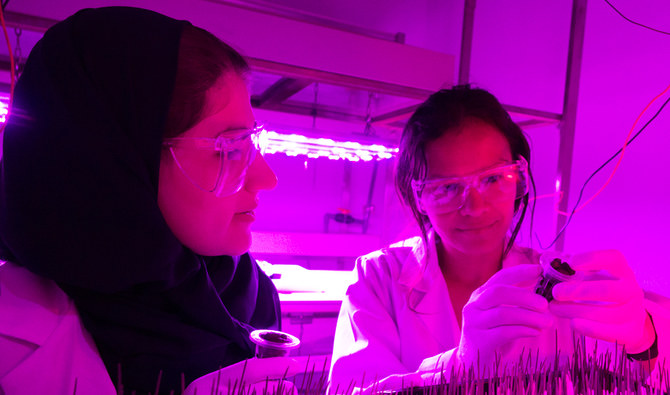
The company’s laser-based artificial lighting system has proved to be a major boon to the horticulture industry since its introduction. “We utilize laser technology within the visible light spectrum, and we grow plants in a more efficient way,” Kordopati told Arab News.
“We noticed that most plants and salads we have (in the Kingdom) are imported, traveling long distances … so we asked ourselves: ‘Why not have indoor farms here in the region and in Saudi Arabia, where people can have fresh local produce with no pesticides or chemicals?’”
Oaesis is thought to be the world’s first provider of laser-based energy efficient grow lights for indoor farming, enabling growers to produce fresh, healthy, year-round vegetables and fruits.
“We utilize the laser technology providing artificial light with lower energy consumption and better efficiency,” Kordopati said. “This technology is capable of growing any kind of indoor farming plants (such as microgreens, lettuces, herbs and berries) on a commercial scale, maximizing yields effortlessly.”
She added that using light with less heat emissions was better for plants, with Oaesis’ system providing “up to 4.5 times more light to plants with almost 80 percent less heat emissions compared to current technologies. Our system is competitive with the cost of current technologies and has shown a 35 percent reduction of total operating costs for an indoor farm.”
Kordopati pointed out that the population of Saudi Arabia was expected to reach 39.5 million by 2030, “raising the need for food production by 35 percent.” One of the best potential sustainable ways of growing food locally was through the use of indoor/vertical farms, as opposed to traditional agricultural methods which used vast quantities of water and space.
“Saudi Arabia’s Vision 2030 tackles this problem by adapting more sustainable, productive and efficient ways to produce local food,” she said.
Oaesis’ mission was aligned with the Saudi Vision 2030 reform plan. “Our mission is to help more companies, locally and globally, to improve their farms and provide better, fresh and nutritious produce with less energy demands,” Kordopati added.
“Also, Oaesis will hopefully inspire new local and global indoor farms to enter the market in Saudi Arabia.”
In addition, the startup will help toward achieving the Vision 2030 goal of reducing waste and providing better food using sustainable and efficient resources. “We wish to see a future where energy is used as efficiently as possible.”
On the company’s name, Kordopati said: “We’re in Saudi Arabia, and when we think about plants in a desert, an oasis comes to mind … We’re making an imaginary oasis in the Kingdom, and we want to be unique in what we’re doing.”