

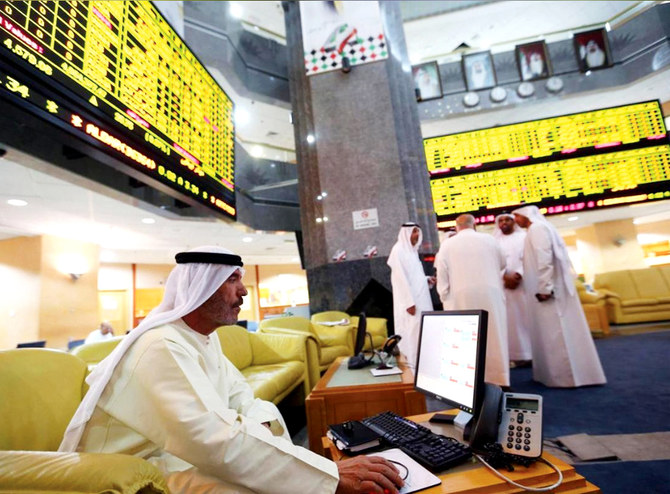
GCC bourses close in the red as US-Iran tensions escalate

Most Gulf markets are reacting negatively due to the ongoing geopolitical tensions and the situation may continue for some time. (Reuters)
Short Url
Updated 06 January 2020
Follow

GCC bourses close in the red as US-Iran tensions escalate

  • Egypt’s blue-chip index also hard hit as all its shares ended lower

DUBAI: Gulf bourses saw steep declines on Sunday, with Kuwait falling the most following tensions between the US and Iran, while outside the Gulf Egypt was also hard hit as all its shares ended lower.

Iranian military commander Qassem Soleimani was killed on Friday in a US drone strike on his convoy at the Baghdad airport, seen by Tehran as an act of war that risks regional conflagration.

“Not surprising, the Gulf markets are reacting negatively given we are in the middle of all the geopolitics action,” said Vrajesh Bhandari, a senior portfolio manager at Al Mal Capital.

“We fear this can be an overhang over the next few months and not just a one day or week thing.”

Saudi Arabia’s benchmark index lost 2.4 percent, weighed down by a 2.1 percent drop in Al-Rajhi Bank and a 1.7 percent fall in Saudi Aramco to SR34.6 ($9.2), which hit its lowest intraday level since last month’s market debut.

Egypt’s blue-chip index dived 4.4 percent, touching its lowest since September 2019. The country’s largest lender Commercial International Bank closed down 1.9 percent and Eastern Company dived 4.9 percent.

In Kuwait, the index plunged 4.1 percent with all stocks in the red including Kuwait Finance House, down 5.1 percent, and National Bank of Kuwait, off 2.8 percent.

The Dubai index tumbled 3.1 percent, hurt by a 3.1 percent slide in its largest lender Emirates NBD and a 3.7 percent decline in Emaar Properties.

Abu Dhabi’s index lost 1.4 percent, with the UAE’s largest lender First Abu Dhabi Bank retreating 1.2 percent, while Abu Dhabi Commercial Bank was down 3.3 percent.

HIGHLIGHTS

• Saudi Arabia’s benchmark index lost 2.4 percent.

• The Dubai index tumbled 3.1 percent.

• Abu Dhabi’s index lost 1.4 percent.

• The small bourse of Oman dropped by just 0.3 percent.

The decline in Gulf shares comes despite a surge in oil prices, on which all six GCC nations rely heavily for public revenues.

“It’s certainly due to fears of a possible US-Iranian conflict breaking out in the Gulf,” said Mohammed Zidan, market strategist at Thinkmarket in Dubai.

“I think the decline will continue for some time and especially as long as tensions and the threat of an armed conflict continue,” Zidan told AFP.

The Qatar index eased 2.1 percent with all its 20 stocks closing lower. Lender Masraf Al Rayan fell 2.7 percent and Qatar National Bank declined 1.4 percent.

The normally dormant bourse of Bahrain, home to the US 5th fleet, fell 2.3 percent.

The small bourse of Oman dropped by just 0.3 percent.


Islamic banks’ market share in Turkiye rises to 9.2%: Fitch Ratings

Updated 9 sec ago
Follow

Islamic banks’ market share in Turkiye rises to 9.2%: Fitch Ratings

RIYADH: Islamic banks in Turkiye lifted their asset market share to 9.2 percent in 2025 from 8.1 percent a year earlier, as financing and deposits outpaced the broader banking sector, a new analysis showed. 

In its latest report, Fitch Ratings said financing and deposit market shares rose to 7.9 percent and 10.4 percent, respectively, by the end of 2025, compared with 7.3 percent and 9.4 percent in 2024.

The agency noted that new digital Islamic banks are emerging in the country, with investment from Gulf Cooperation Council countries expected to continue. 

Turkiye’s strong ties with Islamic countries across the Balkans, Africa and the Middle East support the development of its Islamic banking sector, attracting investors and contributing to the industry’s growth.

In its latest report, Fitch stated: “Three recently established private Islamic banks (two digital) grew rapidly in the first nine months of 2025. Investment in digital participation banking from the Gulf Cooperation Council countries underscores the potential for further investment from the region.” 

It added: “Planned establishment of new participation banks, and rapid growth of recently established banks – albeit from small bases – means that the segment landscape may be reshaped in 2026.” 

Dubai Islamic Bank PJSC’s investment in digital bank TOM underscores the potential for further GCC investment. 

Turkish regulators have approved the establishment of Halk Katilim Bankasi A.S. and Adil Katilim Bankasi A.S. (digital), while BIM Birlesik Magazalar A.S.’s application is pending. 

Fitch added that state-owned participation banks may merge or pursue initial public offerings, potentially reshaping the banking landscape. 

The report predicts Islamic banks’ market share will rise further in 2026, supported by strong internal capital generation and growth appetite. However, the non-performing financing ratio may increase moderately due to high inflows. 

“The segment’s non-performing financings ratio deteriorated to 2 percent at end-2025 compared to 1.2 percent in 2024 but remained below the sector average of 2.5 percent,” said Fitch. 

It added: “We expect pressure to persist given still-high financing rates, high but declining inflation, and the sensitivity of unsecured retail (lower share than conventional banks) and SME segments to economic cycles. We forecast a moderate increase in the segment NPF ratio in 2026.”