ISLAMABAD: Pakistan’s parliament is expected to complete the legislative process regarding the appointment, reappointment and tenure of three services chiefs, including chief of army staff, by Wednesday as the National Assembly and Senate have to separately vet and approve the bills, a top government official said on Saturday.
“The opposition parties want to properly vet and examine the bills before putting them to vote [in both houses of parliament separately]. Therefore, the whole process is expected to be completed by Wednesday,” Muhammad Mushtaq, Additional Secretary (Legislation) at the National Assembly Secretariat, told Arab News on Saturday.
The government had called the National Assembly and Senate sessions on Saturday in a bid to get the three amendment bills – Pakistan Army (Amendment) Act 2020, Pakistan Navy (Amendment) Act 2020, and Pakistan Air Force (Amendment) Act 2020 – passed with the support of at least two major opposition parties, the Pakistan Muslim League-Nawaz (PML-N) and the Pakistan Peoples Party (PPP).
However, the government later postponed the parliamentary sessions till Monday, January 6, by issuing notifications.
The National Assembly and Senate’s joint standing committee on defense passed the three bills and laid down the procedure for the appointment and reappointment of services chiefs. But later the opposition parties said the bills should be separately discussed in the Senate Standing Committee since Senators did not have the right to vote on them in the joint committee.
“We will demand the chairman Senate to refer the bills to the standing committee when it is tabled in the House,” Senator Mushahidullah Khan of the PML-N told Arab News. “The government should follow the parliamentary procedure to pass the bills instead of trying to bulldoze the process.”
All the three bills are mandatory to be passed by both houses of parliament separately with a majority before acquiring undisputed legal status.
Federal Minister for Defense Pervez Khattak on Friday tabled the Pakistan Army (Amendment) Act 2020 in the National Assembly, paving the way for a three-year extension in the army chief’s service tenure.
He also separately presented the Pakistan Navy (Amendment) Act and the Pakistan Air Force (Amendment) Act in the lower house, which the speaker, as per parliamentary procedure, referred to the defense committee for further deliberations.
The federal cabinet on Wednesday approved amendments in the army, navy and air force acts in a hurriedly convened meeting to plug legal lacunae in the appointment and reappointment of services chiefs as pointed out by the Supreme Court in its verdict in November last year.
Prime Minister Imran Khan extended General Bajwa’s tenure through a notification in August 2019, but the Supreme Court suspended it on Nov 26, 2019, citing procedural irregularities and loopholes in the relevant laws.
The court later announced that General Bajwa would remain the army chief for another six months during which parliament would legislate on army chief’s extension/reappointment.
“The retirement age and service limits prescribed for a General, under the rules and regulations made under this act, shall not be applicable to the Chief of the Army Staff, during his tenure of appointment, reappointment, or extension, subject to a maximum age of sixty four (64) years,” the Pakistan Army (Amendment) Act, 2020, reads.
The amendment bill also empowers the president to “reappoint the Chief of the Army Staff for additional tenure of three years,” or extend his tenure for another three years on the advice of the Prime Minister, “in the national security interest or exigencies, from time to time.”


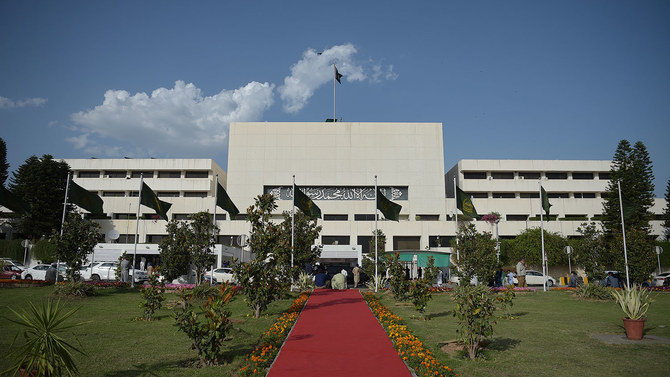
Parliament expected to decide on army chief's tenure next week
https://arab.news/rnvvu
Parliament expected to decide on army chief's tenure next week

- Opposition wants the government to follow parliamentary procedures to get the bills passed
- Passage of the amended army act will pave way for Gen Bajwa’s three-year extension

Pakistan to begin first phase of Hajj 2026 trainings from today
- Training programs to be held in phases across Pakistan till February, says religion ministry
- Saudi Arabia allocated Pakistan a total quota of 179,210 pilgrims for Hajj 2026
ISLAMABAD: Pakistan’s religious affairs ministry has said that it will begin the first phase of mandatory Hajj 2026 training for pilgrims intending to perform the pilgrimage from today, Thursday.
The one-day Hajj training programs will be held in phases across the country at the tehsil level until February. The ministry directed intending pilgrims to bring their original identity cards and the computerized receipt of their Hajj application to attend the training sessions.
“Pilgrims should attend the one-day training program according to their scheduled date,” Pakistan’s Ministry of Religious Affairs (MoRA) said in a statement.
The ministry said training schedules are being shared through the government’s Pak Hajj 2026 mobile application as well as via SMS. It added that details of the schedule are also available on its website.
According to the ministry, training programs will be held in Abbottabad on Jan. 2; Ghotki, Thatta and Kotli on Jan. 3; and Tando Muhammad Khan and Khairpur on Jan. 4.
Hajj training sessions will be held in Rawalakot, Badin and Naushahro Feroze on Jan. 5, while pilgrims in Fateh Jang, Dadu and Tharparkar will receive the training on Jan. 6.
The ministry said training programs will be conducted in Umerkot and Larkana on Jan. 7, followed by sessions in Mirpurkhas, Shahdadkot and Mansehra on Jan. 8.
Pakistan’s religious affairs ministry has previously said these trainings will be conducted by experienced trainers and scholars using multimedia.
It said the training has been made mandatory to ensure that intending pilgrims are fully aware of Hajj rituals and administrative procedures.
Saudi Arabia has allocated Pakistan a quota of 179,210 pilgrims for Hajj 2026, of which around 118,000 seats have been reserved under the government scheme, while the remainder will be allocated to private tour operators.
Under Pakistan’s Hajj scheme, the estimated cost of the government package ranges from Rs1,150,000 to Rs1,250,000 ($4,049.93 to $4,236), subject to final agreements with service providers.


