

UAE’s $200 million support will create jobs, boost exports — PM’s aide

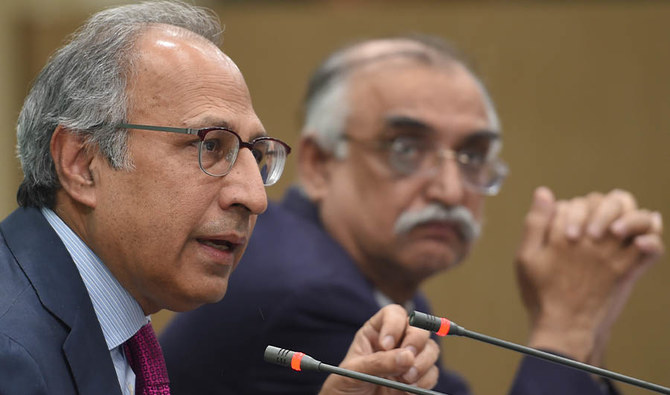
Adviser to the Prime Minister on Finance and Revenue Dr Abdul Hafeez Shaikh (L) and Chairman Federal Board of Revenue (FBR) Syed Shabbar Zaidi (R) address a media briefing in Islamabad on October 12, 2019. (AFP)
Short Url
Updated 03 January 2020
Follow

UAE’s $200 million support will create jobs, boost exports — PM’s aide

  • Abu Dhabi crown prince directed Khalifa Fund to allocate $200 million for Pakistan’s SMEs
  • Small and Medium-sized enterprises contribute 40% of Pakistan’s GDP

KARACHI: The newly announced $200 million support by the United Arab Emirates for Pakistan’s SMEs will help create jobs and enhance exports, Pakistan’s de facto finance minister, Dr. Abdul Hafeez Shaikh said on Thursday. 

Sheikh Mohamed bin Zayed Al Nahyan, Crown Prince of Abu Dhabi and Deputy Supreme Commander of the UAE Armed Forces, on Thursday, directed the Khalifa Fund for Enterprise Development, Khalifa Fund, to allocate $200 million to support small and medium-sized enterprises, SMEs, in Pakistan.

The allocation comes after Al Nahyan’s meeting with Prime Minister Imran Khan in Islamabad during his daylong visit. 

“Would like to thank HRH Sheikh Muhammed Bin Zayed Al-Nahyan, Crown Prince of Abu Dhabi and Deputy Supreme Commander of the Armed Forces for announcing $200 Million support to Pakistan after meeting with Prime Minister Imran Khan,” Shaikh tweeted.

He said that “the money will be spent on small business promotion and jobs,” adding that the support was a “testimony to the expanding economic relations and friendship between our countries.”

This initiative aims to encourage innovation in projects and support entrepreneurship, to assist the Pakistani government’s efforts to create a stable and balanced national economy that will help achieve the country’s sustainable development, UAE’s state news agency reported.

The initiative is also part of the close ties between the UAE and Pakistan and the keenness of their leaderships to strengthen and develop them, reflecting the development witnessed by their overall relations over the past decades.

Small and medium-sized businesses constitute nearly 90 percent of all enterprises in Pakistan employing 80 percent of the non-agricultural labor force and contributing 40 percent to the country’s GDP, according to Small and Medium Enterprises Development Authority (SMEDA).

The stakeholders of the SME sector complain about the lack of quick access to finances through banks. However, analysts expect the funds allocated by the UAE would help the sector to enhance exports enabling them to capitalize on the opportunity created after the implementation of the second phase of the China-Pakistan Free Trade Agreement.

“Depends on the method of disbursement. Banks are generally reluctant to lend to SMEs because of lack of transparency, succession and management issues,” Samiullah Tariq, Director Research at Arif Habib Limited, told Arab News.

“If in some way, the government allocates this fund to banks and they are able to disburse it to SMEs in an efficient way at a discounted rate then it can help SMEs avail China Pakistan FTA and increase Pakistan’s exports,” said Tariq

Calling for a clear policy for the SME sector, the stakeholders say that despite a 90 percent payback ratio, SMEs still face problems, unlike large enterprises. 

“The small traders and businessmen are required to submit collateral for loans despite the fact that this sector. In UAE and other parts of the world, they have realized that without SMEs a country cannot be run but in Pakistan, we are still unable to clearly define what SMEs are,” Ali Raza, chairman of Pakistan Association for Small and Medium Enterprises, told Arab News.

Raza called for a review of SME policy with clear vision and incentives for the sector as many countries, including Japan, are willing to contribute to the sector’s growth. “SME sector should be facilitated and introduced with latest technology and innovations,” Raza suggested.


Sindh assembly passes resolution rejecting move to separate Karachi

Updated 21 February 2026
Follow

Sindh assembly passes resolution rejecting move to separate Karachi

  • Chief Minister Shah cites constitutional safeguards against altering provincial boundaries
  • Calls to separate Karachi intensified amid governance concerns after a mall fire last month

ISLAMABAD: The provincial assembly of Pakistan’s southern Sindh province on Saturday passed a resolution rejecting any move to separate Karachi, declaring its territorial integrity “non-negotiable” amid political calls to carve the city out as a separate administrative unit.

The resolution comes after fresh demands by the Muttahida Qaumi Movement (MQM) and other voices to grant Karachi provincial or federal status following governance challenges highlighted by the deadly Gul Plaza fire earlier this year that killed 80 people.

Karachi, Pakistan’s largest and most densely populated city, is the country’s main commercial hub and contributes a significant share to the national economy.

Chief Minister Syed Murad Ali Shah tabled the resolution in the assembly, condemning what he described as “divisive statements” about breaking up Sindh or detaching Karachi.

“The province that played a foundational role in the creation of Pakistan cannot allow the fragmentation of its own historic homeland,” Shah told lawmakers, adding that any attempt to divide Sindh or separate Karachi was contrary to the constitution and democratic norms.

Citing Article 239 of Pakistan’s 1973 Constitution, which requires the consent of not less than two-thirds of a provincial assembly to alter provincial boundaries, Shah said any such move could not proceed without the assembly’s approval.

“If any such move is attempted, it is this Assembly — by a two-thirds majority — that will decide,” he said.

The resolution reaffirmed that Karachi would “forever remain” an integral part of Sindh and directed the provincial government to forward the motion to the president, prime minister and parliamentary leadership for record.

Shah said the resolution was not aimed at anyone but referred to the shifting stance of MQM in the debate while warning that opposing the resolution would amount to supporting the division of Sindh.

The party has been a major political force in Karachi with a significant vote bank in the city and has frequently criticized Shah’s provincial administration over its governance of Pakistan’s largest metropolis.

Taha Ahmed Khan, a senior MQM leader, acknowledged that his party had “presented its demand openly on television channels with clear and logical arguments” to separate Karachi from Sindh.

“It is a purely constitutional debate,” he told Arab News by phone. “We are aware that the Pakistan Peoples Party, which rules the province, holds a two-thirds majority and that a new province cannot be created at this stage. But that does not mean new provinces can never be formed.”

Calls to alter Karachi’s status have periodically surfaced amid longstanding complaints over governance, infrastructure and administrative control in the megacity, though no formal proposal to redraw provincial boundaries has been introduced at the federal level.