Pakistan government introduces bill to extend army chief’s tenure

1 / 2
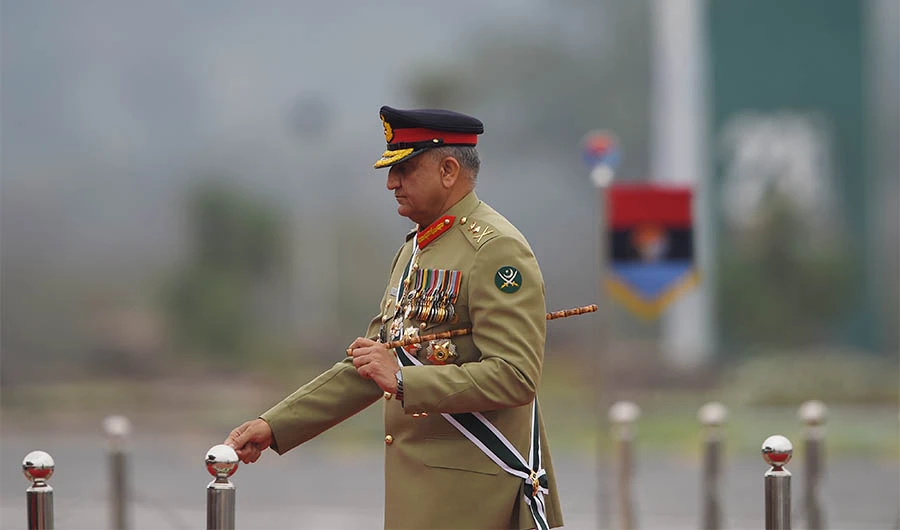
Pakistan Army Chief General Qamar Javed Bajwa arrives to attend the Pakistan Day parade in Islamabad on March 23, 2019. (AFP)
2 / 2
Pakistan's Prime Minister Imran Khan speaks with China's President Xi Jinping (not pictured) during their meeting at the Diaoyutai State Guesthouse in Beijing, China, October 9, 2019. (Reuters/ File Photo)
Short Url
Updated 03 January 2020
Follow

Pakistan government introduces bill to extend army chief’s tenure

  • In a surprise ruling, the apex court struck down the army chief's tenure extension in November 2019
  • The bill aims to provide legal cover for Gen. Bajwa's extension with support of opposition parties

ISLAMABAD: Pakistan’s government on Friday introduced legislation to extend the tenure of the army chief in line with a Supreme Court order that it must justify its wish to see the top commander stay on in the job for an extra three years.
The government of Prime Minister Imran Khan approved an extension for General Qamar Javed Bajwa in August, citing a worsening national security situation in the region over its rivalry with India.
But in a surprise ruling, the Supreme Court struck down the extension in November, ordering the government and army to produce legal provisions and arguments on the reasoning behind the move, pitting the judiciary against the government and powerful military.
Pakistan’s military has ruled the country for about half its 72-year history and sets defense and security policy and recently has had a role in framing economic policies too.
The army chief usually serves a three-year term.
On Friday, the first day of a new parliamentary session, the government introduced a lower house bill to provide legal cover for Bajwa’s extension after managing to win the support of opposition parties, government officials said.
“We are willing to support the legislation if the government follows parliamentary procedures,” said Bilawal Bhutto Zardari, the leader of a main opposition party.
The legalization is expected to be passed by next week, clearing the way for Bajwa in his post until 2022.
During Bajwa’s tenure, the opposition has accused the military of meddling in elections and politics to support Khan, while limiting civil liberties and muzzling the media.
The military denies interfering in politics.
Curfew extended in Gilgit-Baltistan, probe ordered after deadly Khamenei protests

Updated 03 March 2026
Follow

Curfew extended in Gilgit-Baltistan, probe ordered after deadly Khamenei protests

  • At least 15 people were killed in clashes with law enforcement agencies over the weekend in Gilgit-Baltistan
  • Government also announces a de-weaponization campaign, crackdown on hate speech and cybercrime in region

ISLAMABAD: The government in Pakistan’s Gilgit-Baltistan (GB) region on Tuesday extended a curfew in Gilgit district and ordered a judicial probe into violent protests over the killing of Iranian Supreme Leader Ali Khamenei in US-Israeli strikes last week, an official said.

At least 15 people were killed in clashes with law enforcement agencies over the weekend in GB, where protesters torched and vandalized several buildings, including United Nations regional offices, an army-run school, software technology park and a local charity building.

The violence prompted regional authorities to impose curfew in Gilgit and Skardu districts on March 2-4 as officials urged people to stay indoors and cooperate with law enforcers, amid widespread anger in Pakistan, particularly among members of the Shiite minority, over Khamenei’s killing.

On Tuesday, the GB government convened to review the situation and announced the extension of curfew in Gilgit among a number of security measures as well as ordered the establishment of a judicial commission to investigate the weekend violence in the region.

“The government has made it clear that the law will strictly take its course against elements involved in vandalism at government institutions, private properties and incidents of vandalism in Gilgit and Skardu and no kind of mischief will be tolerated,” Shabbir Mir, a GB government spokesperson, said in a statement.

“In view of the security situation, curfew will remain in force in Gilgit, while the decision to extend the curfew in Skardu will be taken keeping the ground realities and the changing situation in view.”

The statement did not specify how long the curfew will remain in place in Gilgit.

Besides the formation of the judicial commission to investigate the violent clashes, the government also decided to launch a large-scale de-weaponization campaign in the entire Gilgit district, for which relevant institutions have been directed to immediately complete all necessary arrangements, according to Mir.

In addition, a crackdown has been ordered on hate speech, spread of fake news and cybercrime.

“The aim of these decisions is to ensure the rule of law, protect the lives and property of citizens and crack down on miscreants,” he said. “Approval has also been given to immediately survey the affected infrastructure and start their restoration work on priority basis.”

Demonstrators in Pakistan’s southern port city of Karachi also stormed the US Consulate on Sunday, smashing windows and attempting to burn the building. Police responded with batons, tear gas, and gunfire, leaving 10 people dead and more than 50 injured.

Pakistani authorities have since beefed up security at US diplomatic missions across the country, including around the US consulate building in Peshawar, to avoid any further violence.