

Abu Dhabi crown prince arrives in Islamabad on day-long visit

Sheikh Mohammed bin Zayed Al-Nahyan, the crown prince of Abu Dhabi and deputy supreme commander of the UAE Armed Forces, arrived in Islamabad on Thursday on a day-long visit. (Photo Courtesy: Foreign Office of Pakistan)
Short Url
Updated 02 January 2020
Follow

Abu Dhabi crown prince arrives in Islamabad on day-long visit

  • Will hold a one-on-one meeting with PM Khan during his official visit
  • UAE is Pakistan’s largest trading partner in the Middle East

ISLAMABAD: Sheikh Mohammed bin Zayed Al-Nahyan, the crown prince of Abu Dhabi and deputy supreme commander of the UAE Armed Forces, arrived in Islamabad on Thursday on a day-long visit, the Foreign Office said.

 The visiting royal accompanied by a high-level delegation was received by Prime Minister Imran Khan at the Nur Khan airbase.
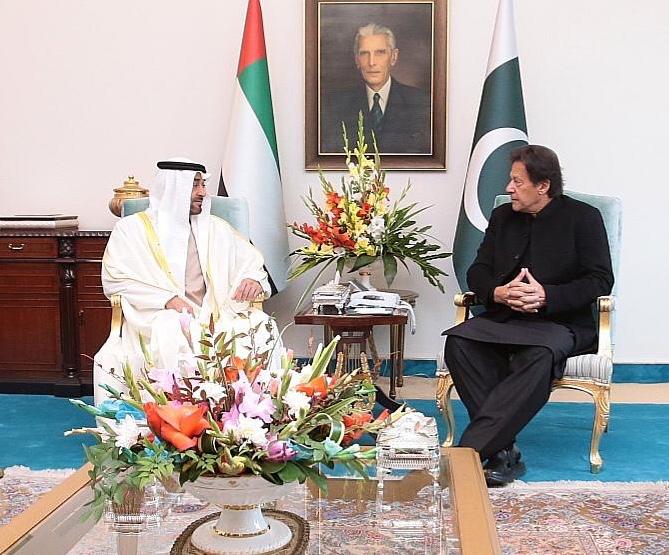


Sheikh Mohammed bin Zayed Al-Nahyan, the crown prince of Abu Dhabi and deputy supreme commander of the UAE Armed Forces, arrived in Islamabad on Thursday on a day-long visit. (Photo Courtesy: Foreign Office of Pakistan)

Al-Nahyan will hold a one-on-one meeting with Prime Minister Imran Khan followed by a luncheon hosted by the premier, the foreign office said in a statement Wednesday night. 

"The exchange of views between the two leaders will cover bilateral matters and regional and international issues of common interest, the statement added. 
 Islamabad said the visit illustrates the strength and substance of the Pakistan-UAE special relationship, based on commonalities of faith, cultural affinities, and a shared resolve to take mutual cooperation to a new level.
 UAE is Pakistan’s largest trading partner in the Middle East and a major source of investments. The Gulf country is also among Pakistan’s prime development partners in education, health, and energy sectors -- hosting more than 1.6 million Pakistani expatriates, which contribute remittances of around $4.5 billion annually to the GDP, the foreign office said.

On Wednesday, the UAE ambassador to Pakistan, Hamad Obaid Al-Zaabi said in a statement that the visit will "further strengthen the bonds of friendship between the two brotherly countries" and that the two leaders will "discuss the ways to enhance bilateral relations between the two countries and exchange views on matters of mutual interest and regional and global situation."

The UAE crown prince last visited Islamabad in January 2019 upon PM Khan’s invitation.

Khan visited the UAE several times since August 2018  after assumed the country's top public office in order to secure financial assistance to tackle Pakistan’s economic crisis. The UAE pledged $3 billion in balance-of-payments support and oil supply on deferred payments.
During the prime minister’s visit to the UAE in November 2018, the two countries agreed to chalk out a comprehensive road-map to accelerate cooperation and partnership in areas specific to the trade, investment, economic development, energy, infrastructure, and agricultural sectors.
The UAE crown prince’s visit is part of growing bilateral exchanges. Last week, the UAE Culture Minister Sheikh Nahyan bin Mubarak Al-Nahyan met with PM Khan and President Arif Alvi in Islamabad.
“It was our endeavor to further strengthen the existing bilateral engagement at all levels and in all fields including trade, investment, energy, culture and tourism,” the president said after the meeting.
He also highlighted that 1.6 million Pakistanis living in the Emirates were a bridge between the two countries and contributed to the UAE’s development.


Pakistan says responding to Afghan ‘offensive operations’ after border fire as tensions escalate

Updated 26 February 2026
Follow

Pakistan says responding to Afghan ‘offensive operations’ after border fire as tensions escalate

  • Afghan Taliban spokesperson says “large-scale offensive operations” launched against Pakistani military bases
  • Pakistan says Afghan forces opened “unprovoked” fire across multiple sectors along shared border

ISLAMABAD: Afghanistan’s Taliban authorities said on Thursday they had launched “large-scale offensive operations” against Pakistani military bases and installations, prompting Pakistan to say its forces were responding to what it described as unprovoked fire along the shared border.

The escalation follows Islamabad’s weekend airstrikes targeting what it said were Tehreek-e-Taliban Pakistan (TTP) and Daesh militant camps inside Afghanistan in response to a wave of recent bombings and attacks in Pakistan. Islamabad said the strikes killed over 100 militants, while Kabul said dozens of civilians were killed and condemned the attacks as a violation of its sovereignty.

In a post on social media platform X, Afghan government spokesperson Zabihullah Mujahid said Afghanistan had launched “large-scale offensive operations” in response to repeated violations by the Pakistani military.


Pakistan’s Ministry of Information said Afghan forces had initiated hostilities along multiple points of the frontier.

“Afghan Taliban regime unprovoked action along the Pakistan–Afghanistan border given an immediate, and effective response,” the ministry said in a statement.

The statement said Pakistani forces were targeting Taliban positions in the Chitral, Khyber, Mohmand, Kurram and Bajaur sectors, claiming heavy Afghan casualties and the destruction of multiple posts and equipment. It added that Pakistan would take all necessary measures to safeguard its territorial integrity and the security of its citizens.


Separately, security officials said Pakistani forces had carried out counterattacks in several border sectors.

“Pakistan’s security forces are giving a befitting reply to the unprovoked Afghan aggression with full force,” a security official said, declining to be named. 

“The Pakistani security forces’ counter-attack destroyed Taliban’s hideouts and the Khawarij fled,” they added, referring to TTP militants. 

The claims from both sides could not be independently verified.

Cross-border violence has intensified in recent weeks, with Pakistan blaming a surge in suicide bombings and militant attacks on militants it says are based in Afghanistan. Kabul denies providing safe havens to anti-Pakistan militant groups.

The clashes mark the third major escalation between the neighbors in less than a year. Similar Pakistani strikes last year triggered weeklong clashes before Qatar, Türkiye and other regional actors mediated a ceasefire in October.

The 2,600-kilometer (1,600-mile) frontier, a key trade and transit corridor linking Pakistan to landlocked Afghanistan and onward to Central Asia, has faced repeated closures amid tensions, disrupting commerce and humanitarian movement. Trade between the two nations has remained closed since October 2025.