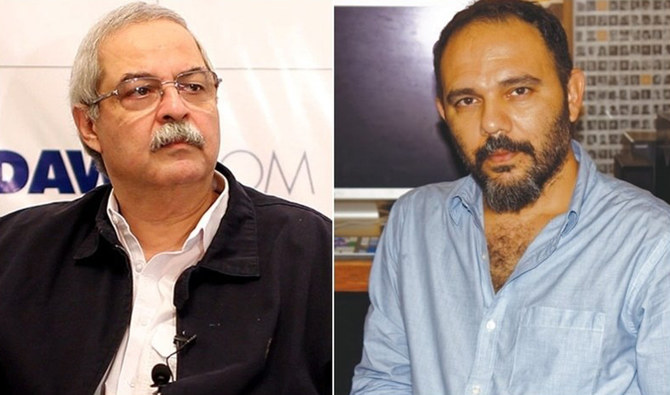
ISLAMABAD: The chief executive of one of Pakistan’s most influential newspapers has denied accusations he raped an acclaimed filmmaker, in a case that has spotlighted sexual abuse targeting men and added momentum to the country’s fledgling #MeToo movement.
Director Jamshed Mahmood Raza took to social media over the weekend to allege that Dawn newspaper’s Hameed Haroon raped him 13 years ago.
In October, Raza first described the assault publicly on Twitter but referred to the alleged perpetrator as a “powerful person in our media world.”
Haroon — who hails from one of Pakistan’s wealthiest and most influential families — issued a fierce denial in Dawn, the country’s most popular English daily, late Monday, calling the accusations “simply untrue and intentionally fabricated.”
“I categorically deny the allegation of rape leveled against me,” said Haroon in a statement.
Raza later slammed Haroon’s comments, saying the statement was “nothing but a slap to all us survivors.”
The allegations have again stirred controversy in the deeply conservative country, where most discussions about sex and abuse are considered taboo.
Some voices have called for accountability, while others dismissed notions of male-on-male sexual assault.
“I have a question: how can a grown man be raped by another individual? Couldn’t they have fought him off,” tweeted writer Salman Rashid.
Others disagreed.
“Rape is not only about physical power; it is about power in general. If a powerful person coerces you to have sex with them, that is rape,” wrote Nida Kirmani on Twitter.
The #MeToo and #Timesup campaigns have gone global since allegations of sexual misconduct by Hollywood producer Harvey Weinstein were made in 2017, sparking an avalanche of accusations against other powerful men.
However, the movement has been slow to catch on in Pakistan, where women have fought for their rights for years in a patriarchal society where so-called “honor” killings and attacks on women remain commonplace.
Cases and allegations involving men assaulting other men have been even more rarely discussed in the country.

Pakistani media mogul rejects rape accusations by filmmaker
https://arab.news/6pbku
Pakistani media mogul rejects rape accusations by filmmaker
- Filmmaker alleges Dawn newspaper’s Hameed Haroon raped him 13 years ago
- Haroon dissed the allegations as “simply untrue and intentionally fabricated“
Pakistan approves $713 million to ease power sector’s cash flow constraints
- Finance minister chairs Economic Coordination Committee meeting to approve grants, review economic situation
- Pakistan is grappling with a ballooning “circular debt,” or unpaid bills and subsidies, that has choked its power sector
KARACHI: Pakistan’s top economic body this week approved a grant of $713 million to ease the power sector’s cash flow constraints, the Finance Division said in a statement, as Islamabad looks to reform its priority sectors.
The development took place as Finance Minister Muhammad Aurangzeb chaired a meeting of the Economic Coordination Committee (ECC) to approve grants for various projects and review the overall economic situation of the country.
“[ECC approved] another Technical Supplementary Grant amounting to Rs200 billion ($713 million) under the head of Government of Pakistan investment in DISCOs’ equity to address cash flow constraints in the power sector,” the Finance Division said on Thursday.
DISCOs, which handle billing, recoveries and grid maintenance, have long suffered from corruption and political interference.
Pakistan has attempted to privatize its loss-making state-owned enterprises to raise funds and reform them as envisaged under a $7 billion International Monetary Fund (IMF) program secured last year.
Prime Minister Shehbaz Sharif’s government plans to privatize three DISCOs, the Islamabad Electric Supply Company (IESCO), Faisalabad Electric Supply Company (FESCO) and Gujranwala Electric Power Company (GEPCO) in the months ahead.
The Pakistani government, which owns or controls much of the power infrastructure, is grappling with a ballooning “circular debt,” or unpaid bills and subsidies, that has choked the power sector and weighed on the economy.
The liquidity crunch has disrupted supply, discouraged investment and added to fiscal pressure, making it a key focus under Pakistan’s IMF program.
The ECC also approved, on the interior ministry’s proposal, a provision of Rs 4.775 billion [$17.19 million] as payment to 945 families of “missing persons” as identified by the Commission of Inquiry on Enforced Disappearances.
“The disbursement will be made under the supervision of the Commission in accordance with approved procedures,” it added.
Taking stock of the economic situation, the ECC noted that cumulative inflation for the period July–November averaged 5 percent, which it said was “significantly lower” than the 7.9 percent figure recorded during the corresponding period of the previous year.
It attributed this improvement to prudent fiscal management, effective price stabilization measures and close market monitoring by the government.