

Pakistan brings home 250 prisoners from Malaysian jails before new year

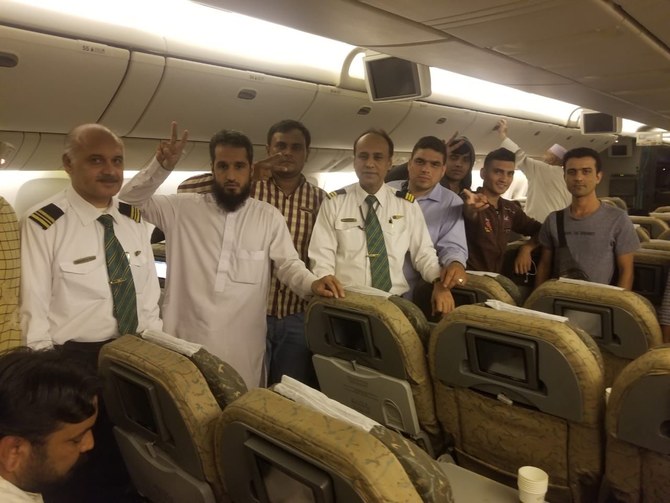
A special PIA flight brings Pakistani detainees back home from Malaysia on Dec. 31, 2019. (Photo courtesy: PIA)
Short Url
Updated 01 January 2020
Follow

Pakistan brings home 250 prisoners from Malaysian jails before new year

  • Malaysian government grants amnesty to stranded detainees every year
  • PIA’s special flight brought back the prisoners from Kuala Lampur on Tuesday

ISLAMABAD: About 250 Pakistani nationals languishing in different Malaysian jails returned to their homeland on Tuesday ahead of New Year’s Eve.

A special flight of Pakistan International Airlines brought back the Pakistanis from Kuala Lampur to Islamabad after the Malaysian government granted them amnesty.

“Special instructions were given to the Pakistani High Commission by Special Assistant to Prime Minister (SAPM) Zulfi Bukhari to mobilize all resources to bring back maximum Pakistani prisoners after registering them under the Malaysian Royal Amnesty Scheme,” according to a statement by the Press Information Department (PID) issued on Monday.

Most of the detainees were stuck in Malaysia after their visas expired.

“Earlier this year, 320 Pakistani nationals were repatriated which makes a total of 8,190 Pakistani nationals released by Malaysian authorities till date,” the PID added.

Pakistan and Malaysia have close bilateral ties which were further enhanced when Prime Minister Imran Khan signed several agreements with the Malaysian government during his visit to the country in November this year.


Pakistan engages Saudi Arabia, China in bid to ease surging Middle East tensions 

Updated 10 March 2026
Follow

Pakistan engages Saudi Arabia, China in bid to ease surging Middle East tensions 

  • Pakistan’s foreign minister stresses need for de-escalation in conversations with Chinese, Saudi counterparts
  • Tensions in the Middle East continue to remain high as conflict between US, Israel and Iran intensifies

ISLAMABAD: Pakistan’s Deputy Prime Minister Ishaq Dar spoke to the foreign ministers of Saudi Arabia and China on Tuesday, stressing the importance of diplomatic engagement to de-escalate tensions in the Middle East as the Iran war intensifies. 

Pakistan has constantly engaged regional countries in efforts to broker a ceasefire in the Middle East, after the US and Isreal launched coordinated strikes against Iran on Feb. 28. 

Iran launched fresh attacks on Gulf countries on Tuesday morning, where it has targeted US military bases in recent weeks. In addition to firing missiles and drones at Israel and American bases in the region, Iran has also been targeting energy infrastructure which, combined with its stranglehold on the Strait of Hormuz, has sent oil prices soaring worldwide. 

Dar spoke to Saudi Foreign Minister Prince Faisal bin Farhan to discuss developments in the Middle East and ongoing deliberations at the UN Security Council, Pakistan’s foreign office said in a statement. 

“DPM/FM shared Pakistan’s perspective, underscoring the importance of continued coordination and diplomatic engagement to support de-escalation and promote peace and stability across the region and beyond,” the statement said. 

Dar, who also serves as Pakistan’s foreign minister, spoke to Chinese foreign minister Wang Yi over the telephone separately. The two discussed the evolving regional situation and broader global developments.

Dar underscored the need to ease tensions in the Middle East and the wider region during the conversation, the foreign office said. 

Yi appreciated Pakistan’s constructive efforts aimed at promoting de-escalation and stability in the region, it added. 

“The two leaders stressed the importance of de-escalation and emphasized the need to pursue dialogue and diplomacy in accordance with the principles of the UN Charter,” the foreign office’s statement said. 

The conflict in the Middle East has hit Pakistan hard as well, forcing Islamabad to hike petrol and diesel prices by Rs55 per liter last Friday. 

Pakistan’s government has also announced a set of austerity measures, which include closing schools and cutting down on government expenditures, as it evaluates petrol stocks and looks for alternative supply routes.