

Rohingya refugees facing winter sickness crisis in Bangladesh refugee camps: Health officials

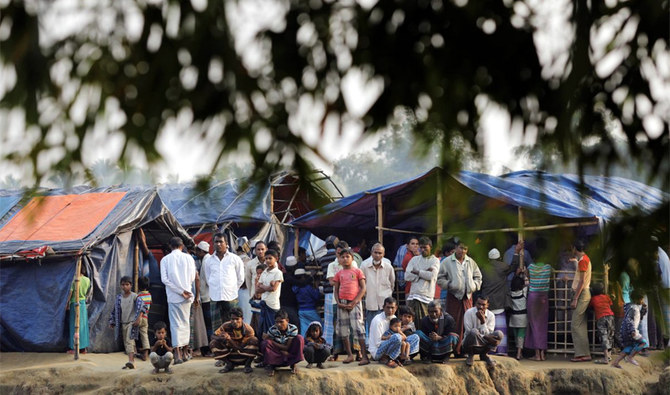
Rohingya refugees are seen at a refugee camp in Cox's Bazar, Bangladesh. (Reuters/File)
Short Url
Updated 31 December 2019
Follow

Rohingya refugees facing winter sickness crisis in Bangladesh refugee camps: Health officials

  • Children, elderly worst hit as cold spell sees rise in pneumonia, diarrhea cases at Cox’s Bazar

DHAKA: Health officials have warned of a winter sickness crisis among Rohingya refugees living in makeshift tents at camps in Bangladesh.

The cold weather currently gripping the country has increased the suffering for tens of thousands of the ethnic group’s people trapped in camps at Cox’s Bazar, with children and the elderly worst affected.

“As winter is getting heavier on the refugees in the camps, we have noticed an increase of pneumonia and diarrhea patients, and children are the most vulnerable of these cases,” Dr. Abdul Matin, civil surgeon in Cox’s Bazar, told Arab News.

“We are on alert to provide the best treatment to the refugees. Some of our hospitals and health centers are providing round-the-clock services for them.”

Matin, the highest-ranking health sector governmental official in the district, said doctors and medical officers at the state-run Ukhia General Hospital were on standby to provide maximum health care support to Rohingya patients.

To help prevent cholera from spreading among refugees, the Bangladesh government, with assistance from UNICEF (the UN Children’s Fund), was running an oral cholera vaccination program in 34 camps, with phase one due to end on Dec. 31, he added.

Matin pointed out that to protect children from pneumonia and other respiratory diseases, the government was also running an immunization program against acute respiratory infections.

FASTFACT

More than half of 1m Rohingya refugees in Bangladesh aged under 18.

“My six-year-old daughter has been suffering from diarrhea for the past three days. She can’t eat anything now, and whatever she eats or drinks she can’t hold for long, and vomits,” Amena Khatun, 38, a refugee queuing with her daughter at a health center in the Kutupalang camp, told Arab News.

Another Rohingya woman, Saleha Begum, 24, was waiting see a doctor with her three-year-old son at a center run by the BRAC health organization. “Little Arman (her son) hasn’t slept for the past two nights. He is suffering from serious respiratory problems. I don’t know what happened to him,” she said.

To combat the ongoing cold spell, health bodies have been running 129 medical posts at Cox’s Bazar refugee camps and 32 primary health care centers providing 24/7 services, said Louise Donovan, UNHCR (UN High Commissioner for Refugees) spokeswoman at Cox’s Bazar.

“UNHCR and partners have distributed winter assistance kits, which include blankets and sleeping mats, to over 86,000 households in order to help the refugees keep warm during the harsh weather. Further distributions are ongoing,” she added.

Bangladesh currently hosts more than 1 million Rohingya refugees, most of whom fled from Rakhine State in Myanmar following a military crackdown in August 2017.

According to UNICEF, more than half of the Rohingya population at Cox’s Bazar is under 18 years old.


South Korea: Civilians sent drones to North Korea four times, harming ties

Updated 4 sec ago
Follow

South Korea: Civilians sent drones to North Korea four times, harming ties

SEOUL: South Korea’s Unification Minister Chung Dong-young said on Wednesday that three civilians had sent drones to North Korea on four occasions since President Lee Jae Myung took office last year, harming inter-Korean ties.
The trio flew the aircraft between September 2025 and January, Chung said, citing an ongoing investigation by police and the military. Drones crashed on two occasions in North Korea, in line with claims ‌made by ‌Pyongyang, he said.
On two other attempts the ​drones ‌returned ⁠to Paju, ​a border ⁠settlement in South Korea, after flying over Kaesong, a city in North Korea, Chung said.
South Korean authorities were investigating the three civilians on suspicion of violating the aviation safety act and breaching criminal law by benefiting the enemy, he said.
Some officials at South Korea’s military intelligence agency and the National Intelligence Service were also under investigation for alleged involvement with the ⁠trio, he said.
“We express official regret to the ‌North,” Chung said, adding that the government ‌was taking the drone incursion incidents very seriously.
North ​Korea has reacted angrily, saying ‌last month that drones from South Korea entered its airspace, after ‌another intrusion in September.
Kim Yo Jong, the powerful sister of North Korean leader Kim Jong Un, urged Seoul to investigate the incident, warning provocations could result in “terrible situations.”
Chung also expressed regret over South Korea sending 18 drones to North Korea under ‌the direction of ousted President Yoon Suk Yeol.
“It was an extremely dangerous incident aimed to induce an attack ⁠against South ⁠Korea by sending 18 drones on 11 occasions, to sensitive areas in North Korea including the airspace over the Workers’ Party office,” he said.
South Korean prosecutors have
indicted Yoon
, who was ousted in April 2025, on charges that include aiding an enemy state.
They accused him and his military commanders of ordering a covert drone operation into the North to raise tensions and justify his martial law decree.
Yoon denies wrongdoing.
South Korea’s government plans to strengthen penalties for sending drones to the North, Chung said, including up to a one-year jail term or a 10 million ​won ($6,928) fine.
A clause will ​also be added to South Korea’s inter-Korean relations development act to block actions that heighten tensions on the peninsula, he said.