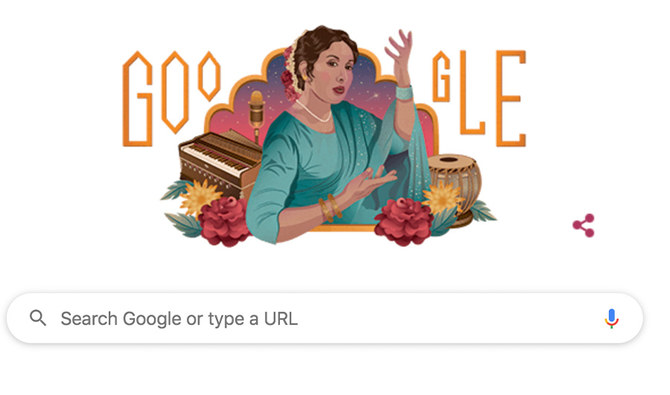
Google honors Pakistani ghazal singer Iqbal Bano

Iqbal Bano is December 28, 2019's Google Doodle. Google honors the late ghazal singer on what would have been her 81st birthday. (Courtesy of Google)
Short Url
Updated 28 December 2019
Follow

Google honors Pakistani ghazal singer Iqbal Bano

  • Bano received the Pride of Performance award in 1974
  • She would have turned 81 today

ISLAMABAD: Google doodle has once again honored a Pakistani great, this time by illustrating the country’s famous ghazal singer, Iqbal Bano, on what would have been her 81st birthday.

Bano was born in New Delhi, India, in 1935. She spent her formative years in the neighboring country and started training in classical music under Ustad Sabri Khan of the Delhi Gharana. In 1952, at the age of 17, she married and moved to Pakistan where her singing career flourished.

She was known for her classical Urdu ghazals, thumri, ballads as well as easy-listening tunes which found their way into popular consumption through film soundtracks and the radio.

Bano was also known for her activism, most legendarily for her defiant and radical bucking of the rules when in 1986 she performed Faiz Ahmed Faiz’s poetry and work which was banned at the time before a crowd in Lahore. Recordings of Bano’s bold move found their ways to all corners of South Asia. One of those songs, “Hum Dekhenge,” has long been a song and recitation of resistance in South Asia, both in Pakistan and India.

That same poem has recently been sung and performed by students and protesters in neighboring India where people have been rallying against the Citizenship Amendment Act (CAA) which its critics describe as an anti-Muslim piece of legislation. In fact, a faculty member of the Indian Institute of Technology in Kanpur filed a complaint against his students for performing the song during a protest, claiming that it was pro-communist and anti-Indian.

Bano’s first public performance in Pakistan took place in 1957 at the Lahore Arts Council prior to which she worked with Radio Pakistan where she sang ghazals live on air. Her music found its way to Afghanistan and Iran since she also performed Persian poetry.

Bano received Pakistan’s Pride of Performance award in 1974 for her contributions to classical music. She passed away after battling a short illness on April 21, 2009 at age 74.

Google Doodle has honored a number of Pakistani greats in the past, including Abdul Sattar Edhi, Nusrat Fateh Ali Khan and Noor Jehan.


Pakistan expands pilgrim travel system for Iran, Iraq with licenses to 67 new operators

Updated 16 December 2025
Follow

Pakistan expands pilgrim travel system for Iran, Iraq with licenses to 67 new operators

  • New system requires all Iraq-Iran pilgrimages to be organized by licensed groups under state oversight
  • Long-running “Salar” model relied on informal caravan leaders, leading to overstays and missing pilgrims

ISLAMABAD: Pakistan has issued registration certificates to 67 additional licensed pilgrimage companies, expanding a tightly regulated travel system designed to curb overstays, undocumented migration and security risks linked to religious travel to Iran and Iraq, the ministry of religious affairs said on Tuesday.

The move is part of a broader overhaul of Pakistan’s pilgrim management framework after authorities confirmed that tens of thousands of Pakistani pilgrims had overstayed or gone missing abroad over the past decade, raising concerns with host governments and triggering diplomatic pressure on Islamabad to tighten oversight.

“The dream of safe travel for pilgrims to Iran and Iraq through better facilities and a transparent mechanism is set to be realized,” the religious affairs ministry said in a statement, quoting Federal Minister for Religious Affairs Sardar Muhammad Yousaf, who announced that 67 new Ziyarat Group Organizers had been registered.

Pakistan’s government has dismantled the decades-old “Salar” system, under which informal caravan leaders arranged pilgrimages with limited state oversight. The model was blamed for weak documentation, poor accountability and widespread overstays, particularly during peak pilgrimage seasons. 

Under the new framework, only licensed companies are allowed to organize pilgrimages, and they are held directly responsible for ensuring pilgrims return within approved timelines.

Authorities say pilgrimages to Iran and Iraq will be conducted exclusively under the new system from January 2026, marking a full transition to regulated travel. The religion ministry said it has now completed registration of 24 operators in the first phase and 67 more in the second, with remaining applicants urged to complete documentation to obtain licenses.

The religious affairs ministry said a digital management system is being developed with the National Information Technology Board to monitor pilgrim movements and operator compliance, while a licensed ferry operator has also secured approval to explore future sea travel options.

The overhaul has been accompanied by tighter coordination with host countries. Earlier this month, Pakistan and Iraq agreed to share verified pilgrim data and restrict entry to travelers cleared under the new system, following talks between interior ministers in Islamabad and Baghdad. Pakistan has also barred overland pilgrim travel for major religious events, citing security risks in its southwestern Balochistan province, meaning travel to Iran and Iraq is now limited to approved air routes.

Officials say the reforms are aimed at balancing facilitation with accountability, as tens of thousands of Pakistani pilgrims travel annually to key Shia shrines, including Karbala and Najaf in Iraq and Mashhad and Qom in Iran. Travel peaks during religious occasions such as Arbaeen, when millions of worshippers converge on Iraq, placing heavy logistical and security demands on regional authorities.

The government says the new system is intended to restore confidence among host countries while ensuring safer, more transparent travel for Pakistani pilgrims.