

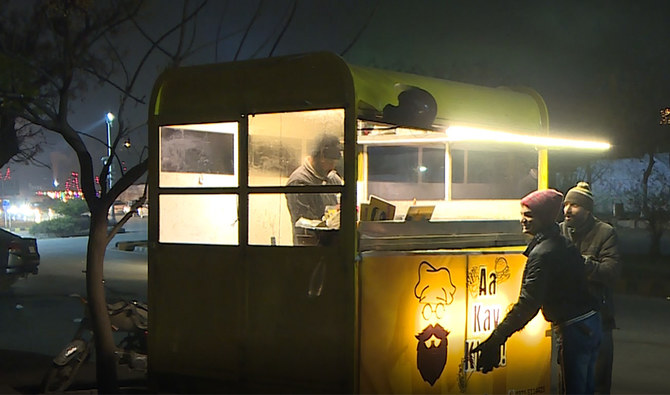
Aa Kay Khao in Islamabad, where deaf street vendor empowers others

Short Url
Updated 28 December 2019
Follow

Aa Kay Khao in Islamabad, where deaf street vendor empowers others

  • 18 people with hearing loss manage Aa Kay Khao
  • Mobeen decided to create opportunities for deaf people to earn a living

ISLAMABAD: Their eyes are their ears, their hands are their mouth. At a roadside food joint in an upscale area of Islamabad, a group of hearing impaired men using sign language confidently sell western and Arabic fast food to earn a decent living.

The business, Aa Kay Khao, which means “come and eat,” is run by Muhammad Mobeen, 33, who in early childhood contracted meningitis, which left him deaf.

Employed at an insurance company, where he was a data entry officer, Mobeen grew frustrated watching how the hearing impaired were unable to get jobs in the government and private sector. He took it upon himself to create a platform for them to earn their livelihood.

Relying on his own savings and family support, Mobeen started the food business and employed only deaf workers. Gradually, the enterprise expanded and he now offers catering services also to schools.

Mobeen’s goal is to empower every hearing impaired person in the country and to make them equal stakeholders in the business.

This is his story, covered first by Arab News. Watch this video report on a noble cause with a big plan.


Pakistan stresses increasing trade, economic engagement with Europe amid EU-India deal 

Updated 09 February 2026
Follow

Pakistan stresses increasing trade, economic engagement with Europe amid EU-India deal 

  • Deputy PM Ishaq Dar chairs meeting to review measures to strengthen Pakistan-EU economic and trade cooperation
  • Free trade agreement grants Indian exporters sweeping tariff-free access to EU, Pakistan’s second-largest export market

ISLAMABAD: Pakistan’s Deputy Prime Minister and Foreign Minister Ishaq Dar on Monday stressed the importance of deepening trade and economic engagement with the European Union (EU) amid the bloc’s recent free trade agreement with India. 

India and EU last month announced they had successfully concluded negotiations for a free trade agreement with the EU, which Indian Prime Minister Narendra Modi described as the “mother of all trade deals.” The agreement grants Indian exporters sweeping tariff-free access to the EU, Pakistan’s second-largest export market. European Commission President Ursula von der Leyen said the deal created a free trade zone of two billion people.

The main concern for Pakistan is that the India-EU deal may significantly reduce Islamabad’s tariff advantage under the EU’s Generalized Scheme of Preferences Plus, which allows duty-free access for many Pakistani exports in return for commitments on labor rights, human rights and governance. Pakistan’s foreign office, however, has said it continues to view its trade relationship with the EU, particularly under the GSP Plus framework, as mutually beneficial.

Dar chaired a high-level inter-ministerial meeting to review measures aimed at strengthening Pakistan’s economic and trade cooperation with EU on Monday, the foreign ministry said. 

“DPM/FM underscored the importance of deepening and expanding trade and economic engagement with the EU, noting that the EU remains a key economic partner for Pakistan, particularly under the GSP Plus framework,” the statement said. 

He highlighted that Pakistan has successfully completed four biennial GSP Plus reviews, reaffirming Islamabad’s commitment to fully meeting its obligations under the scheme to expand mutually beneficial trade opportunities.

The meeting was attended by the federal minister of law and senior officials as well as Pakistan’s ambassador to the EU. 

The development takes place as Pakistan’s exports dwindle. After rising 5 percent to $32.1 billion last fiscal year, the Pakistan Bureau of Statistics reported that exports fell 9 percent to $15.2 billion in the first half of the current year through December. 

Pakistani industrialists and financial analysts have urged the government to reduce domestic production costs, particularly high power tariffs. EU accounts for a substantial share of Pakistan’s exports, particularly textiles and garments. 

“The EU-India FTA will have a definite impact on Pakistan’s textile exports to the EU,” said Shankar Talreja, the head of research at Karachi-based Topline Securities Ltd, told Arab News last month. 

“Pakistani companies’ competitive advantage to compete against a giant like India needs to be restored in the form of regionally aligned energy tariffs and policy certainty.”