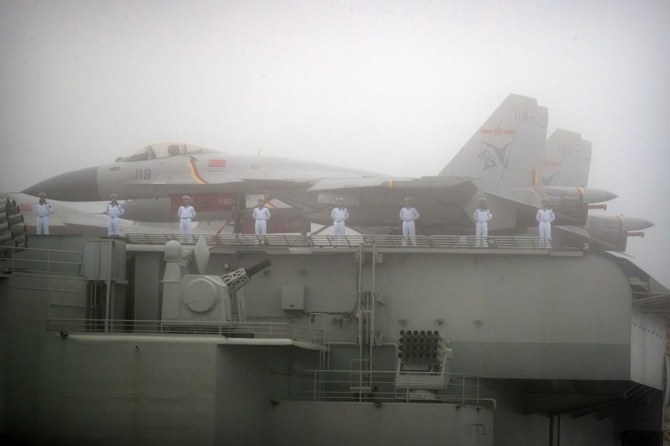
China aircraft carrier sails through Taiwan Strait again

China’s only other carrier the Liaoning, above, has passed through the Taiwan Strait several times in recent years, most recently in June. (AFP)
Short Url
Updated 26 December 2019
Follow

China aircraft carrier sails through Taiwan Strait again

  • Shandong, China’s first domestically built carrier, and accompanying ships traversed the strait separating China from self-ruled Taiwan
  • China still sees Taiwan as part of its territory awaiting reunification, by force if necessary

TAIPEI: A newly commissioned Chinese aircraft carrier sailed through the Taiwan Strait for a second time Thursday, Taipei’s defense ministry said, just weeks before the island goes to polls to elect a new president.
The ministry said it was fully monitoring the Shandong, China’s first domestically built carrier, and accompanying ships as they traversed the strait separating China from self-ruled Taiwan.
Taiwan’s presidential office said in a statement that China had an “international responsibility” to contribute to cross-strait and regional peace and welfare.
Last month Beijing confirmed it had sent the new carrier through the strait as part of routine training, sparking concerns from Washington’s de facto embassy in Taiwan.
At the time, foreign minister Joseph Wu accused China of attempting to intervene in Taiwan’s elections, saying “voters won’t be intimidated.”
The sail-bys come ahead of Taiwan’s January 11 presidential elections, with Beijing-skeptic President Tsai Ing-wen seeking a second term against a challenger who favors warmer ties with China.
Beijing has stepped up military and diplomatic pressure on Taiwan since Tsai came to power in 2016, as her government refuses to acknowledge that the democratic island is part of “one China.”
Tsai — who has voiced support for Hong Kong’s pro-democracy movement — has described the elections as a fight for Taiwan’s freedom and democracy.
China still sees Taiwan as part of its territory awaiting reunification, by force if necessary.
Beijing announced earlier this month that the Shandong had officially entered service.
Its only other carrier — the Liaoning — has passed through the Taiwan Strait several times in recent years, most recently in June.
US navy ships periodically conduct “freedom of navigation” operations in the Taiwan Strait, while Canadian and French ships have also sailed through the waterway this year.
China views any ships passing through the strait as a breach of its territorial sovereignty — while the US and many other nations see the route as international space.


Macron pushes back against Trump’s tariff threats, calls for stronger European sovereignty at Davos

Updated 5 sec ago
Follow

Macron pushes back against Trump’s tariff threats, calls for stronger European sovereignty at Davos

  • French president calls for stronger European sovereignty and fair trade rules, signaling Europe will not bow to economic coercion amid US tariff threats 

LONDON: French President Emmanuel Macron warned about global power and economic governance, implicitly challenging US President Donald Trump’s trade and diplomatic approach, at the World Economic Forum in Davos on Tuesday.

Without naming Trump, Macron described a world sliding toward a “law of the strongest,” where cooperation is replaced by coercion and economic pressure becomes a tool of dominance.

His comments come as Europe faces renewed threats of tariffs and coercive measures from Washington following the fallout over Greenland and other trade disputes.

Macron, wearing sunglasses on stage, warned political and business leaders of a world under pressure, marked by rising instability, weakened international law, and faltering global institutions.

“We are destroying the systems that help us solve shared problems,” he said, warning that uncontrolled competition, especially in trade, puts collective governance at risk.

In recent days, Trump has threatened punitive tariffs on European exports, including a 200 percent levy on French wine, after Macron refused to join the “Board of Peace” for Gaza.

Trump also announced a 10 percent tariff on exports from Britain and EU countries unless Washington secured a deal to purchase Greenland from Denmark, a move European officials have privately called economic blackmail.

Macron rejected what he described as “vassalization and bloc politics,” warning that submitting to the strongest power would lead to subordination rather than security.

He also criticized trade practices that demand “maximum concessions” while undermining European export interests, suggesting that competition today is increasingly about power rather than efficiency or innovation.

Macron also said that Europe has long been uniquely exposed by its commitment to open markets while others protect their industries.

“Protection does not mean protectionism,” he said, emphasizing that Europe must enforce a level playing field, strengthen trade defense instruments, and apply the principle of “European preference” where partners fail to respect shared rules.

Macron warned against passive moral posturing, arguing that it would leave Europe “marginalized and powerless” in an increasingly harsh world. His dual strategy calls for stronger European sovereignty alongside effective multilateralism.

The timing of the speech underscored its urgency. Trump recently published private messages from NATO leaders and Macron, following a diplomatic controversy over Greenland.

Macron closed his Davos speech with a clear statement of principles: “We prefer respect to bullying, science to obscurantism, and the rule of law to brutality.”