

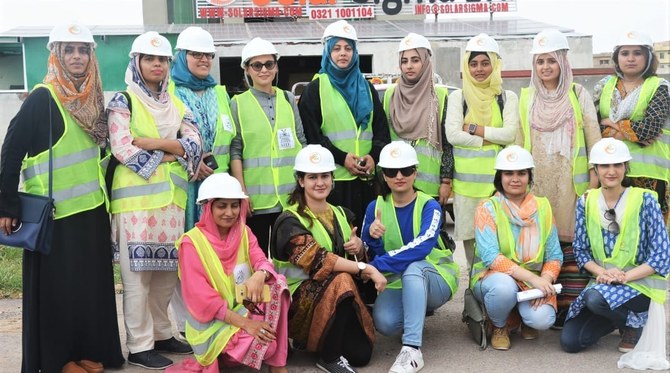

ISLAMABAD: “Energy companies usually do not see women fit for technical roles,” says Roma Iqbal, a Lahore-based engineer. “But with my passion and expertise, I proved that I am the right girl for the job.”
In September, she joined SkyElectric, Pakistan’s leading solar energy company, becoming yet another woman to successfully enter the photovoltaic industry.
With a degree in electrical engineering from the University of Huddersfield, in July Iqbal became one of the 20 women who received solar panel installation training by She in Energy and Women In Renewable Energy (WIRE Pakistan).
WIRE has trained nearly 100 women in various fields related to green technology.
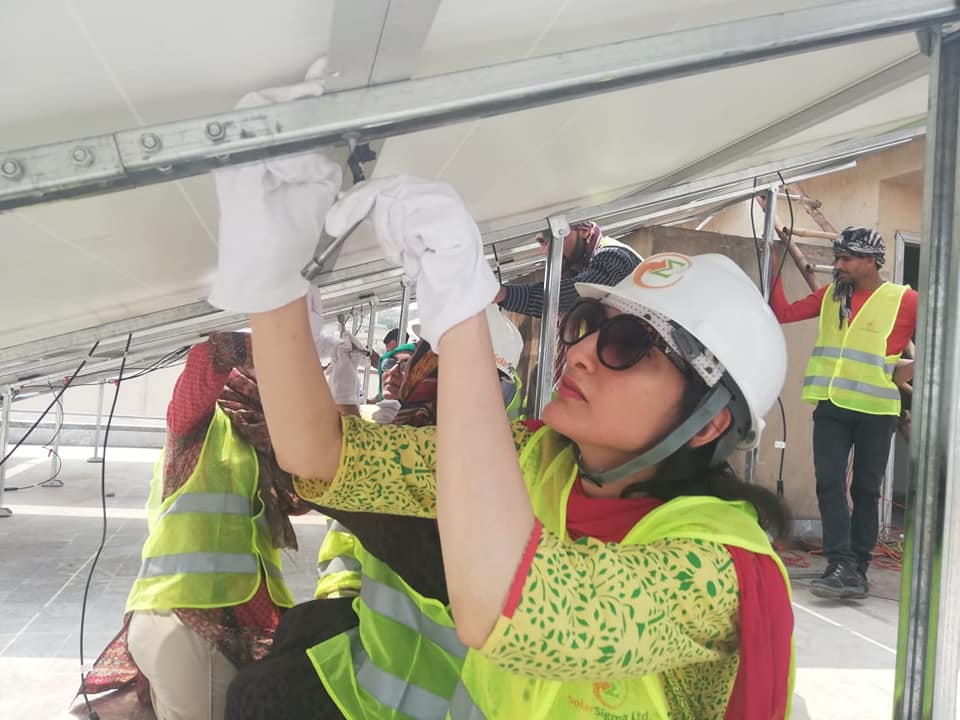
A WIRE training participant is fixing a solar panel. (Photo courtesy: WIRE Pakistan)
“One of the girls was so enthused that she wanted to install solar panels on her home all by herself,” WIRE Pakistan co-founder Anila Fatima told Arab News.
“Another one called after a few days to share that she got a job right away. The response has been marvelous. It indicates that the future is bright for Pakistani women professionals and also for Pakistan’s green energy sector,” she said.
In a bid to expand the participation of women in the industry, WIRE is also active in creating job opportunities by connecting women graduates with employers.
A 2018 study showed that out of 61,672 people employed in the country’s nine power companies, only 2,494 – about 4 percent – were women. “For sustainable economic growth, Pakistan must involve more educated women to participate in the economic activity,” Fatima said.
Pakistan’s shift to green power, particularly to solar energy offers opportunities not only in addressing the country’s vulnerability to climate change, but also in the social sphere, as it will open many new jobs, for female workers as well.
“This is perhaps the only arena that integrates all dimensions of sustainable development – environmental, economic and social,” Fatima said.
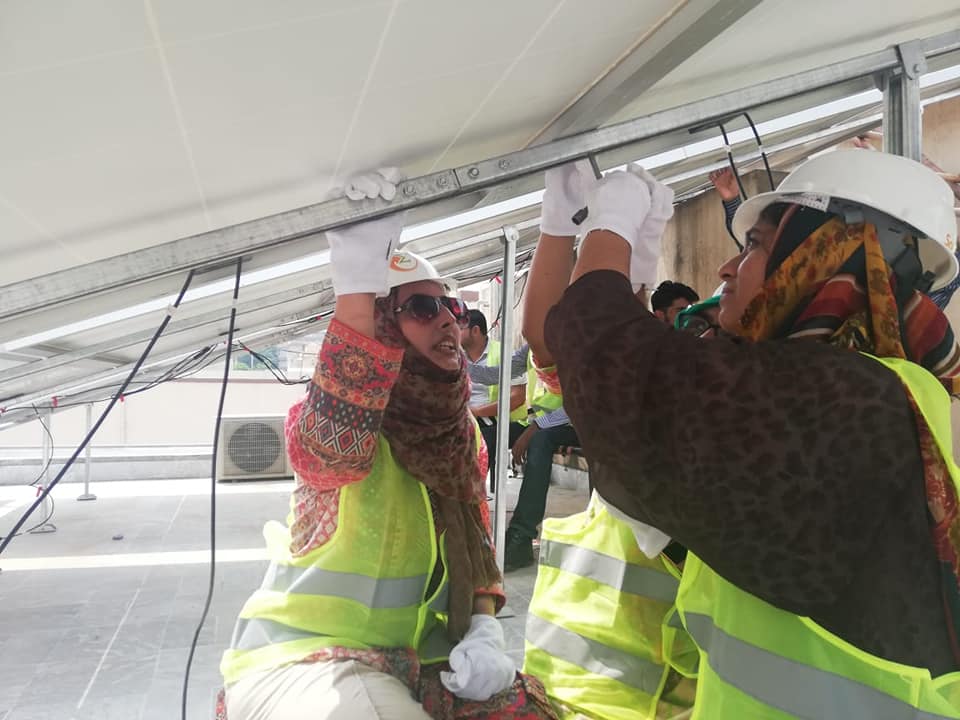
Female trainees and trainers participate in solar panel installation training by She in Energy and WIRE Pakistan in Islamabad, July 2019. (Photo courtesy: WIRE Pakistan)
With her success story, Iqbal also encouraged more women to venture into the traditionally male-dominated field.
The 27-year-old engineer moved to the green sector after having spent two years at a thermal power plant. She believes in the world’s transition to renewables and says that Pakistani female engineers can greatly benefit from it.
Similarly, Pakistan would also benefit from its female engineers’ involvement, which is increasing.
Nameerah Hameed, founder of Women in Energy which aims “to disrupt the traditional mindset that plagues the male-dominated energy and power sector in Pakistan” by building a strong network of female experts says the organization started with 20 women in 2018. It now has over 100 members, comprising female managers, policymakers, economists, engineers, academics and climate experts.
Introducing diversity to Pakistan’s power sector is vital to accelerating the country’s green transition. According to Fatima, “bringing more women can also increase awareness in the society about the use of clean energy as women are more passionate about health and environment.”


