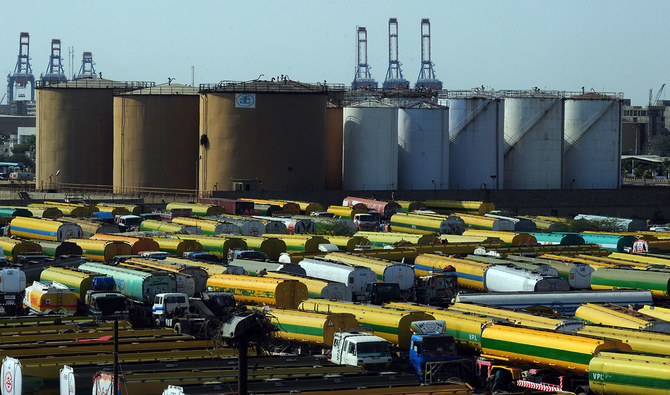
KARACHI: Pakistan is taking steps to reconstruct and redesign its existing oil import handling facilities to accommodate increasing loads of bulk liquid cargo, after two oil terminals at Karachi port stopped working, officials said.
Pakistan has three multipurpose oil import terminals, Oil Pier-I, Oil Pier-2 and Oil Pier-3, out of which two have been rendered non-functional.
Currently, Oil Pier-2 is the only operational terminal.
“A German firm which has been given contract for the redesigning of OP-I will submit its report by end of March or in early April 2020,” Rear Admiral Jamil Akhtar, Chairman of Karachi Port Trust (KPT), a government body that manages port affairs, told Arab News on Sunday.
“The firm... will give proposals and different financial options and merits and demerits of the projects and we will move accordingly to manage the funding,” he said and added: “Generally speaking, reconstruction of an oil pier...costs between $60-100 million.”
Oil Companies Advisory Council (OCAC), an independent organization representing five refineries, 28 oil marketing companies and a Pipeline Company, on Thursday drew the attention of the federal government through a letter that warned of a looming energy crisis if the facilities were not repaired.
“It is pertinent to mention that around 65% of petroleum products of import vessels including crude oil were handled at Karachi Port through Oil Pier-1 and 2 in the financial year 2018-19, which translated into around 12 million tons per year or 23 vessels per month,” the OCAC letter dated Dec. 19 said, and warned of a wide shortage of petroleum products in the days and weeks ahead.
It also said that Oil Pier-1, if completely reconstructed could take more than two years to build. Oil Pier-3, it added, would not be operationally ready until seven to eight months after the awarding of a new tender in January next year.
“There is the need to reconstruct the oil piers,” Akhtar said, but denied that the country was on the brink of a crisis in the absence of the two oil facilities.
“We are working to replace the fenders of Oil Pier-1, which will be completed within the next three to four weeks. At present, we are managing through enhanced discharge rate from the vessels. The situation will be normal,” he said.
As KPT moves to repair the oil terminals, authorities say they have other options in case a crisis arises.
“We have emergency pipes we can lay down on other jetties and connect them with the oil pipelines and discharge the oil. There is no issue at least from my point of view,” the KPT chairman said.
During the last fiscal year, 504 oil tankers docked at the KPT to discharge 12.38 million tons of cargo, according to OCAC data.
The OCAC fears that in the present situation, where only one terminal is operational, the inflow of liquid cargo in scheduled time will be impossible to handle. Maritime ministry officials said steps to ensure the uninterrupted import of oil have already been taken.
“This is not a panic-like situation. Steps have already been taken to fix the fenders of Oil Pier-1. We can also used other berths in case of an emergency,” Mahmood Moulvi, an adviser at the maritime affairs ministry, told Arab News.
Traditionally, KPT has been constructing berths but “now we are re-looking at it and working on terminalization,” the KPT chief said.


![]()

Pakistan to revamp oil infrastructure in face of energy crisis
Short Url
https://arab.news/gsvvr
Pakistan to revamp oil infrastructure in face of energy crisis
- KPT has three multipurpose oil import terminals, of which only one is presently working
- Reconstruction of an oil terminal costs around $100 million, says KPT Chairman
Latest updates


© 2026 SAUDI RESEARCH & PUBLISHING COMPANY, All Rights Reserved And subject to Terms of Use Agreement.