

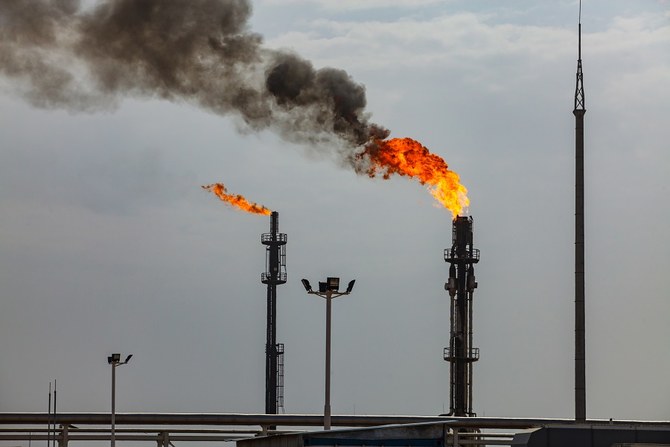

DUBAI: Saudi Aramco has emerged as the most effective energy company in the world at mitigating emissions of the atmospheric pollutant methane from natural gas operations, according to consulting firm Thunder Said Energy.
A research survey put Aramco, the world’s biggest listed company, at the top of a table that included all the big energy groups.
The Saudi company was about six times more efficient than US energy giants Exxon Mobil and Chevron, in both current emissions and targets for future reduction, as a proportion of its gas production.Equinor, the state energy company of environmentally conscious Norway, ranked second in the survey.
Thunder Said’s Rob West, an expert in energy economics, said that controlling methane emissions was a crucial aspect of the move to decarbonize global energy supplies, in which gas is playing an increasingly important role. Methane, a much more powerful greenhouse gas than carbon dioxide (CO2), is released in the gas production and transportation process.
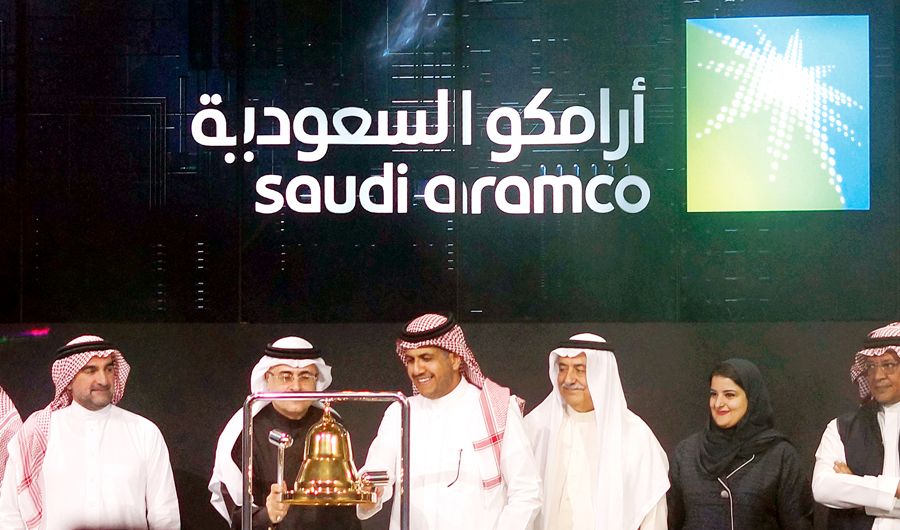
Saudi Aramco became the world’s most valuable public company this year with a stock offering launch in December. (AP)
“Scaling up natural gas is the largest decarbonization opportunity on the planet. But this requires minimizing methane leaks. Exciting new technologies are emerging,” West said. Global gas demand will treble by 2050 as producers and consumers seek cleaner alternatives to coal and oil.
Aramco, the biggest oil exporter, has huge quantities of natural gas, which it has identified as a key area of expansion for domestic supply and export in the form of liquified natural gas. “We basically look at natural gas as an area for growth for the company,” Khalid Al-Dabbagh, Aramco’s chief financial officer, said in an investor call in the run-up to its successful IPO this year.
Aramco spends a big proportion of its research and development budget on measures to counter the environmentally damaging effects of the oil and gas business, including advanced technology to reduce pollutants in energy products.
Although most environmentalists have focused their attention on CO2 as the main contributor to global warming, and hence to damaging climate change, some experts regard methane as a far more serious threat.
There is far more CO2 in the atmosphere, but methane is up to 120 times more powerful as a warming agent and takes longer to leave Earth’s atmosphere. “Methane accounts for around 25 to 30 percent of all the warming occurring on the planet,” West said, while around a quarter comes from fossil fuel production.
“Mitigating methane emissions is becoming crucial for tackling net emissions.”
While methane leaks at all stages of the natural gas production process, almost half is emitted during the upstream phase. Sensors, drones and even satellites are being increasingly used to detect these emissions. Aramco stopped “flaring” gas years ago.
“The world will need superior methods to mitigate methane. In the developed world, this will be necessary for operators wishing to demonstrate low carbon credentials, and preserve their access to customers and capital markets,” West said. “The other way for investors to lower methane emissions may be to favor companies with low methane emissions and targets to improve.”


