

Lebanon PM-designate begins tough talks to form government

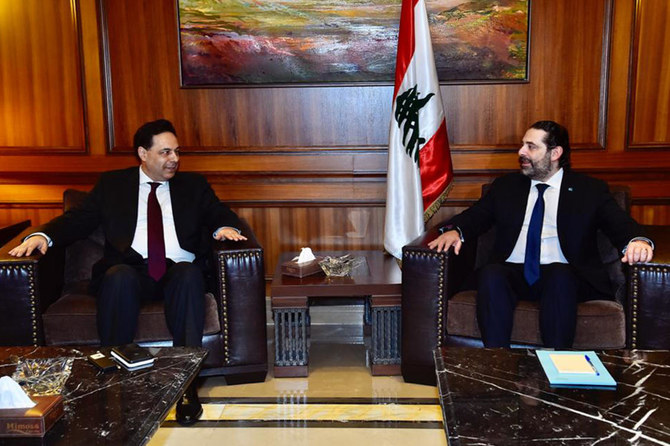
Newly-assigned Lebanese Prime Minister, Hassan Diab, left, meets with outgoing Prime Minister Saad Hariri, in Beirut, Lebanon, Saturday, Dec. 21, 2019. (AP)
Short Url
Updated 21 December 2019
Follow

Lebanon PM-designate begins tough talks to form government

  • Hassan Diab, a 60-year-old engineering professor, was designated prime minister on Thursday
  • Hariri’s Sunni bloc did not endorse his nomination, along with other key Christian and Druze Muslim parties

BEIRUT: Lebanon’s prime minister-designate launched consultations Saturday to form a desperately-needed government for a protest-hit country facing economic collapse amid political rifts over the cabinet’s line-up.
Debt-burdened Lebanon has been without a fully functioning government since former prime minister Saad Hariri resigned on October 29 in the face of nationwide protests.
Demonstrators are demanding an overhaul of the political establishment which they deem corrupt and inept, insisting on a government of independents and experts with no ties to the country’s sectarian parties.
Hassan Diab, a 60-year-old engineering professor, was designated prime minister on Thursday with backing from the country’s Iran-aligned Shiite Hezbollah movement and its allies.
But Hariri’s Sunni bloc did not endorse his nomination, along with other key Christian and Druze Muslim parties and have said they will not take part in Diab’s government.
Diab, considered a technocrat, is hoping to set up the new cabinet within four to six weeks and has said he wanted to choose experts to join the line-up, calling on demonstrators to give him a “chance” to carry out the task.

The rebirth of AlUla
Hegra, ancient city of the Nabataeans in Saudi Arabia’s historic AlUla Valley, is emerging from the mists of time to take its rightful place as one of the wonders of the world

Enter


keywords

The challenges he must overcome became clear however from the onset of Saturday’s talks with various officials and lawmakers.
Parliament speaker Nabih Berri said he “insists on securing representation for all parliamentary groups,” in the next government — a position shared by his Shiite Amal party and Hezbollah.
Samir Al-Jisr, a deputy from Hariri’s Future Movement, urged Diab to form a government “of independent experts not affiliated with established political parties,” to rescue Lebanon from the brink of collapse.
“Considering that this government, just like Diab’s nomination, will be supported by only one political stripe, then its formation should take less than” a month or six weeks, he said after meeting the premier-designate.
He was referring to allies Hezbollah, Amal and the Free Patriotic Movement founded by Christian President Michel Aoun who chose Diab to form a cabinet.
Such backing has sparked an uproar, with Sunni supporters of Hariri blocking roads and scuffling with security forces in Beirut and other cities for the past two consecutive nights to voice their opposition for Diab.
Some roads remained blocked on Saturday in Sunni-majority second city Tripoli and in the northern Akkar region.
Hezbollah sought to appease the anger of the protesters on Saturday, insisting that the next government will not be lopsided.
“No one should think the government will be one of confrontation or one endorsed by only one political stripe,” said Hezbollah MP Mohammad Raad after meeting Diab.
The new government, he said, will seek to “revitalize” the economy that has taken a beating since the unprecedented protests began on October 17.
Since then, tensions have been heightened by the looming bankruptcy of the debt-burdened Lebanese state.
A dollar-liquidity crisis has pushed banks to impose informal capital controls on dollar deposits and the Lebanese pound, officially pegged to the US dollar, has lost around 30 percent of its value on the black market.
The faltering economy has pushed several companies to close, while surviving businesses try to stay open by paying half-salaries and laying off employees.
A recession of more than 0.2 percent is expected for this year, the World Bank says.
The international community, donors, and financial organizations have warned that debt-saddled Lebanon could ill afford any delay in getting a new government.
The United States, France and other allies of Lebanon have warned they would withhold financial support until a government that can demonstrate willingness to reform can be formed.
Multi-confessional Lebanon is ruled by a complex political system that seeks to maintain a fragile equilibrium between political parties representing the country’s major confessional sects.
It usually takes months to form a government as political groups haggle over the allocation of cabinet seats and the distribution of ministerial portfolios.

The rebirth of AlUla
Hegra, ancient city of the Nabataeans in Saudi Arabia’s historic AlUla Valley, is emerging from the mists of time to take its rightful place as one of the wonders of the world

Enter


keywords

Iran FM tells UN all military bases of ‘hostile forces’ legitimate targets

Updated 6 sec ago
Follow

Iran FM tells UN all military bases of ‘hostile forces’ legitimate targets

  • UN chief condemns escalation, calls for immediate return to negotiating table
  • Emergency session of Security Council set to convene on Saturday in New York

NEW YORK: Iran will use “all necessary defensive capabilities and means” to confront attacks by the US and Israel, and will treat “all bases, facilities, and assets of the hostile forces in the region” as legitimate military targets under its right to self-defense, Foreign Minister Abbas Araghchi said on Saturday.

In a letter to UN Secretary-General Antonio Guterres and the president of the Security Council, Araghchi said US and Israeli airstrikes are “a clear violation” of the UN Charter and amount to “an open armed aggression” against Iran.

Tehran is exercising its “inherent and lawful right of self-defense” under the UN Charter, he added.

The letter, seen by Arab News, accused the US and Israel of launching coordinated, large-scale attacks on Iranian territory, targeting defensive facilities and civilian sites in several cities.

Araghchi said Iran will continue to act “decisively and without hesitation until the aggression ceases fully and unequivocally,” adding that the US and Israel “shall bear full and direct responsibility for all ensuing consequences, including any escalation arising from their unlawful actions.”

He called on the 15-member Security Council to convene an emergency meeting to address a “breach of peace which is a real and serious threat to international peace and security,” and urged UN member states to “unequivocally condemn this act of aggression.”

An emergency session of the council is set to convene in New York on Saturday, requested by France, Bahrain, Colombia, China and Russia.

The Russian mission at the UN said in a statement that during the meeting, Moscow will demand that the US and Israel “immediately cease their illegal and escalatory actions and embark on a path toward a political and diplomatic settlement.” It added that “Russia is willing to provide all necessary assistance in this process.”

Meanwhile, Guterres condemned the military escalation, saying “the use of force by the United States and Israel against Iran, and the subsequent retaliation by Iran across the region, undermine international peace and security.”

The UN Charter clearly prohibits “the threat of the use of force against the territorial integrity or political independence of any state, or in any other manner inconsistent with the Purposes of the United Nations,” Guterres said in a statement.

He called for an immediate cessation of hostilities and de-escalation, and an immediate return to the negotiating table, adding that “failing to do so risks a wider regional conflict with grave consequences for civilians and regional stability.”

UN human rights chief Volker Turk also deplored the escalation and warned that civilians are the ones who end up paying “the ultimate price.”

He said: “Bombs and missiles are not the way to resolve differences but only result in death, destruction and human misery.”

Turk called for restraint and implored the parties “to see reason, to de-escalate, and (return) to the ‘negotiating table’ where they had been actively seeking a solution only hours earlier.”