ISLAMABAD: Pakistan on Friday asked the WhatsApp management to provide details of its users allegedly targeted by an Israeli spyware in the country and update it on remedial measures to avoid recurrence of such hacking incidents.
The development comes after NSO – an Israeli spyware firm – was sued by WhatsApp/Facebook on October 29 for “violating both the US and California laws as well as the WhatsApp terms of service.”
A special type of malware named “Pegasus” was reportedly employed between 28 April and 10 May 2019, approximately affecting 1400 senior government and military officials in twenty countries including Pakistan.
“Pakistan Telecommunication Authority (PTA) has taken up the matter with the WhatsApp management,” the state-owned telecom regulator said in a statement on Friday.
“PTA intends to get the details of users who were targeted in Pakistan [along with] an update on the remedial measures taken by WhatsApp to prevent the occurrence of such hacking attempts in future,” it said.
The authority has also advised the public to upgrade the WhatsApp application by downloading its latest version and keep the operating system of their device up to date in order to “avoid such incidents.”
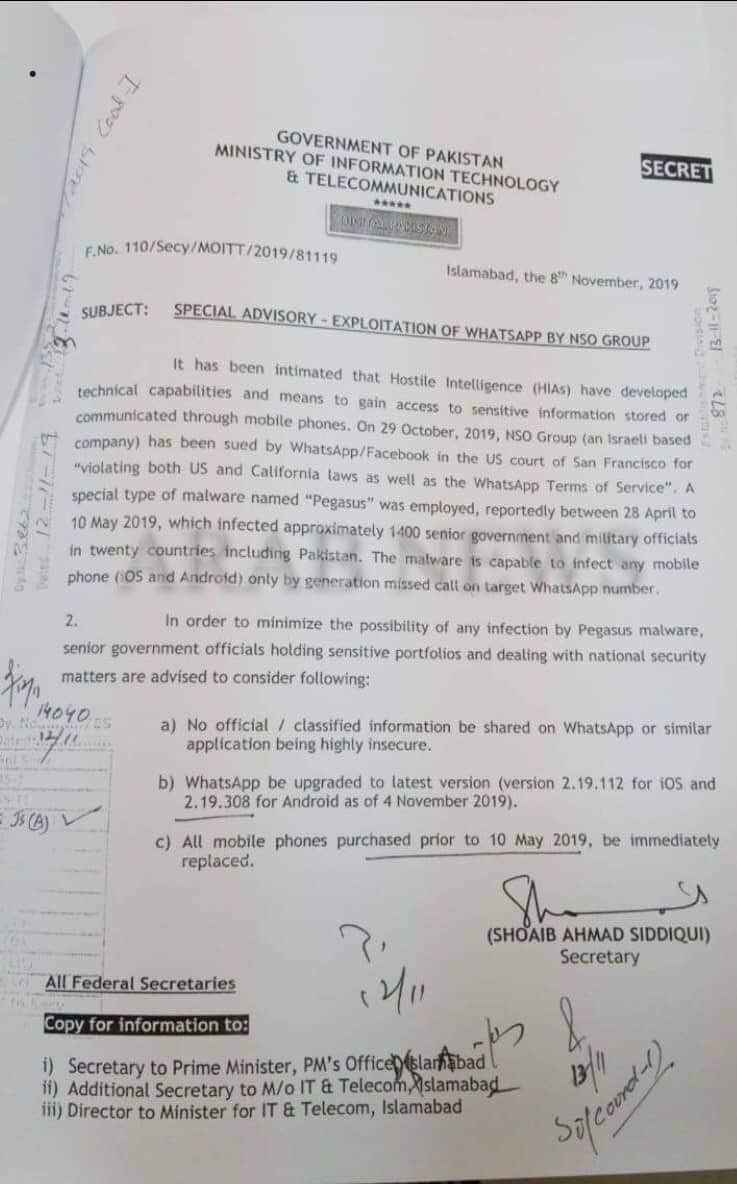
Picture of an official document Arab News exclusively obtained on November 20, 2019. The document asks senior government functionaries not to share classified information with anyone on WhatsApp or similar applications for security reasons.
Quoting a confidential document, Arab News reported last month that the government had directed senior officials holding “sensitive portfolios and dealing with national security matters” not to share “official/classified information” on “WhatsApp or similar applications” for security reasons.
“The malware [Pegasus] is capable of infecting any mobile phone [iOS and Android] only by generating a missed call on the targeted WhatsApp number,” a special advisory issued by the Ministry of Information Technology, a copy of which is available with Arab News, said last month.
In order to minimize the possibility of any infections by Pegasus malware, the ministry also directed government functionaries to immediately replace all mobile phones purchased prior to 10 May 2019.
Against this backdrop, Pakistan is developing a local instant messaging application – an alternate to WhatsApp – to protect official data and sensitive information from hackers and hostile intelligence agencies.
“We have been working to improve our cybersecurity and develop a messaging application like WhatsApp for government officials,” Dr. Arslan Khalid, Prime Minister Imran Khan’s focal person on digital media, told Arab News. “This local application will help us protect sensitive government data and other classified information from hostile spying agencies and hackers.”
The application, which is likely to cost about Rs1.3 billion ($8.37 million), will be launched by June 2020.
Officials at WhatsApp told media in October that senior government officials in multiple US-allied countries were targeted earlier this year with a hacking software that used Facebook Inc’s WhatsApp to take over users’ phones. Victims belonged to the United States, the United Arab Emirates, Bahrain, Mexico, Pakistan, India and other nations.
Pakistan is ranked among the top seven countries for inadequate cybersecurity, with 25 percent of its mobile phones and 14.8 percent of computers infected with malware, according to a study conducted by technology site Comparitech.
Digital rights experts have urged the government to publish the list of officials whose WhatsApp accounts were compromised through the malware for transparency.
“All public officials who communicate sensitive information [through WhatsApp] should be strictly asked to apply all digital security tools to protect their data and conversations from being hacked,” Nighat Dad, Executive Director of Digital Rights Foundation, told Arab News.
She said that since WhatsApp was a private company, it was not accountable to any other country or government and might refuse to cooperate with Pakistan.
“Smart phones are surveillance devices and can be hacked through malware to listen to all conversations in real time. It is also possible to take screen shots of what is on display and copy all data in the device,” Dad added, advising the government to make its “security protocols foolproof for everyone, especially government functionaries.”