ISLAMABAD: The Pakistan Bar Council said on Friday it would file a petition in the Supreme Court to defend a judge who wrote the verdict in the high treason case against the country’s former army chief, General (retired) Pervez Musharraf.
The government had criticized the wordings of the ruling, saying it would file a reference against the judge in the Supreme Judicial Council.
Justice Waqar Ahmed Seth’s order in the detailed judgment released on Thursday drew widespread criticism in which he instructed the authorities to “drag” Musharraf’s “corpse” to D-Chowk and hang it there for three days, if he was found dead before the execution of death penalty awarded to him in the case.
The government announced shortly after the release of the detailed judgment that it would move the Supreme Judicial Council — a constitutional body authorized to hear cases of misconduct against members of the country’s superior judiciary – against Justice Seth for his “despicable” observation in the judgment.
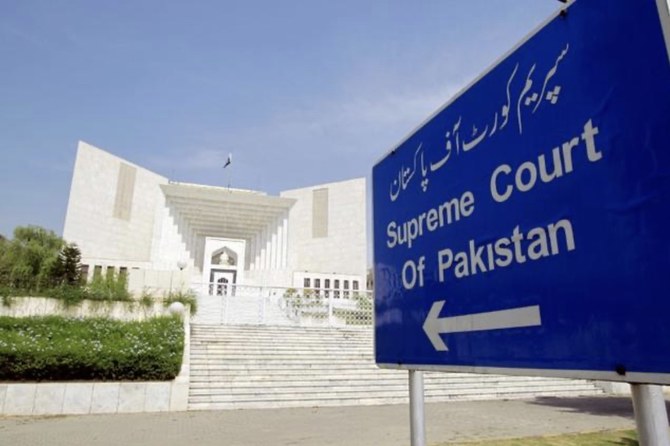
“We will challenge the government’s reference against Justice Seth in the Supreme Court, and defend his verdict in the case,” Syed Amjad Shah, vice chairman of the Pakistan Bar Council, the country’s top regulatory body of lawyers, told Arab News on Friday.
He said that the government’s “mala fide intent” against the judge was exposed by its stance against the verdict. “The government has the prerogative to file a reference against any judge, but under the law it cannot be entertained,” he said.
Shah said the government and other aggrieved parties can file a petition in the Supreme Court against the ruling, but “cannot get a judge removed” through the Supreme Judicial Council on the basis of a judgment.
The 76-year-old, former military ruler was handed down death sentence on Tuesday in absentia as he currently resides in Dubai and is undergoing treatment for multiple ailments. He seized power in October 1999 in a bloodless military coup and remained in power till 2008.
The apex court’s senior lawyers said it was a lengthy and complicated process to file a reference against any judge of the superior judiciary and then get him removed for misconduct, physical or mental incapacity.
“The government apparently wants to offset pressure from different sides by filing the reference,” Habibullah Khan, senior advocate Supreme Court, told Arab News. “The government wants to show it has adopted a legal course against the judge who used graphic reference in the Musharraf ruling.”
About the formation of Supreme Judicial Council, he said it consisted of five members — the chief justice of the Supreme Court, the next two senior most judges of the apex court and two senior judges from high courts.
The council may initiate a probe on the request of the president or on its own, if it suspects that a judge may be incapable of properly preforming his/her duties due to physical and mental incapacity or misconduct.
All proceedings of the council are held in-camera and are not open to public, he said.
“If a judge is charged with any of the offense, he is removed by the president,” he said. “But in Justice Seth’s case, the government is not in a position to establish a cogent case against him.”
However, political analysts said the government was left with no option but to file a reference against the judge after the ruling against the former chief of the all-powerful military.
“The government is trying to get a face saving by moving a reference against the judge,” Zebunnisa Burki, political analyst, told Arab News. “The government is caught in a catch-22: It can neither support the verdict nor oppose it openly.”


![]()

Pakistan lawyers’ body backs judge who issued Musharraf ruling
Short Url
https://arab.news/8ma95
Pakistan lawyers’ body backs judge who issued Musharraf ruling
- The Pakistan Bar Council says it will challenge the government’s reference in the apex court
- The government can neither support nor oppose Musharraf’s death penalty, says political analyst
Latest updates


© 2026 SAUDI RESEARCH & PUBLISHING COMPANY, All Rights Reserved And subject to Terms of Use Agreement.