


CAIRO: An Egyptian technology business is aiming to help regional enterprises benefit from the use of artificial intelligence (AI).
AI is being relentlessly integrated into the fundamentals of business and everyday life, demonstrating exceptional potential for boosting the global economy.
In the Middle East and North Africa (MENA) region, the new technology is expected to make an economic contribution of $320 billion (SR1.2 trillion) by 2030, with gains expanding annually by between 20 percent and 34 percent.
Saudi Arabia is forecast to be the chief beneficiary of this trend as it adds an estimated $135.2 billion to its gross domestic product, with the Neom smart city project being a clear sign of the Kingdom’s commitment to technology and AI.
On the other hand, there has never been a more controversial time for AI, not just in the region but also around the globe.
While companies are excited to explore its use to obtain insights that can help them transform their products and services, employees are fearful of losing their jobs to AI-powered bots.
“AI is trendy now, and there are so many talks and events about it, (but) many executives might agree that despite all the interest, tangible business results are scarce,” said Ahmed Abaza, co-founder and CEO of Synapse Analytics, an Egyptian digital transformation company helping businesses adopt AI solutions.
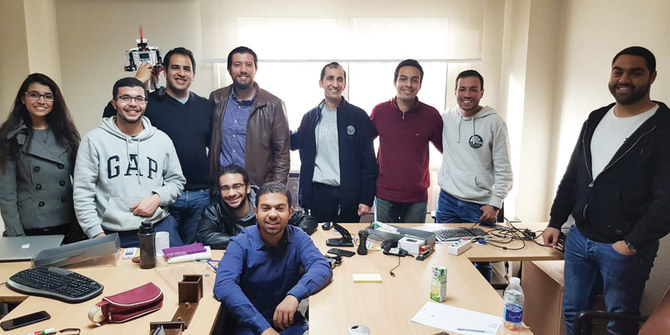
Founded in January 2018 by 29-year-old Abaza and Galal El-Beshbishy, 24, the Cairo-based venture has been experimenting with a variety of market sectors — from robotics to banking — and utilizing AI for everything, from image tracking and analysis to business analytics.
The company’s ultimate goal is to revisit how AI could be Incorporated within enterprises. In spite of an influx of funds into AI business adoption, Abaza believes that firms can easily fall victim to the powerful hype surrounding the technology instead of making results-driven investments.
Dr. Mark Esposito, the instructor of Harvard’s two-day intensive AI in Business program, shares this view, with one publication quoting him as saying that “the low-hanging fruit is recognizing where in the value chain (companies) can improve operations. AI does not start with AI. It starts at the company level.”
However, this is not the only challenge for the region’s AI sector. Many executives that Synapse Analytics worked with could not understand the potential of the technology.
“Pitching that we could save 15 percent of their working capital using AI seemed too good to be true,” said Abaza.
IT personnel were not exposed to much AI, either, which made them demand extensive testing and led to project delays.
Finding and maintaining talent was another challenge for the fledgling industry.
Abaza said that a good AI engineer was a person with comprehensive knowledge across multiple domains, including software development, IT, statistics and mathematics, plus a hefty dose of business acumen.
Synapse Analytics currently has a team of more than 30 employees, all from highly diversified backgrounds.
“Retaining these talents in the Egyptian market could be a bit challenging since competent AI engineers and data scientists are in huge demand globally,” Abaza added.
To make it easier for businesses to tap into AI, the company is transforming the services it offers into products.
The first one, Azka Vision, is an AI suite designed to collect data from surveillance cameras and CCTVs to provide material for actionable insights.
Two more products are expected to launch soon, including Azka Analytics, an end-to-end supply chain optimization platform using AI that will help companies cut operational costs.
According to Abaza, Synapse Analytics is a profitable operation with a range of local and international clients across the retail, fashion, and finance industries.
His aim is for the company to become a big data and AI lab not only for businesses but for economies, too.
• This report is being published by Arab News as a partner of the Middle East Exchange, which was launched by the Mohammed bin Rashid Al Maktoum Global Initiatives and the Bill and Melinda Gates Foundation to reflect the vision of the UAE prime minister and ruler of Dubai to explore the possibility of changing the status of the Arab region.


