



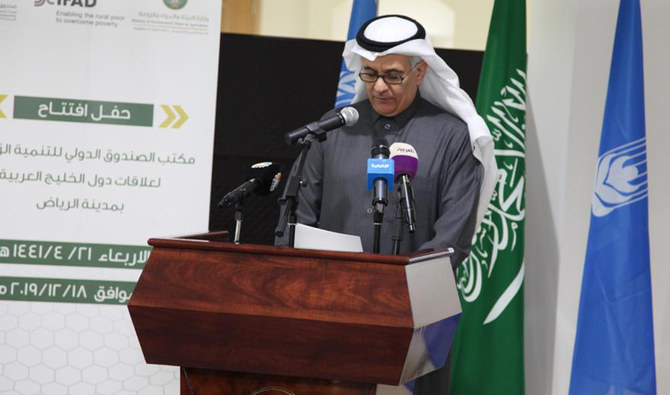

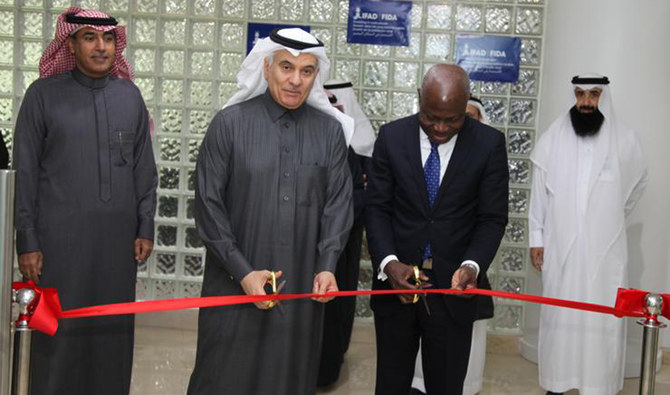

RIYADH: The UN’s International Fund for Agricultural Development (IFAD) on Wednesday inaugurated its liaison office in Riyadh, the first such office in the Gulf region.
Saudi Minister of Environment, Water and Agriculture Abdulrahman Abdulmohsen Al-Fadhli and IFAD’s President Gilbert F. Houngbo inaugurated the office.
The office will play a lead role in strengthening IFAD’s partnerships with the states of the Gulf Cooperation Council (GCC), their institutions, private companies, foundations and research centers, according to IFAD’s President Gilbert F. Houngbo.
Speaking at the inauguration of the Agricultural Development Fund (ADF) headquarters, Houngbo said: “The Arab Gulf countries were instrumental in establishing IFAD, and have been strong supporters of the organization for more than 40 years.”
“The opening of this office will strengthen our collaboration to combat extreme poverty and hunger in developing countries, to share knowledge and to maximize the use of IFAD’s technical expertise to support sustainable food security in the region,” he said.
This new office will play a vital role in cultivating and strengthening alliances between IFAD and the Arab Gulf countries: Saudi Arabia, Kuwait, Oman, Qatar and the UAE, who are members of IFAD, he said.
It will also raise awareness of the importance of investing in smallholder agriculture to reduce hunger and poverty, he said.
The office will also facilitate knowledge-sharing and the implementation of regional programs, including Reimbursable Technical Assistance (RTA), to help the Gulf States to address their food security concerns.
Al-Fadhli said that the opening of the IFAD office will build the partnership and cooperation between GCC states and its financial institutions, and will contribute to expanding the fund’s programs and enhance cooperation with the private sector, and will facilitate the implementation of regional programs concerned with food security, including technical assistance and capacity-building.
He said that the Kingdom is keen to support the fund to be able to achieve its goals. It recently raised its contribution to the fund’s resources by 10 percent to aid agricultural development and comprehensive sustainable rural transformation and to fight poverty and hunger and achieve food security.
Saudi Arabia is a founding member of IFAD, a member of its executive board and has contributed more than $485 million since its inception in 1977.
Ron Hartman, director, global engagement, partnership and resource mobilization, IFAD, told Arab News: “The opening of IFAD’s office is a critical step for strengthening the partnership between IFAD and its Gulf member states. Since IFAD was founded in 1977, the Gulf states have played a key role in shaping the fund as the only global financing institution solely focused on investing in rural development.”
“The office will enable deeper interaction on critical issues facing the region, such as fragility, resilience, potable water and environment vulnerability,” he said, adding that the office will also facilitate greater sharing of knowledge between the Gulf and the rest of the world.
“IFAD office will seek to support and align with the Saudi Vision 2030 for a vibrant society, thriving economy and an ambitious nation. In particular, it will seek to continue its technical support for economic diversification and supporting agricultural SMEs. An example of this type of support is the current partnership between IFAD and the Ministry of Environment, Water and Agriculture to provide technical support to 30,000 small-scale coffee and mango farmers in Jazan region. This technical support will increase productivity and market access for these small-scale farmers,” he said.
IFAD, a specialized agency of the UN, was one of the major outcomes of the first World Food Conference held in Rome in 1974. Three years after the conference in Rome, IFAD was set up as an international financial institution in 1977. Since then, IFAD-supported projects have reached millions of people.
The inauguration was attended by government representatives including Munir bin Fahad Al Sahli, director general of the ADF, Khalida Bouzar, IFAD regional director for the Near East, North Africa, Europe and Central Asia, and IFAD senior officials.


