BAGHDAD: The day before the deadline to designate a new Iraqi prime minister, political parties were wrangling Wednesday over three candidates: all insiders and all rejected by a months-old anti-government protest movement.
President Barham Saleh has until midnight Thursday to appoint a replacement for outgoing premier Adel Abdel Mahdi, who resigned after two months of unprecedented demonstrations that have rocked the capital Baghdad and Shiite-majority south.
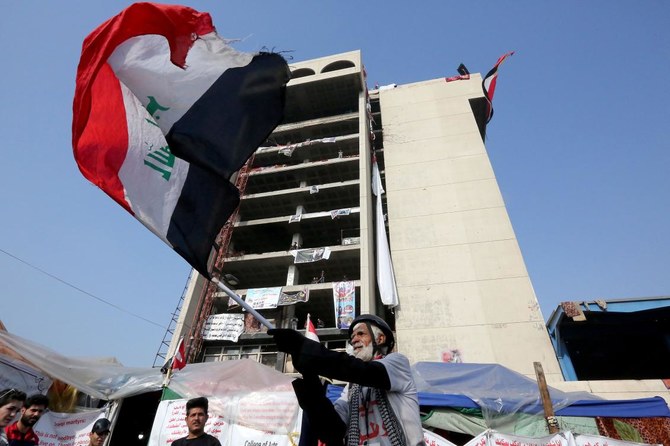
The protests continue to push for the overhaul of the political system in place since the 2003 US-led invasion that toppled Saddam Hussein, defying violence that has left around 460 dead and 25,000 wounded.
As candidates’ names were leaked in recent weeks, giant posters of them with their faces crossed out in red quickly appeared in Baghdad’s Tahrir Square, epicenter of the protests since October 1.
On Wednesday, three names appeared to remain on the table after many meetings of party heads and other leaders of parliamentary groups.
Qusay Al-Suhail, outgoing higher education minister, has for several weeks been presented by officials as the candidate of Iran.
Iran wields growing clout in Iraq, with its emissary Major General Qasem Soleimani presiding over the negotiations.
A former key member of Shiite cleric Moqtada Sadr’s movement, Suhail rejoined the Rule of Law Alliance of former prime minister Nouri Al-Maliki — close to Iran and enemy of Sadr — and seems to become the favorite for the premiership.
But the Iraqi political machine can been fickle.
Earlier Wednesday, the front-runner was Mohammed Al-Soudani, 49, former minister and ex-governor of a southern province now in the grip of protests and violence.
His demotion is due to his not having been received by Grand Ayatollah Ali Sistani — longtime kingmaker in Iraqi politics — when he presented himself to be endorsed in Najaf a few days ago, according to sources in the Shiite shrine city.
The 89-year-old cleric, the highest religious authority for the majority of Iraqi Shiites, had already said — for the first time — that he did not want to be involved in the formation of the new government.
A third candidate is intelligence chief Moustafa Al-Kazemi, a shadowy figure seen as backed by the US.
If parliament does not approve a candidate who has emerged from inter-party negotiations, then the president has the constitutional right to appoint the premier himself.
“He’s betting on a last-minute intervention,” one political official told AFP.
Another possible twist: no candidate is approved, the post of prime minister will be vacant from Thursday at midnight. Under the constitution, that would place Saleh in the post himself.
Formally, the “largest coalition” in parliament should present a candidate to the president, who then submits his name to a vote.
But so far, neither the president nor parliament has said which coalition is the largest.
Adding to the uncertainty, on Wednesday an outspoken liberal lawmaker critical of Iraq’s endemic corruption threw his hat into the ring.
Fayeq Al-Sheikh Ali presented his “candidacy to... form a professional and non-partisan government,” in a letter to Saleh which he also shared with his more than 285,000 Twitter followers.
Head of a secular alliance, Sheikh Ali won a parliamentary seat last year after promising to counter Islamists’ efforts to ban alcohol in the country.
He was stripped of his immunity from prosecution in September following accusations he praised Saddam Hussein’s Baath party, despite his long history of opposing the executed dictator.
But he has already generated enthusiasm in the street and on social media, with protesters saying he would be a sign of change.
“The government only exchanges positions between the same people, as if it was playing a game of chess,” said 23-year-old protester Hussein Ali in Tahrir Square.
“Neither Soudani nor Suhail represnt us. I reject them and so does the whole of Tahrir Square.”
Umm Mohammed, a protester in her 50s, said she was fed up with the political class.
“We have already tested them and we no longer want them,” she said.
“We want a prime minister who comes from the people, someone who is protesting here with us.”


![]()

Iraqi parties debate PM candidates, already rejected by the street
Short Url
https://arab.news/6va3y
Iraqi parties debate PM candidates, already rejected by the street
- President Barham Saleh has until midnight Thursday to appoint a replacement for outgoing premier Adel Abdel Mahdi
- Three names appeared to remain on the table after many meetings of party heads


Latest updates




Recommended


© 2026 SAUDI RESEARCH & PUBLISHING COMPANY, All Rights Reserved And subject to Terms of Use Agreement.