

Musharraf ‘can surely never be a traitor’: Pakistan army

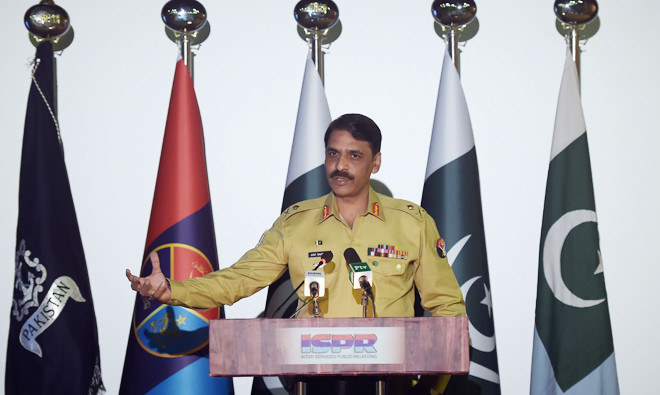
Pakistan's army spokesman Major General Asif Ghafoor speaks with media representatives as he gives details of a captured would-be female suicide bomber Noreen Leghari during a press conference in Rawalpindi on April 17, 2017. (AFP)
Short Url
Updated 17 December 2019
Follow

Musharraf ‘can surely never be a traitor’: Pakistan army

  • The military criticized court decision as concluded in haste
  • Given his service for Pakistan, Musharraf cannot be a traitor, says ISPR

ISLAMABAD: The Pakistan Army has received with “pain and anguish” a court decision that convicted former President Gen. Pervez Musharraf of high treason and sentenced him to death.

The former military ruler received the death sentence in absentia on Tuesday, following a six-year legal case.

The decision has been received with a “lot of pain and anguish by rank and file of Pakistan Armed Forces,” the Pakistan Army’s media wing, Inter-Services Public Relations, said in a statement.

“An ex-Army Chief, Chairman Joint Chief of Staff Committee and President of Pakistan, who has served the country for over 40 years, fought wars for the defense of the country can surely never be a traitor,” the ISPR said in reference to Musharraf.

The military also criticized the legal process behind the ruling by saying the case was concluded “in haste” and was marred by “denial of the fundamental right of self-defense.”

Musharraf’s lawyer Salman Safdar also said the judgment was “announced in haste,” and the conviction of his client in absentia “doesn’t have any legal foundation to stand on,” he told Arab News. He referred to the sentence as “unconstitutional and illegal” and called the case “politically motivated.”

“The sentence will be overturned in appeal,” he said, adding that he had yet to consult Musharraf regarding the appeal process.

Musharraf seized power in October 1999 by toppling the civilian government of former Prime Minister Nawaz Sharif in a bloodless coup. He remained in power until 2008.


Islamabad steps up vehicle checks to boost security as 166,000 cars get electronic tags

Updated 18 January 2026
Follow

Islamabad steps up vehicle checks to boost security as 166,000 cars get electronic tags

  • Authorities say over 3,000 vehicles registered in past 24 hours as enforcement intensifies
  • Extended service hours introduced to push full compliance with digital monitoring system

ISLAMABAD: Authorities in the Pakistani capital have intensified enforcement against vehicles without mandatory electronic tags with more than 166,000 cars now registered, according to data released on Sunday evening, as Islamabad moves to strengthen security and digital monitoring at key entry and exit points.

The Islamabad Capital Territory (ICT) administration introduced the electronic tagging system late last year as part of a broader effort to regulate traffic, improve record-keeping and enhance surveillance in a city that hosts the country’s main government institutions, foreign missions and diplomatic enclaves.

Under the system, vehicles are fitted with electronic tags that can be read automatically by scanners installed at checkpoints across the capital, allowing authorities to identify unregistered vehicles without manual inspections. Vehicles already equipped with a motorway tag, or m-tag, are exempt from the requirement.

“A total of 166,888 vehicles have successfully been issued M-Tags so far, including 3,130 vehicles in the last 24 hours,” the ICT administration said, according to the Excise Department.

Officials said readers installed at checkpoints across Islamabad are fully operational and are being used to stop vehicles still without tags, as enforcement teams carry out checks across the city.

To facilitate compliance, authorities have expanded installation facilities and extended operating hours. The Excise Department said m-tag installation is currently available at 17 booth locations, while select centers have begun operating beyond normal working hours.

According to Director General Excise Irfan Memon, m-tag centers at 26 Number Chungi and 18 Meel are providing services round the clock, while counters at Kachnar Park and F-9 Park remain open until midnight to accommodate motorists unable to visit during daytime hours.

Officials said the combination of enforcement and facilitation was aimed at achieving full compliance with minimal disruption, adding that operations would continue until all vehicles operating in the capital are brought into the system.

The enforcement drive builds on a wider push by the federal government to integrate traffic management, emergency response and security monitoring through technology-driven “safe city” initiatives. Last month, Interior Minister Mohsin Naqvi reviewed Islamabad’s surveillance infrastructure and said reforms in monitoring systems and the effective use of technology were the “need of the hour.”

Authorities have urged motorists to obtain electronic tags promptly to avoid delays and penalties at checkpoints as enforcement continues across the capital.