

‘The most beautiful place’: Halima Aden wowed by Egyptian coast

Halima Aden delivered an empowering speech at the World Youth Forum. AFP
Short Url
Updated 17 December 2019
Follow

‘The most beautiful place’: Halima Aden wowed by Egyptian coast

  • Halima Aden jetted to Egypt’s Sharm El-Sheikh this week to join a panel discussion at the third edition of the World Youth Forum
  • The 22-year-old made sure to document every moment of her trip to the North African nation

DUBAI: Somali-American model Halima Aden jetted to Egypt’s Sharm El-Sheikh this week to join a panel discussion at the third edition of the World Youth Forum.

The first hijab-wearing model to make it big in the international fashion industry sat down to share her inspiring story — from a refugee who grew up in a Kenyan camp to an international supermodel who has graced the runways of renowned brands.

Aden also took to the stage during the opening ceremony, which was inaugurated by Egyptian President Abdel Fattah Al-Sisi, of the three-day event last week to deliver an empowering speech that addressed diversity and the power of engaging with one another.

“As young people, we have the power to change the world. I’ve found that our generation knows the importance in learning to understand alternative views and backgrounds and to engage across the divisions imposed by societal narratives,” stated the Minnesota-based beauty who made headlines when she competed in the Miss Minnesota USA pageant wearing her headscarf.

“Don’t change yourself. Change the game,” she urged during her speech.

The 22-year-old made sure to document every moment of her trip to the North African nation with her 1.1 million Instagram followers, sharing videos and clips on her Instagram Stories.
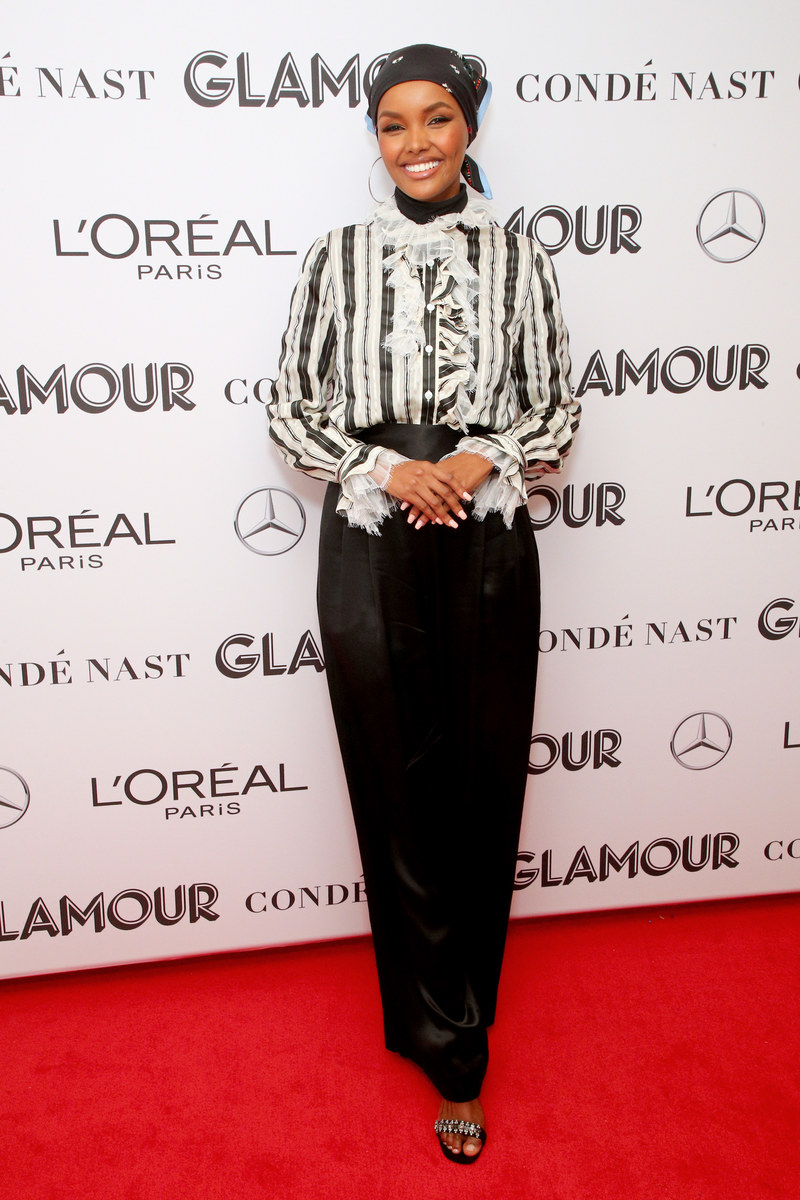


The first hijab-wearing model to make it big in the international fashion industry sat down to share her inspiring story. AFP

“The most beautiful place,” she wrote alongside one video, tagging the Egyptian resort town situated between the desert and the Red Sea.

She also got to casually rub shoulders with the humanoid robot Sophia.

“I can’t believe we causally got to hang out with the First Lady of Egypt and @realsophiarobot,” she captioned an image of herself with Hanson Robotics’ most advanced humanoid robot.

Launched in 2017, the World Youth Forum is a platform with a mission to enable youth from around the world to engage in key global issues and recommend initiatives to top policymakers.

This year’s topics included the industrial revolution, food security, environmental challenges, women empowerment and arts and cinema. 

Also speaking at the event were a number of other inspirational figures from around the globe such as the world’s first armless pilot Jessica Cox, Emirati politician Shamma Al-Mazrui, who was the youngest government official in the world, and Egyptian filmmaker Abu Bakr Shawky, who is best known for his movie “Yommedine,” among many others. 


Mini op-ed: Recognising a shift in how people relate to wellness, self-care

Updated 05 March 2026
Follow

Mini op-ed: Recognising a shift in how people relate to wellness, self-care

DUBAI: I have spent nearly a decade working in the beauty industry in Saudi Arabia and the UAE, and Ramadan always has a way of prompting change; in habits, in priorities, and in the routines people have been carrying without question. Speaking from my own corner of the industry, one of these habits is often hair removal.

Saudi Arabia’s beauty and personal care market was valued at about $7.56 billion in 2025 and is set to grow to an estimated $8.03 billion in 2026. Within that growth, personal care encompassing the daily (sometimes unglamorous) routines hold the largest share. But market size alone does not tell the full story. A study conducted at King Abdulaziz University Hospital, Jeddah, found that three quarters of Saudi women experienced complications from temporary hair removal methods, including skin irritation, in-grown hairs and hyperpigmentation. A separate 2025 study published in the Majmaah Journal of Health Sciences found that laser hair removal was both the most considered and most commonly undergone cosmetic procedure among Saudi respondents, yet dissatisfaction with cosmetic procedure outcomes was reported by nearly half of all participants. The numbers point to a gap not in demand, but in results. 

When I launched a specialized electrolysis practice in the UAE in 2016, it was with a clear gap in mind; safe, regulated, permanent hair removal for the region’s specific needs. The range of hair types here and the prevalence of conditions such as polycystic ovary syndrome, or PCOS, demanded a method that works across all of them.  Electrolysis is the only method recognized by the US Food and Drug Administration and American Marketing Association as achieving true permanent results, regardless of hair color or type. 

Despite this, awareness in Saudi Arabia remains limited. Part of this is familiarity, laser has dominated the conversation for years, and electrolysis, which requires more sessions and a licensed electrologist’s precision, has struggled to break through. Part of it is education. Many clients who come to us have never heard of electrolysis; they come because they have exhausted everything else. 

Right now, Saudi Arabia is in the middle of a genuine transformation in how people relate to wellness and self-care. The beauty market is maturing, consumers are asking harder questions of the brands they choose and Vision 2030 has not just shaped the economy, it has shaped how Saudis are showing up in their own lives. In that context, the idea of choosing permanence over repetition lands differently.
 
Mariela Marcantetti is a beauty industry entrepreneur based between Saudi Arabia and the UAE.