

In UAE, affordable school brings new hope for Pakistani students

Omar Farooqui with the children at the opening of the academy. (Photo Credit: Hope Academy)
Short Url
Updated 15 December 2019
Follow

In UAE, affordable school brings new hope for Pakistani students

  • A 2017 HSBC study said the UAE had the second-highest school fees in the world
  • A majority of the children studying at Dubai’s ‘Hope Academy’ have never been to school

DUBAI: Hundreds of students with financial constraints, a majority of them Pakistanis, are waiting in line for enrollment in Dubai’s Hope Academy since it opened its doors just over a month ago.

Over 250 children-- from kindergarten level to the 8th grade-- are currently studying at the affordable, community-based school, in a country where school fees are otherwise considered the second highest in the world, according to a 2017 HSBC study.
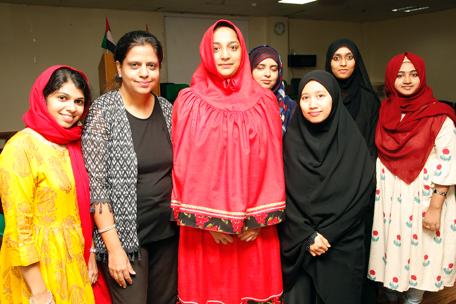


The teachers of Hope Academy. (Photo Credit: Hope Academy)

“These are children of those people living in the UAE who cannot afford to send their children to regular schools,” Omar Farooqui, President of Coded Minds, told Arab News, and added: “It is as if a ghost population has come to the fore.”

Coded Minds is a Dubai-based global iSTEAM and leadership education company and has founded Hope Academy.

“Hope Academy is a movement,” Farooqui continued. “It was an idea that came from behind a table where we discussed how we could bring quality STEM education to the masses.”

“We are expanding to other emirates including Abu Dhabi and Ajman to accommodate 500 other children by January,” he said.

Statistics gathered by the academy show that 29.94 percent of the children seeking admission belongs to Pakistan, followed by 11.65 percent Syrians and Indians-- from a total of 45 different nationalities.

“These are the children of people who have not regularized their status in the UAE or cannot afford school fees, widowers, single parents and many others with unfortunate circumstances,” Farooqui said.

“But we didn’t realize that there was this huge number,” he added.

He said that there were families with multiple children who had never been to school.

The academy charges $286 per year and teaches core subjects -Science, Technology, English and Maths. 

The academy will also be partnering with the United Nations High Commissioner for Refugees (UNHCR) in the future and offer its services to the children of 8,000 refugee families in the country, Farooqui said.
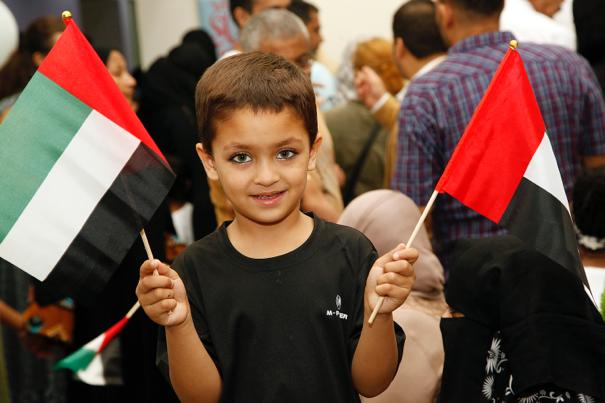


Mohammed Rayyan on his first day at school. (Photo Credit: Hope Academy)

Teachers are hired full-time, with a whopping 70 percent of them, women. Since many of the children have never been to regular schools, the academy carries out an assessment of their educational readiness and adjusts them in classes accordingly.

For Ishaq Ahmed who is from Swabi in northwest Pakistan, the opportunity is a Godsend. Ironically, Ahmed is a school driver but he cannot afford to send his five-year-old son to the school where he works.

“I am so happy I got to know about this academy and now my son is a part of it,” Ahmed said.

This is the first time his son has been to school.

“Whenever I get the time in between work, I go and check on my child. My heart fills with pride on seeing him sit in class and learn,” he said.

Earlier this year, the Pakistan Association Dubai (PAD) became the first welfare association in the UAE to join hands with Hope Academy, followed by the Pakistan Social Centre Sharjah.

Rizwan Fancy, Director for Welfare at PAD said: “There are a large number of Pakistani children in the UAE who cannot continue their education because of financial problems. Such initiatives will help lots of families who are desperate for an opportunity to send their children back to the classroom.”


Pakistan Senate committee approves draft law paving way for legal crypto trade 

Updated 8 sec ago
Follow

Pakistan Senate committee approves draft law paving way for legal crypto trade 

  • Pakistan Virtual Assets Regulatory Authority to grant licenses to issue crypto coins, regulate crypto exchange under new law, says senator
  • Major cryptocurrencies such as Bitcoin, Ethereum and XRP expected to be traded legally in Pakistan within weeks, says lawmaker

ISLAMABAD: A Pakistani Senate committee approved a draft bill to regulate virtual assets on Wednesday, paving the way for cryptocurrency trading to become legal in the country.

Pakistan has been undertaking efforts over the past couple of months in drafting rules to regulate the fast-expanding market for digital coins and tokens, requiring virtual-asset service providers to obtain government approval. Islamabad’s moves to adopt digital currency is a significant shift in policy, considering it had previously banned cryptocurrency transactions in 2018 citing financial risks and lack of regulation.

Last month, Pakistan signed a memorandum of understanding with a company affiliated with the World Liberty Financial, a crypto-based finance platform launched in September 2024 and linked to US President Donald Trump’s family. The agreement explores the use of a dollar-linked stablecoin for cross-border payments. 

Pakistan Senate’s Standing Committee on Cabinet approved the draft “Virtual Asset Act 2026” during a meeting on Wednesday. The bill relates to the Pakistan Virtual Assets Regulatory Authority’s mandate (PVARA) and its power to issue licenses. 

“So under the new law, what will happen is that there will be an authority which already exists, the Pakistan Virtual Asset Regulatory Authority (PVARA), that will have the power to give licenses in which crypto coins can be issued, in which mining can be done, and they will be able to regulate the whole (crypto) market,“” Senator Dr. Afnan Ullah Khan, a member of the committee, told Arab News.

He said under the new law, PVARA will be able to check which company has the license to issue crypto coins and which ones can raise funds for this purpose.

When asked whether crypto trading will be legal in Pakistan after the bill passes in parliament, Dr. Afnan said the draft law will first be presented in the Senate and National Assembly for approval. After that, he said the president will sign it into law. 

“Then it will become legal,” Dr. Afnan said. “It will not take a few weeks, it will take maybe like a week.”

He added that major crypto coins such as Bitcoin, Ethereum and XRP will be traded in Pakistan through crypto exchanges.

Dr. Afnan said the bill was analyzed by committee members, adding that the final draft was approved with the consent of all parties.

He said the law also caters to concerns on the use of cryptocurrency for money laundering and illegal purposes, adding that it also proposes fines for violations by licensees.

PVARA last year issued No Objection Certificates (NOCs) to two global crypto exchanges HTX and Binance. 

PVARA said the NOCs allow Binance and HTX to conduct preparatory and engagement activities within Pakistan under “defined regulatory oversight,” clarifying that it does not constitute a “full operating license.”