Child killed as quake strikes southern Philippines

1 / 7
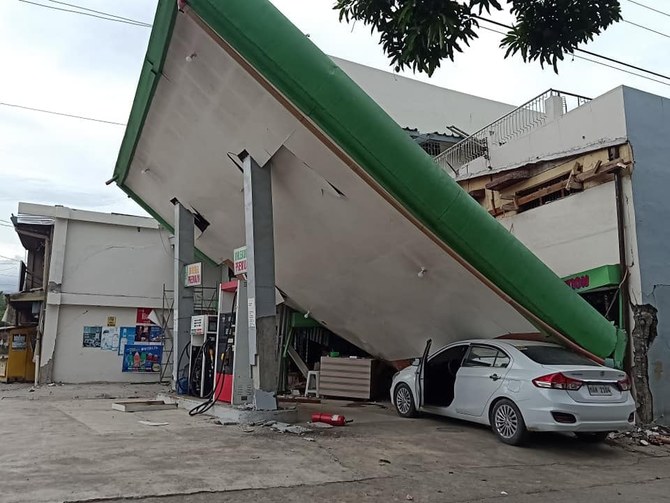
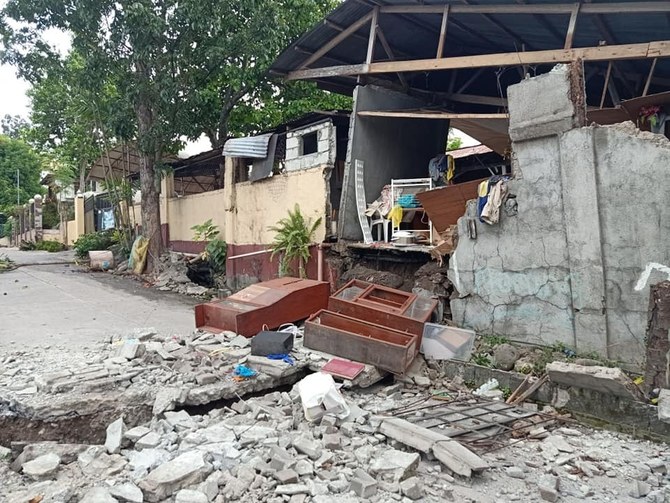
Above, damaged structures after a magnitude 6.8 earthquake centered 61 kilometers southwest of Davao hit on Sunday, December 15, 2019. (PIA Davao Region Facebook)
2 / 7
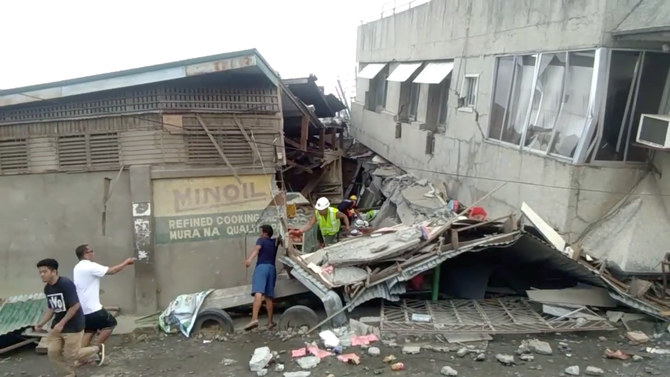
Rescuers look for trapped victims at collapsed market building in Padada, Davao del Sur of southern Philippines on Sunday, December 15, 2019. (Vincent Yaj Makiputin via Reuters)
3 / 7
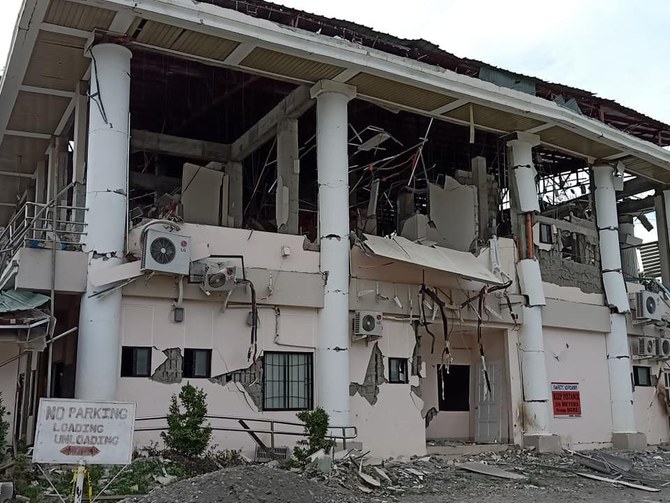
Above, damaged structures after a magnitude 6.8 earthquake centered 61 kilometers southwest of Davao hit on Sunday, December 15, 2019. (PIA Davao Region Facebook)
4 / 7
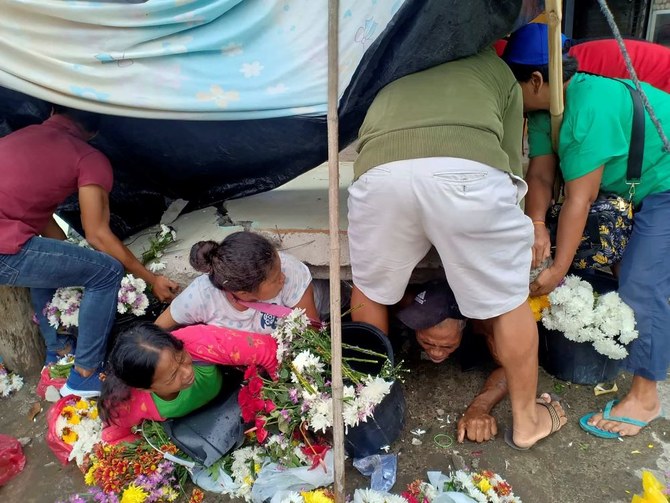
Trapped flower vendors are pulled out from a collapsed wall following a strong earthquake that struck Padada, Davao del Sur province, southern Philippines on Sunday, Dec. 15, 2019. (John Angelo Jomao-as/AP)
5 / 7
Above, damaged structures after a magnitude 6.8 earthquake centered 61 kilometers southwest of Davao hit on Sunday, December 15, 2019. (PIA Davao Region Facebook)
6 / 7
Above, damaged structures after a magnitude 6.8 earthquake centered 61 kilometers southwest of Davao hit on Sunday, December 15, 2019. (PIA Davao Region Facebook)
7 / 7
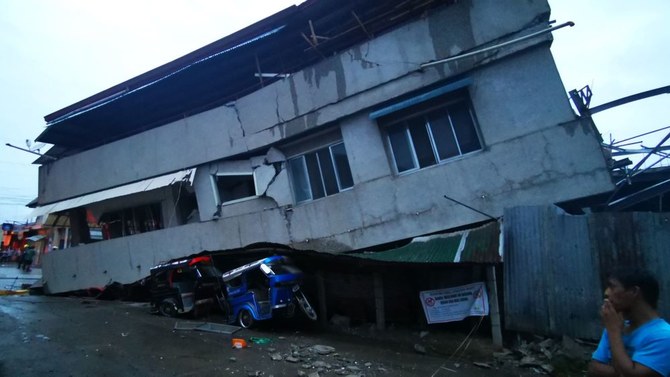
Residents look at a destroyed building after a 6.8magnitude earthquake in the town of Padada in Davao del Sur province on the southern island of Mindanao. (Ferdinandh Cabrera/AFP)
Short Url
Updated 15 December 2019
Follow

Child killed as quake strikes southern Philippines

  • A rescue operation had been launched at a heavily damaged market building in Padada
  • Patients were evacuated from hospitals as a precaution and nervous crowds massed outside shopping malls

MANILA: A powerful earthquake hit the southern Philippine island of Mindanao on Sunday, killing a child, injuring dozens and damaging buildings in an area still recovering from a string of deadly quakes in October.
Police said a rescue operation had been launched at a heavily damaged market building in Padada near the 6.8 magnitude quake’s epicenter, which is about 90 kilometers (55 miles) south of the major city of Davao.
Patients were evacuated from hospitals as a precaution and nervous crowds massed outside shopping malls after the jolt and dozens of smaller, but strong aftershocks.
“We can no longer use our office because the walls cracked and the stairs collapsed,” local police spokeswoman Lea Orbuda told AFP. “The power is off and the water taps are dry.”
A provincial police commander said the number of injured across the hardest hit areas had reached 62, with one confirmed fatality after a child was crushed under a collapsed structure.
The commander, Alberto Lupaz, said there appeared to be some people trapped under the damaged market building but rescue efforts had been delayed.
“They (rescuers) were attempting to check the rubble... the aftershocks were too strong,” Lupaz said.
President Rodrigo Duterte, who is from Davao, was caught up in the earthquake but was unharmed, officials said.
“The First Lady... said the car she was riding (in) was swaying,” spokesman Salvador Panelo said. “They are unhurt.”
There was no threat of a tsunami, said the US Geological Survey, which initially reported the magnitude at 6.9.
The Philippines is situated on the Pacific “Ring of Fire,” an arc of intense seismic activity that stretches from Japan through Southeast Asia and across the Pacific basin.
Three quakes above 6.0 magnitude hit roughly the same area of Mindanao in a matter of weeks in October, killing some two dozen people and heavily damaging office buildings, schools and apartments.
Tens of thousands of people were forced into shelters by the string of tremors, the government said, either because their homes were damaged or they were too afraid to return.
Most of the deaths in October were due to collapsing walls and falling debris, including a teenage boy who was crushed by a falling wall as he tried to escape his school.
Other fatalities were attributed to rock and landslides unleashed by the violent shaking that injured at least 400 people.
The Philippines has been hit by several very powerful earthquakes in recent decades, including one of magnitude 7.8 that struck the northern resort town of Baguio in 1990.
That tremor toppled multi-story buildings and hotels, killing some 1,200 people.


Pakistani fighter jet crashes in Jalalabad, pilot captured: Afghan military, police

Updated 42 min 34 sec ago
Follow

Pakistani fighter jet crashes in Jalalabad, pilot captured: Afghan military, police

  • Fighting between Pakistan and Afghanistan’s Taliban military entered its third day on Saturday
  • Pakistan’s strikes on Friday hit Taliban military installations and posts, including in Kabul and Kandahar

JALALABAD: A Pakistani jet has crashed in Jalalabad city and the pilot captured alive, the Afghan military and police said Saturday, with residents telling AFP the man parachuted from the plane before being detained.
"A Pakistani fighter jet was shot down in the sixth district of Jalalabad city, and its pilot was captured alive," police spokesman Tayeb Hammad said.
Wahidullah Mohammadi, spokesman for the military in eastern Afghanistan, confirmed the Pakistani jet was downed by Afghan forces "and the pilot was captured alive".

The AFP journalist heard a jet overhead before blasts from the direction of the airport in Jalalabad, the capital of Nangarhar province, which sits on the road between Kabul and the Pakistani border.

Fighting between Pakistan and Afghanistan’s Taliban military entered its third day on Saturday, following overnight clashes as the international community expressed increasing concern about the conflict and called for urgent talks.

Pakistan’s strikes on Friday hit Taliban military installations and posts, including in Kabul and Kandahar, in one of the deepest Pakistani incursions into its western neighbor in years, officials said.

Islamabad accuses the Taliban of harboring Tehreek-e-Taliban Pakistan (TTP) militants, who it claims are waging an insurgency inside Pakistan, a charge the Taliban denies.

Pakistan described its actions as a response to cross-border assaults, while Kabul denounced them as a breach of its sovereignty, saying it remained open to dialogue but warned any wider conflict would result in serious consequences.

The fighting has raised ‌the risk ‌of a protracted conflict along the rugged 2,600-kilometer frontier.

Diplomatic efforts gathered ‌pace ⁠late on Friday ⁠as Afghanistan said its foreign minister, Amir Khan Muttaqi, spoke by telephone with Saudi Arabia’s Prince Faisal bin Farhan about reducing tensions and keeping diplomatic channels open.

The European Union called for both sides to de-escalate and engage in dialogue, while the United Nations urged an immediate end to hostilities.

Russia urged both sides to halt the clashes and return to talks, while China said it was deeply concerned and ready to help ease tensions.

The United States supports Pakistan’s right to defend itself against attacks by ⁠the Taliban, a State Department spokesperson said.

Border fighting continues

Exchanges of fire continued along ‌the border overnight.

Pakistani security sources said an operation dubbed “Ghazab Lil Haq” was ongoing and that Pakistani forces had destroyed multiple Taliban posts and camps in several sectors. Reuters could not independently verify the claims.

Both sides have reported heavy losses with conflicting tolls that Reuters could not verify. Pakistan said 12 of its ‌soldiers and 274 Taliban were killed while the Taliban said 13 of its fighters and 55 Pakistani soldiers died.

Taliban deputy spokesman Hamdullah Fitrat ⁠said 19 civilians were ⁠killed and 26 wounded in Khost and Paktika. Reuters could not verify the claim.

Pakistan’s Defense Minister Khawaja Muhammad Asif said “our cup of patience has overflowed” and described the fighting as “open war,” warning that Pakistan would respond to further attacks.

Taliban Interior Minister Sirajuddin Haqqani said in a speech in Khost province that the conflict “will be very costly,” and that Afghan forces had not deployed broadly beyond those already engaged.

He said the Taliban had defeated “the world, not through technology, but through unity and solidarity,” and through “great patience and perseverance,” rather than superior military power.

Pakistan’s military capabilities far exceed those of Afghanistan, with a standing army of hundreds of thousands and a modern air force.

In stark contrast, the Taliban lacks a conventional air force and relies largely on light weaponry and ground forces.

However, the Islamist group is battle-hardened after two decades of insurgency against US-led forces before returning to power in 2021.