

Turkey summons US envoy over Armenian genocide vote

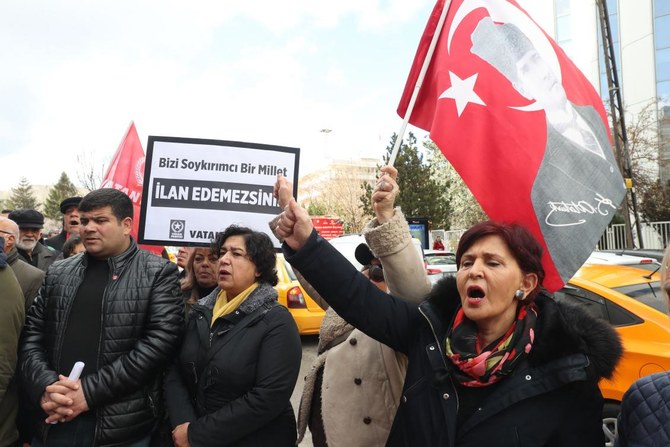
People demonstrate outside the US embassy, on December 13, 2019 in Ankara, one day after US congress formally recognized the 1915-1917 murder of up to 1.5 million Armenians as genocide. (AFP)
Short Url
Updated 13 December 2019
Follow

Turkey summons US envoy over Armenian genocide vote

  • Armenia claims 1.5 million died in the killings
  • US is now in line with 30 other countries in recognizing Armenia’s claim of genocide

ISTANBUL: Turkey summoned the US ambassador on Friday after the US Senate voted to recognize the 1915 killings of Armenians as genocide.

Deputy foreign minister Sedat Onal delivered the government’s reaction to envoy David Satterfield, said the foreign ministry, after Turkish officials warned that the vote endangered relations.

American senators followed the House of Representatives in voting to recognize the killings of Armenians during the First World War as genocide, for which the Ottoman Empire — the forerunner of modern-day Turkey — bore responsibility.

Armenia claims 1.5 million died in the killings. Turkey says the number of deaths was far lower and Turks also died, blaming the killings on the First World War.

The US is now in line with 30 other countries in recognizing Armenia’s claim of genocide.

A US embassy spokesman in Ankara however told AFP that the Senate vote had not changed the administration’s position, pointing out that US President Donald Trump had stopped short of calling the killings genocide earlier this year.

The Congress resolution had been blocked several times by allies of Trump, who has sought a close relationship with NATO ally Turkey and President Recep Tayyip Erdogan.

During a meeting in Washington last month, Trump said he was a “big fan” of Erdogan despite opposition from many in the Congress to the red-carpet welcome.


Women main victims of Sudan conflict abuses: minister to AFP

Updated 4 sec ago
Follow

Women main victims of Sudan conflict abuses: minister to AFP

  • Khalifa said sexual violence has been reported on both sides, but she insisted it is “systematic” among the RSF
  • Her ministry has documented more than 1,800 rapes between April 2023 and October 2025

PORT SUDAN: Women are the main victims of abuse in Sudan’s war, facing “the world’s worst” sexual violence and other crimes committed with impunity, a rights activist turned social affairs minister for the army-backed government told AFP.
The Sudanese army and the paramilitary Rapid Support Forces (RSF) have been locked in a brutal conflict since April 2023 that has killed tens of thousands of people, displaced around 11 million and been marked by widespread sexual violence.
Sulaima Ishaq Al-Khalifa said abuses against women routinely accompanied looting and attacks, with reports of rape often perpetrated as “the family witnessed” the crime.
“There is no age limit. A woman of 85 could be raped, a child of one year could be raped,” the trained psychologist told AFP at her home in Port Sudan.
The longtime women’s rights activist, recently appointed to the government, said that women were also being subjected to sexual slavery and trafficked to neighboring countries, alongside forced marriages arranged to avoid shame.
Khalifa said sexual violence has been reported on both sides, but she insisted it is “systematic” among the RSF, who she says use it “as a weapon of war” and for the purposes of “ethnic cleansing.”
Her ministry has documented more than 1,800 rapes between April 2023 and October 2025 — a figure that does not include atrocities documented in western Darfur and the neighboring Kordofan region from late October onwards.
“It’s about... humiliating people, forcing them to leave their houses and places and cities. And also breaking... the social fabrics,” Khalifa said.
“When you are using sexual violence as a weapon of war, that means you want to extend... the war forever,” because it feeds a “sense of revenge,” she added.

- ‘War crimes’ -

A report by the SIHA Network, an activist group that documents abuses against women in the Horn of Africa, found that more than three-quarters of recorded cases involved rape, with 87 percent attributed to the RSF.
The United Nations has repeatedly raised alarm over what it describes as targeted attacks on non?Arab communities in Darfur, while the International Criminal Court (ICC) has opened a formal investigation into “war crimes” by both sides.
Briefing the UN Security Council in mid-January, ICC deputy prosecutor Nazhat Shameem Khan said investigators had uncovered evidence of an “organized, calculated campaign” in El-Fasher — the army’s last stronghold in Darfur captured by the RSF in late October.
The campaign, Khan added, involved mass rapes and executions “on a massive scale,” sometimes “filmed and celebrated” by the perpetrators and “fueled by a sense of complete impunity.”
Darfur endured a brutal wave of atrocities in the early 2000s, and a former Janjaweed commander — from the militia structure that later evolved into the RSF — was recently found guilty by the International Criminal Court of multiple war crimes, including rape.
“What’s happening now is much more ugly. Because the mass rape thing is happening and documented,” said Khalifa.
RSF fighters carrying out the assaults “have been very proud about doing this and they don’t see it as a crime,” she added.
“You feel that they have a green light to do whatever they want.”
In Darfur, several survivors said RSF fighters “have been accusing them of being lesser people, like calling them ‘slaves’, and saying that when I’m attacking you, assaulting you sexually, I’m actually ‘honoring’ you, because I am more educated than you, or (of) more pure blood than you.”

- ‘Torture operation’ -

Women in Khartoum and Darfur, including El-Fasher, have described rapes carried out by a range of foreign nationals.
These were “mercenaries from West Africa, speaking French, including from Mali, Burkina Faso, Nigeria, Chad, as well as Colombia and Libya” — allegedly fighting alongside the RSF, Khalifa added.
Some victims were abducted and held as sexual slaves, while others were sold through trafficking networks operating across Sudan’s porous borders, said Khalifa.
Many of these cases remain difficult to document because of the collapse of state institutions.
In conservative communities, social stigma also remains a major obstacle to documenting the scale of the abuse.
Families often force victims into marriage to “cover up what happened,” particularly when pregnancies result from rape, according to the minister.
“We call it a torture operation,” she said, describing “frightening” cases in which children and adolescent girls under 18 are forced into marriage.