

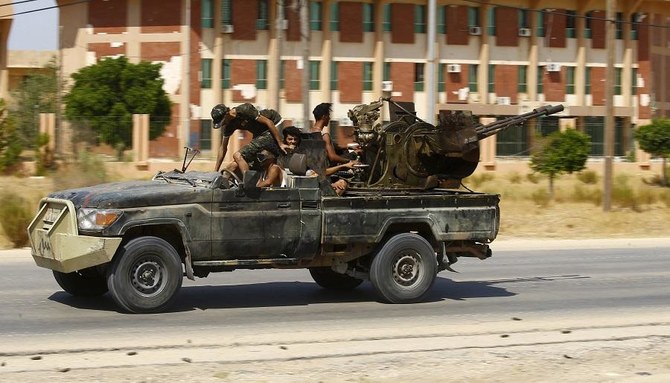

TRIPOLI: Libyan military strongman Khalifa Haftar announced a “decisive battle” for the capital Tripoli on Thursday, eight months after he launched an offensive to wrest it from the government.
“Zero hour has come for the broad and total assault expected by every free and honest Libyan,” he said in a speech aired by the Al-Hadath channel.
Dressed in military uniform, he announced “the decisive battle and the advance on the heart of Tripoli.” Now move forward, “each to his own goal,” he ordered his troops.
Since the fall and killing of longtime dictator Muammar Qaddafi in 2011 in a NATO-backed uprising, Libya has been torn apart by violence between multiple armed groups, many of them backed by foreign powers.
Haftar’s Libyan National Army, which controls much of the country’s east, launched an assault on April 4 to seize Tripoli from the Government of National Accord (GNA).
Haftar says the GNA is backed by “terrorist” groups.
FASTFACT
Since the fall and killing of longtime dictator Muammar Qaddafi in 2011 in a NATO-backed uprising, Libya has been torn apart by violence between multiple armed groups, many of them backed by foreign powers.
The GNA said that the situation was “under control” and that its troops were holding their positions in the capital’s south.
“We are ready to push back any more ... attempt by the Haftar putsch leader,” said GNA Interior Minister Fathi Bashagha on Libya Al-Ahrar television.
Haftar had foreseen a quick victory, but despite vowing in July that success was “imminent,” his forces have remained bogged down on the outskirts of the capital.
Prime Minister Fayez Sarraj called on Libyans to rally around him in the defense of the nation.
In a video posted on the Libyan government’s Facebook page, Sarraj dismissed Haftar’s claim about a new push as “lies” and “delusions” and said his forces have already “taught the invaders a lesson.”
“I call upon you to rally around the project of a civil state and to show faith in our right to build a state, based on institutions, the rule of law and liberties,” Sarraj said. “Libya can only end up as an oasis for freedom and democracy.”
The latest crisis comes amid heightened tension between the two warring sides after Sarraj’s government signed a security arrangement and maritime deal with Turkey last month.
Earlier this week, Turkish President Recep Tayyeb Erdogan said the agreement gives his country the right to send troops to Libya to fend off Hafter’s forces from Tripoli.
The head of the EU’s delegation for relations with Maghreb Countries, Andrea Cozzolino, said she was concerned about Hafter’s threats and warned that a new offensive would only lead “to more suffering for the Libyan civilian population, who have already paid a high price.”
At least 200 civilians and more than 2,000 fighters have been killed since the start of Haftar’s assault on Tripoli, according to the United Nations. The fighting has also displaced some 146,000 people.


