GUWAHATI: Internet access was cut in India’s northeastern city of Guwahati on Friday as thousands gathered for fresh protests against a new citizenship law, a day after police shot dead two demonstrators.
Protests erupted this week after the government introduced new legislation that many in the far-flung northeast believe will give citizenship to immigrants from neighboring Bangladesh, and which other critics say is anti-Muslim.
On Friday morning thousands gathered in central Guwahati as riot police looked on, with residents hurrying out to buy essentials.
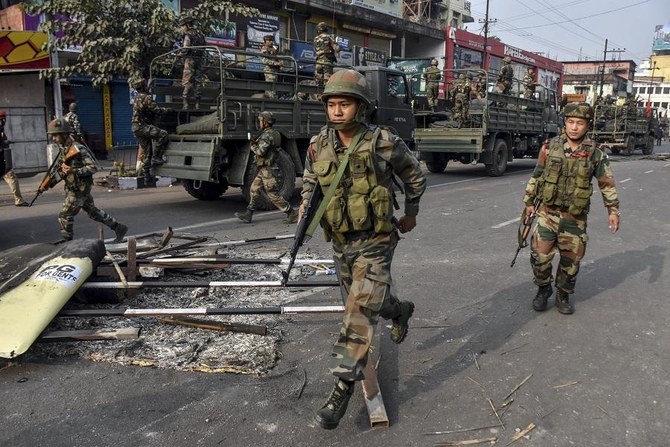
No fresh violence was reported but Guwahati and other areas remained littered from the detritus of recent days, with some roads blocked by fallen trees, concrete poles, stones and iron railings. Many cash machines have run out of cash and most petrol stations were also shut.
A local government official said that Internet access in the Guwahati, the main city of Assam state, had been cut and an AFP reporter confirmed that connections appeared to have been suspended.
The Meghalaya state government has also cut off mobile Internet, with parts of the capital Shillong brought under curfew since Thursday evening.
Japan’s Prime Minister Shinzo Abe was planning to scrap a visit to the city due to begin on Sunday as the security situation deteriorated, media reported Friday. The Japanese leader had been slated to hold talks with Prime Minister Narendra Modi.
On Thursday, police had fired live and blank rounds as thousands of demonstrators in Guwahati and elsewhere took to the streets, some vandalising property and torching vehicles.
The two demonstrators killed in the city were among around 20 people being treated in hospital, “a few” of whom had gunshot wounds, said Ramen Talukdar, a doctor at a Guwahati hospital.
Hundreds of passengers stuck at Guwahati airport were brought to the city on government buses with police escort in the early hours of Friday morning.
Several thousand troops have been drafted in to help police, who fired tear gas and charged demonstrators with batons, in recent days.
Security was increased at the Bangladeshi consulate in Guwahati after a vehicle in the consul’s convoy was attacked Wednesday by mobs, the foreign ministry in Dhaka said.
“They cant settle anyone in our motherland. This is unacceptable. We will die but not allow outsiders to settle here,” Manav Das, a protester told AFP on Friday.
“We will defeat the government with the force of the people and the government will be forced to revoke the law,” said local activist Samujal Battacharya.
The Citizenship Amendment Bill (CAB), signed into law by the Indian president late Thursday, allows for the fast-tracking of applications from religious minorities from three neighboring countries, but not Muslims.
For Islamic groups, the opposition and rights groups, it is part of Modi’s Hindu nationalist agenda to marginalize India’s 200 million Muslims. He denies this.
The US State Department on Thursday urged India to “protect the rights of its religious minorities,” according to Bloomberg.
But many in India’s northeast object for different reasons, fearing that immigrants from Bangladesh — many of them Hindus — will become citizens, taking jobs and weakening the local culture.
The chief ministers of the states of Punjab in the north and Kerala in the south also said that they would not implement the law, the Hindu daily reported.
str/stu/ecl


India shuts down Internet in hotspot after deadly protests
https://arab.news/wr2pm
India shuts down Internet in hotspot after deadly protests

- Protests erupted this week after the government introduced new legislation that many in the far-flung northeast believe will give citizenship to immigrants
- On Friday morning thousands gathered in central Guwahati as riot police looked on


Israeli court overturns conviction of officer who assaulted Palestinian journalist, citing ‘Oct. 7 PTSD’
- Judge sentenced Yitzhak Sofer to 300 hours of community service, saying officer “devoted his life to Israel’s security” and conviction was “disproportionate to severity of his actions”
- Footage shows Sofer throwing photojournalist Mustafa Alkharouf to the ground, and repeatedly beating and kicking him while he covered Palestinian gatherings near Al-Aqsa Mosque
LONDON: An Israeli court overturned the conviction of a border police officer who assaulted a Palestinian journalist, ruling his actions were influenced by post-traumatic stress disorder from serving during the Oct. 7 2023 attacks.
On Tuesday, the Jerusalem Magistrate’s Court sentenced officer Yitzhak Sofer to 300 hours of community service for assaulting Anadolu Agency photojournalist Mustafa Alkharouf in occupied East Jerusalem in December 2023.
Footage shows Sofer and other officers drawing weapons, throwing Alkharouf to the ground, and repeatedly beating and kicking him while he covered Palestinian gatherings near Al-Aqsa Mosque amid heavy restrictions.
Alkharouf was hospitalized with facial and body injuries. His cameraman, Faiz Abu Ramila, was also attacked.
Anadolu photojournalist Mustafa Alkharouf violently attacked by Israeli army in occupied East Jerusalem while covering Palestinian prayers near Al-Aqsa Mosque
— Anadolu English (@anadoluagency) December 15, 2023
Incident highlights ongoing restrictions on Friday prayers and press freedom in region https://t.co/exT6XqjEaA pic.twitter.com/pqugK9HnOt
Sofer had been convicted in September 2024 of assault causing bodily harm (acquitted of threats) and initially faced six months’ community service, as recommended by Mahash, the Justice Ministry’s police misconduct unit.
Judge Amir Shaked accepted the defense request to cancel the conviction, replacing it with community service.
He cited Sofer’s PTSD from responding to the Oct. 7 Hamas-led attack, noting the officer had “no prior criminal record” and had “devoted his life to Israel’s security.”
“The court cannot ignore this when considering whether the defendant’s conviction should stand,” he said, adding that while the incident is “serious and does cross the criminal threshold,” the conviction in place could cause Sofer harm “disproportionate to the severity of his actions.”
The ruling comes amid surging attacks on journalists in the West Bank, East Jerusalem and Gaza since Israel’s war on Gaza began.
The Committee to Protect Journalists reported Israel responsible for two-thirds of the 129 media workers killed worldwide in 2025, the deadliest year on record, citing a “persistent culture of impunity” and lack of transparent probes.
Reporters Without Borders called the Israeli army the “worst enemy of journalists” in its 2025 report, with nearly half of global reporter deaths in Gaza.
Foreign journalists face raids, arrests and intimidation. In late January 2026, Israel’s Supreme Court granted a delay on ruling a ban on foreign media access to Gaza.