

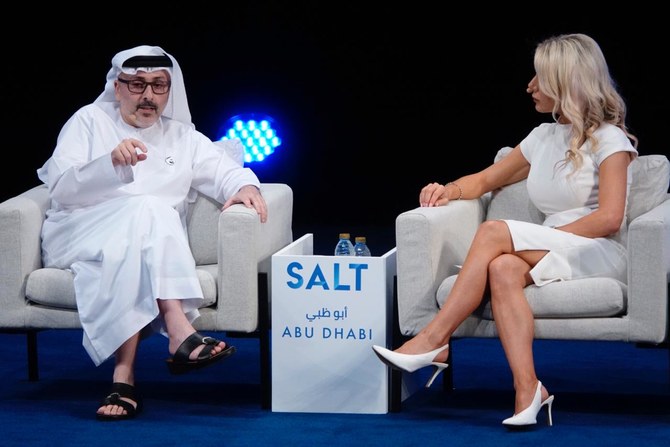

DUBAI: The next wave of value creation in the business world will not come from companies that develop artificial intelligence (AI), but from those that can innovatively deploy technology to transform industries, Waleed Al-Muhairi, deputy CEO of Mubadala Investment Co., said on Tuesday at the first Middle East SALT conference.
The two-day event is taking place in Abu Dhabi, and is run by former White House communications director Anthony Scaramucci.
It is hosting more than 1,000 leaders from the worlds of investment, finance and policymaking at the city’s financial hub, the Abu Dhabi Global Market.
Discussing Mubadala’s partnerships with China, the UAE’s largest trading partner, Al-Muhairi referred to billion-dollar investments in China’s private and public sectors.
“We have a wonderful partnership with China. We’ve established a $10 billion fund there with the China Development Bank, and have deployed almost $2 billion in 15 to 16 different sectors, with technology being the main theme,” he said.
Mubadala currently has $240 billion of assets under management, with close to $100 billion invested in the US (60 percent of the state-owned holding company’s portfolio).
The remaining 40 percent is divided “almost” equally between investments in the UAE, Europe and Asia, “with a heavy concentration in China,” said Al-Muhairi.
“But our objective is to participate in the growth and success of a large, growing and dynamic economy like China’s,” he said, adding that it is only a matter of time before the country becomes the “largest economy on Earth.”
On technology, Al-Muhairi cited Asia-focused private equity firm Hill House, which transformed a mid-level athletic footwear company in China to the No. 1 brand in the country through the deployment of AI.
The company applied the expertise of 50 scientists and engineers to revolutionize the manufacturing process of footwear, while subsequently improving the brand’s retail experience.
By placing censors on the shelves to detect customers’ interest in buying specific footwear, they were able to shorten the cycle of understanding customer feedback and preference, said Al-Muhairi.
“One of the mega trends you see around the world is that preferences matter. And those business that are able to curate a customized experience for customers are going to be the ones who succeed, especially in the retail industry,” he added.
While people often refer to technology as a “sector,” Al-Muhairi believes it is similar to the concept of “electricity” in that it empowers projects and is infused in everything we do today.
“We have to change the way we view technology,” he said, adding that while it is the “life-blood of any successful company” and the “single most important enabler,” it is not an objective in itself.
“We don’t invest in technology for the sake of technology. We invest in it because it will transform something or it will create value and a return,” he said.


