KARACHI: A senior member of Pakistan’s main opposition party said on Sunday the party would wait for a detailed court ruling before deciding on its plan of action with regards to legislation that would allow the government of Prime Minister Imran Khan to grant another term of office to the army chief.
Khan had said in August that he needed General Qamar Javed Bajwa to stay on for another three years because of ongoing security concerns, including heightened tensions with India over the disputed Kashmir region.
But last month, Pakistan’s Supreme Court suspended the extension, citing a series of irregularities and ordering the government and the army to produce legal provisions to support the reasoning behind the move.
After days of legal wrangling, the top court conditionally extended the army chief’s term on November 28 but ruled that the government had six months to justify why it granted the controversial extension and to clarify the section of Pakistan’s constitution governing the armed forces.
The ruling came as a short order. A full verdict is still awaited and has given rise to debate about whether the government would be able to grant the extension by passing an act of parliament or be required to push through a constitutional amendment, which requires a two-thirds majority in parliament.
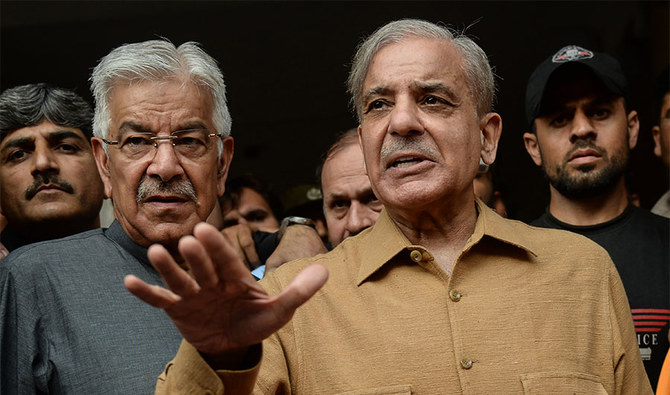
On Saturday, a group of Pakistan Muslim League-Nawaz (PMLN) leaders held a meeting with party president Shehbaz Sharif in London to discuss the party’s plan of action following the Supreme court’s order.
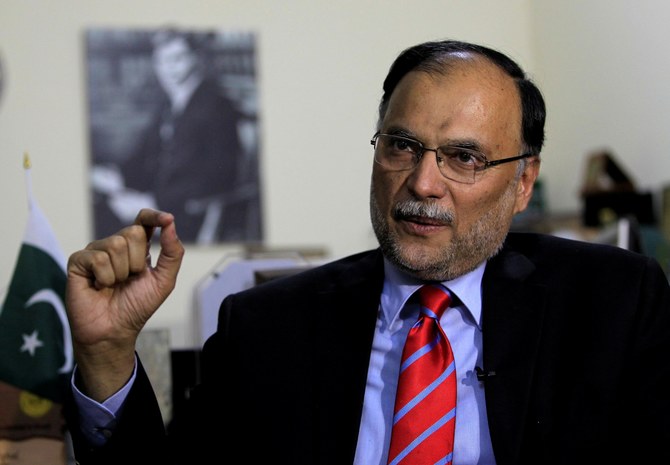
“The PML-N leadership [has] decided to wait for [the] detailed judgment of the Supreme Court and to consult other opposition parties for a joint opposition position on this issue,” PML-N Secretary General Ahsan Iqbal, who was part of the huddle, told Arab News.
PML-N senator Mushahidullah Khan said he believed the Supreme Court’s detailed judgment would make it clear that the Pakistan Tehreek-e-Insaf (PTI) government was required to pass a constitutional amendment rather than simply an act of parliament.
“In the case of the constitutional amendment, the PTI will not be in a position to pass the bill as it requires two-thirds majority from both houses of the parliament,” Khan said. Even in the case of an act, he said the ruling party lacked simple majority in the upper house, or Senate.
Hassaan Sabir, a Karachi based constitutional lawyer, also said the PTI government lacked the required strength to amend the constitution without the support of the opposition.
“If the government fails to get a two-thirds majority in any of the houses... the amendment will fail,” he said, adding that opposition support in the Senate would be necessary even to pass a simple act.
Meanwhile, participants of the London meeting also paid a visit to PML-N party supremo Nawaz Sharif at his London apartment.
Sharif is in the UK for medical treatment after getting bail in a corruption conviction for which he was serving seven years in a Pakistani jail.
PML-N party chairman Raja Zafrul Haq said it was highly likely that Sharif would have to be taken to the US for treatment.


![]()
![]()

PMLN awaits full court ruling before moving on legislation for army chief extension
PMLN awaits full court ruling before moving on legislation for army chief extension
- In short order last month, Supreme Court gave the government six months to legally justify a three-year extension
- Ruling has given rise to debate about whether the government needs to pass an act of parliament or a constitutional amendment
Latest updates


© 2026 SAUDI RESEARCH & PUBLISHING COMPANY, All Rights Reserved And subject to Terms of Use Agreement.