

US, Taliban to continue peace talks on Sunday

1 / 2
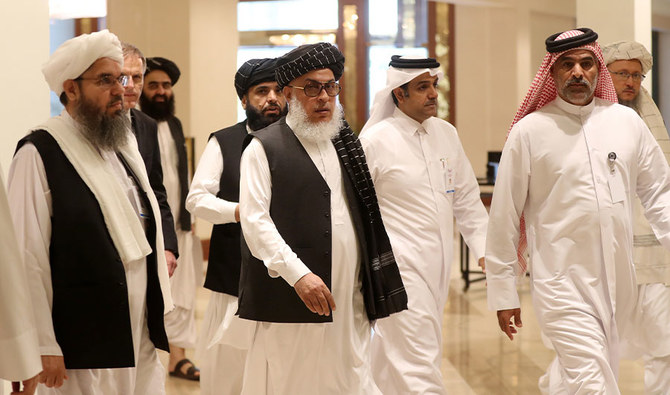
The Taliban's former envoy to Saudi Arabia Shahabuddin Delawar (L) arrives with Taliban Qatar spokesman Suhail Shaheen (C, behind) and Taliban negotiator Abbas Stanikzai (C, front) to attend the Intra Afghan Dialogue talks in the Qatari capital Doha on July 7, 2019. (AFP)
2 / 2
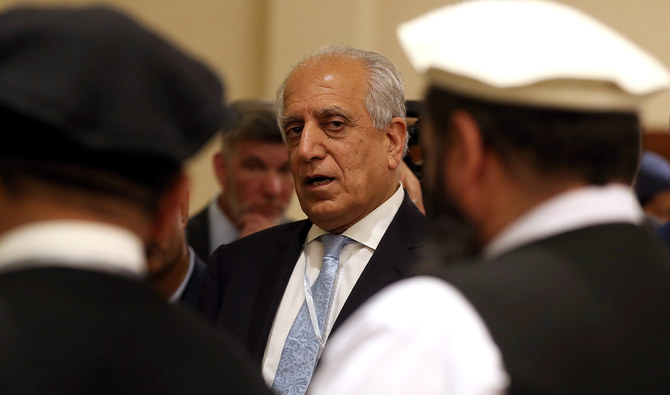
US Special Representative for Afghanistan Reconciliation Zalmay Khalilzad attends the Intra Afghan Dialogue talks in the Qatari capital Doha on July 8, 2019. (AFP)
Updated 08 December 2019
Follow

US, Taliban to continue peace talks on Sunday

  • Focus of resurrected talks to be intra-Afghan dialogue and a cease-fire – US official
  • Anas Haqqani who was just freed in a prisoner swap has joined Taliban negotiating team, spokesman tweeted

ISLAMABAD: The Taliban and the United States will continue their peace talks in Qatar on Sunday, as they try to resolve the protracted conflict in Afghanistan through a negotiated settlement.

The two sides restarted formal peace negotiations on Saturday, the first such initiative after President Donald Trump’s decision to call off talks in early September, an American official privy to the developments, told Arab News.
Trump’s earlier decision to halt talks came in reaction to the deaths of 12 people, including a US soldier, in a Taliban-induced bomb attack in Kabul.
“The US rejoined talks today in Doha. The focus of the discussions will be reduction of violence that leads to intra-Afghan negotiations and a cease-fire,” the official said.
In a Twitter post, Taliban spokesman Suhail Shaheen also confirmed the resumption of talks and said they would continue on Sunday.
"The talks started from where they were stopped. We discussed signing of the agreement. Talks will continue tomorrow (Sunday),” Shaheen tweeted.
Shaheen also said Mullah Abdul Ghani Baradar, head of the Taliban political office, led the Taliban side during negotiations.
In a separate tweet, Shaheen said Anas Haqqani, who was among the three Taliban leaders freed in a high profile prisoner swap earlier this month, had also joined talks as a member of the Taliban negotiating team. 
The peace talks, which began last year, aimed at striking a deal with the Taliban to allow the 18 year war in Afghanistan to end. This would involve the withdrawal of US and foreign troops from Afghanistan in exchange for the insurgents’ guarantee of a cease-fire and that they would not use Afghanistan to launch attacks on other countries.
Earlier on Wednesday, the State Department had said that US Special Representative for Afghanistan Reconciliation, Ambassador Zalmay Khalilzad, would be discussing next steps with the Taliban for intra-Afghan negotiations and “a peaceful settlement of the war, specifically a reduction in violence that leads to a cease-fire.”
A day later, Taliban spokesman Suhail Shaheen told Arab News that formal peace negotiations would resume with the US in a few days.
This followed Khalilzad’s meetings with Afghan leaders, including President Ashraf Ghani, Chief Executive Dr. Abdullah Abdullah and several political leaders in Kabul on Thursday.
On Wednesday, the presidential palace issued a statement saying that the meeting would focus on “the cease-fire and Taliban hideouts outside the 
President Ghani told Khalilzad that both issues should be taken seriously in order to take the peace process forward.
The Taliban and the US had finalized the peace agreement in August – at the conclusion of the ninth round of talks –but the signing of the deal was blocked after Trump’s abrupt decision to call off negotiations.


Pakistan reviews austerity measures amid Middle East crisis, urges strict nationwide implementation

Updated 11 March 2026
Follow

Pakistan reviews austerity measures amid Middle East crisis, urges strict nationwide implementation

  • Deputy Prime Minister Ishaq Dar chairs review meeting of austerity steps
  • Officials briefed on salary cuts, school closures, four‑day week, petrol conservation

ISLAMABAD: Pakistan’s government on Wednesday assessed progress on a sweeping set of austerity measures introduced to mitigate the country’s economic strain from sharply rising global oil prices and supply disruptions linked to the ongoing war in the Middle East.

Prime Minister Shehbaz Sharif this week announced a series of austerity steps, including a four‑day work week for government offices, requiring 50  percent of staff to work from home, cutting fuel allowances for official vehicles by half, grounding up to 60  percent of the government fleet and closing all schools for two weeks to conserve fuel amid the global oil crisis.

The measures were unveiled in response to global oil market volatility triggered by the conflict involving the United States, Israel and Iran, which has disrupted supply routes such as the Strait of Hormuz and pushed crude prices sharply higher, straining Pakistan’s heavily import‑dependent energy sector.

“The meeting stressed the importance of strict and transparent adherence to the austerity measures, promoting fiscal responsibility and prudent use of public resources,” Deputy Prime Minister and Foreign Minister Senator Mohammad Ishaq Dar said in a statement.

He was chairing a meeting of the Committee for Monitoring and Implementation of Conservation and Additional Austerity Measures, constituted under the directions of the PM, bringing together federal and provincial officials to review execution of the broad cost‑cutting plan. 

Dar emphasized the government’s commitment to enforcing the PM’s austerity steps nationwide. The committee’s review also covered reductions in departmental expenditure, deductions from salaries of senior officials earning over Rs. 300,000 ($1,120), and coordination with provincial administrations to ensure uniform implementation of the plan.

Participants at the meeting reiterated that all ministries and divisions must continue strict monitoring and reporting, with transparent oversight mechanisms, as Pakistan navigates the economic pressures from the prolonged Middle East crisis and its fallout on global energy and trade markets.
