

Activist-athlete boosts image of Balochistan

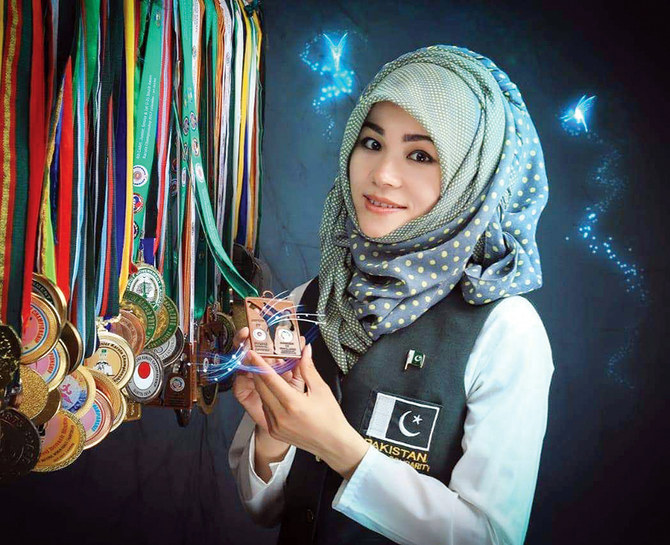
Defying tall odds, Shahida Abbasi becomes second woman athlete to win a gold medal for Pakistan. (Photo/Supplied)
Updated 04 December 2019
Follow

Activist-athlete boosts image of Balochistan

  • There is more to our Hazara town than just bomb blasts, Shahida Abbasi says
  • She credits her father for her win

KARACHI: As Pakistan’s second woman athlete to win a gold medal in karate at the South Asian Games in Nepal, Shahida Abbasi knows how to pack a punch.

That, however, is half the battle won she says.

True glory, she adds, lies in the fact that her town in Balochistan — which until recently was in the news for bomb blasts and target killings — has now become a source of pride for the country.

“When I started karate a few years ago, there would be regular blasts in the Hazara town of Quetta. Now, the town which was in the news for blasts and target killings is being celebrated for its achievements in sports,” Abbasi, 24, told Arab News during a phone interview from Katmandu, the venue for the prestigious games which began on Sunday and end on Dec. 10.

Pakistan won two gold, three silver and four bronze medals, with Abbasi bringing home the trophy in the women’s single karate category. 

“I am happy that I’m a source of pride for my country, my city, my town and my parents,” she said.

First launched in 1984, the South Asian Games, formerly known as the South Asian Federation Games, is a biennial multi-sporting event which sees participation from seven countries — Bangladesh, Bhutan, India, the Maldives, Nepal, Pakistan and Sri Lanka.

Nepal is leading in the games with 15 gold medals, followed by Sri Lanka and India with three gold medals each. Bangladesh came a close third with two gold medals, while Bhutan and Maldives have yet to win a gold. “I am very happy that I was the first from Pakistan to play and gave my country a good start with a gold medal,” Abbasi said, adding that the bouquets she has earned have not been without their share of brickbats.

“When I would go to the academy for learning karate, the boys in my neighborhood would taunt me. I wouldn’t respond but continued my journey with all positivity. Today, I gave them the answer with my performance,” she said.

Abbasi started learning karate in 2004, going on to win national and international medals for her Hazara Club in Quetta and the country.

She credits her father for her win. “'Martial arts is not for girls,’ our neighbors would say. But my father, my main supporter, continued to push me and today I made him proud.”

The second of four sisters, Abbasi said that she called her father in Quetta to tell him that she had won. “But he already knew it! He was very happy and said he’s proud of me,” she said.

Another driving factor for Abbasi to go for gold was to change people’s perception of Balochistan. She said it is considered a backward province but has immense talent and potential. “Give the people of Balochistan a chance, be it in education, sports or any other field, they will prove themselves.”

Muhammad Shah, Abbasi’s coach, praised her “outstanding performance.” 

“She has played better than our expectations,” Shah told Arab News, adding that with support from the government, the athletes can do even better.

“If the government arranges for us around two months training camp, the medals can be doubled. All of my athletes were excellent. However, Shahida Abbasi was brilliant,” Shah said.

Asked if she had a message for other girls her age, Abbasi said: “Have self-respect and self-confidence. With these two things you can outshine in any field.”


Terror at Friday prayers: Witnesses describe blast rocking Islamabad mosque

Updated 2 sec ago
Follow

Terror at Friday prayers: Witnesses describe blast rocking Islamabad mosque

  • The Daesh group has claimed responsibility for the attack, according to the SITE Intelligence Group, which monitors jihadist communications
ISLAMABAD: A worshipper at the Shiite mosque in Islamabad where dozens of people were killed in a suicide blast on Friday described an “extremely powerful” explosion ripping through the building just after prayers started.
Muhammad Kazim, 52, told AFP he arrived at the Imam Bargah Qasr-e-Khadijatul Kubra mosque shortly after 1:00 p.m. (0800 GMT) on Friday and took up a place around seven or eight rows from the Imam.
“During the first bow of the Namaz (prayer ritual), we heard gunfire,” he told AFP outside the Pakistan Institute of Medical Sciences (PIMS) hospital, where many of the wounded were brought for treatment.
“And while we were still in the bowing position, an explosion occurred,” he said.
Kazim, who is from Gilgit-Baltistan in northern Pakistan and lives in Islamabad, escaped unharmed, but accompanied his wounded friend to the PIMS hospital for treatment.
“It was unclear whether it was a suicide bombing, but the explosion was extremely powerful and caused numerous casualties,” Kazim said.
“Debris fell from the roof, and windows were shattered,” he added. “When I got outside, many bodies were scattered... Many people lost their lives.”
The Daesh group has claimed responsibility for the attack, according to the SITE Intelligence Group, which monitors jihadist communications.
Another worshipper, Imran Mahmood, described a gunfight between the suicide bomber, a possible accomplice and volunteer security personnel at the mosque.
“The suicide attacker was trying to move forward, but one of our injured volunteers fired at him from behind, hitting him in the thigh,” Mahmood, in his fifties, told AFP.
“He fell but got up again. Another man accompanying him opened fire on our volunteers,” he said, adding the attacker “then jumped onto the gate and detonated the explosives.”
As of Saturday morning, the death toll stood at 31, with at least 169 wounded.
The attack was the deadliest in the Pakistani capital since September 2008, when 60 people were killed in a suicide truck bomb blast that destroyed part of the five-star Marriott hotel.

Lax security

Describing the aftermath of the attack, Kazim said unhurt worshippers went to the aid of those wounded.
“People tried to help on their own, carrying two or three bodies in the trunks of their vehicles, while ambulances arrived about 20 to 25 minutes later,” he told AFP.
“No one was allowed near the mosque afterwards.”
Kazim, who has performed Friday prayers at the mosque “for the past three to four weeks,” said security had been lax.
“I have never seen proper security in place,” he told AFP.
“Volunteers manage security on their own, but they lack the necessary equipment to do it effectively,” he said.
“Shiite mosques are always under threat, and the government should take this seriously and provide adequate security,” he added.