Activist-athlete boosts image of Balochistan

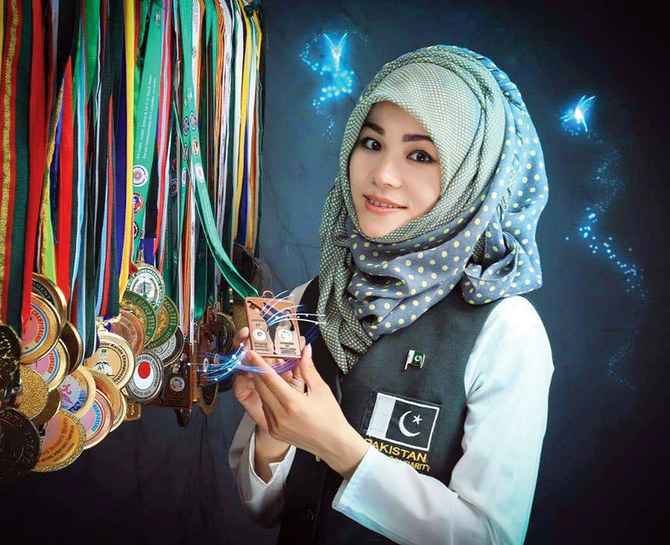
Defying tall odds, Shahida Abbasi becomes second woman athlete to win a gold medal for Pakistan. (Photo/Supplied)
Updated 04 December 2019
Follow

Activist-athlete boosts image of Balochistan

  • There is more to our Hazara town than just bomb blasts, Shahida Abbasi says

KARACHI: As Pakistan’s second woman athlete to win a gold medal in karate at the South Asian Games in Nepal, Shahida Abbasi knows how to pack a punch.

That, however, is half the battle won she says.

True glory, she adds, lies in the fact that her town in Balochistan — which until recently was in the news for bomb blasts and target killings — has now become a source of pride for the country.

“When I started karate a few years ago, there would be regular blasts in the Hazara town of Quetta. Now, the town which was in the news for blasts and target killings is being celebrated for its achievements in sports,” Abbasi, 24, told Arab News during a phone interview from Katmandu, the venue for the prestigious games which began on Sunday and end on Dec. 10.

Pakistan won two gold, three silver and four bronze medals, with Abbasi bringing home the trophy in the women’s single karate category. 

“I am happy that I’m a source of pride for my country, my city, my town and my parents,” she said.

First launched in 1984, the South Asian Games, formerly known as the South Asian Federation Games, is a biennial multi-sporting event which sees participation from seven countries — Bangladesh, Bhutan, India, the Maldives, Nepal, Pakistan and Sri Lanka.

Nepal is leading in the games with 15 gold medals, followed by Sri Lanka and India with three gold medals each. Bangladesh came a close third with two gold medals, while Bhutan and Maldives have yet to win a gold. “I am very happy that I was the first from Pakistan to play and gave my country a good start with a gold medal,” Abbasi said, adding that the bouquets she has earned have not been without their share of brickbats.

“When I would go to the academy for learning karate, the boys in my neighborhood would taunt me. I wouldn’t respond but continued my journey with all positivity. Today, I gave them the answer with my performance,” she said.

Abbasi started learning karate in 2004, going on to win national and international medals for her Hazara Club in Quetta and the country.

She credits her father for her win. “'Martial arts is not for girls,’ our neighbors would say. But my father, my main supporter, continued to push me and today I made him proud.”

The second of four sisters, Abbasi said that she called her father in Quetta to tell him that she had won. “But he already knew it! He was very happy and said he’s proud of me,” she said.

Another driving factor for Abbasi to go for gold was to change people’s perception of Balochistan. She said it is considered a backward province but has immense talent and potential. “Give the people of Balochistan a chance, be it in education, sports or any other field, they will prove themselves.”

Muhammad Shah, Abbasi’s coach, praised her “outstanding performance.” 

“She has played better than our expectations,” Shah told Arab News, adding that with support from the government, the athletes can do even better.

“If the government arranges for us around two months training camp, the medals can be doubled. All of my athletes were excellent. However, Shahida Abbasi was brilliant,” Shah said.

Asked if she had a message for other girls her age, Abbasi said: “Have self-respect and self-confidence. With these two things you can outshine in any field.”


China to support ‘reunification forces’ in Taiwan, go after ‘separatists’

Updated 2 sec ago
Follow

China to support ‘reunification forces’ in Taiwan, go after ‘separatists’

BEIJING: China will offer firm support for “patriotic pro-reunification forces” in ​Taiwan and strike hard against “separatists,” the top Chinese official in charge of policy toward the democratically-governed island said in comments published on Tuesday.
China, which views Taiwan as its own territory despite the objections of the government in Taipei, has ramped up its military and political pressure against the island as Beijing seeks to assert its sovereignty claims.
Addressing this year’s annual “Taiwan Work Conference,” the ruling communist party’s fourth-ranked leader Wang Huning said officials must advance the “great cause of national reunification,” the official state-run Xinhua ‌news agency said.
It ‌is necessary to “firmly support the patriotic pro-unification forces ‌on ⁠the ​island, resolutely ‌strike against ‘Taiwan independence’ separatist forces, oppose interference by external forces, and safeguard peace and stability in the Taiwan Strait,” Xinhua paraphrased him as saying.
The Beijing meeting was also attended by Foreign Minister Wang Yi, underscoring how China sees Taiwan as an issue it needs to promote on the international stage.
China has long offered Taiwan a Hong Kong-style “one country, two systems” model of autonomy, though no major Taiwanese political party supports that.
Taiwan’s government ⁠says Beijing’s rule in the former British colony has only brought repression, with Taiwan President Lai Ching-te on Tuesday ‌citing the sentencing of
Hong Kong tycoon Jimmy Lai
to ‍20 years prison the previous ‍day.
“Jimmy Lai’s sentencing exposes the Hong Kong national security law for what it ‍is — a tool of political persecution under China’s ‘one country, two systems’ that tramples human rights & freedom of press,” Lai wrote on X.
There was no immediate response to Wang Huning’s comments from Taiwan’s government, which says only the island’s people can decide their future.
Beijing has repeatedly warned ​other countries including the US against meddling in Taiwan issue, which it said is its internal affair.
In a call with US President Donald ⁠Trump last week, China’s President Xi Jinping said the Taiwan issue is the most important issue in China-US relations and Washington must handle the issue of arms sales to Taiwan with prudence.
China refuses to speak to Taiwan’s president and has rebuffed his repeated offers of talks, saying he is a “separatist” who must accept that Taiwan is part of China.
Wang was speaking just a week after meeting a delegation from Taiwan’s largest opposition party, the Kuomintang (KMT), who were in Beijing for a meeting of party think-tanks.
Speaking to reporters earlier on Tuesday in Taipei, KMT Vice Chairman Hsiao Hsu-tsen, who led the delegation to Beijing, said there had been no discussion of political issues when ‌they met Wang, as the trip there was to discuss topics like tourism and AI.