Putin, Xi launch ‘historic’ Russian gas pipeline to China

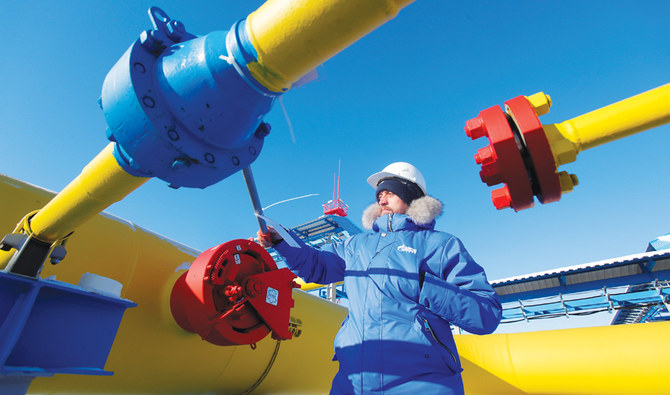
An employee checks a gas valve at a compressor station, a part of Gazprom’s Power Of Siberia gas pipeline, outside the far eastern town of Svobodny, Russia. (Reuters)
Updated 02 December 2019
Follow

Putin, Xi launch ‘historic’ Russian gas pipeline to China

  • The project is aimed at cementing Moscow’s role as the world’s top gas exporter

MOSCOW: Russia and China on Monday launched a giant gas pipeline linking the countries for the first time, one of three major projects aimed at cementing Moscow’s role as the world’s top gas exporter.

Presiding by video linkup over an elaborate televised ceremony, Russian leader Vladimir Putin and Chinese counterpart Xi Jinping hailed the “Power of Siberia” pipeline as a symbol of cooperation.

“Today is remarkable, a truly historic event not only for the global energy market, but first of all for us and for you, for Russia and China,” Putin said.

Xi said the project served as a model of cooperation.

“China-Russia relations are entering a new era,” Xi said. “Everyone worked hard.”The ceremony featured hard-hatted gas workers and videos showing the pipeline’s difficult path from remote areas of eastern Siberia to Blagoveshchensk on the Chinese border.

Workers burst into applause and celebratory music played as the CEO of Russian gas giant Gazprom, Alexei Miller, speaking from the Amur region, ordered a valve opened for the gas to flow across the border.

The 3,000-km pipeline — which Putin has called “the world’s biggest construction project” — will supply China with 38 billion cubic meters of gas annually when fully operational in 2025.

Russia and China signed the 30-year, $400 billion construction deal in 2014 — Gazprom’s biggest ever contract.

The pipeline is part of Russia efforts to develop ties with Asia — in particular top energy importer China — amid longstanding tensions with the West.

Gazprom stressed that the pipeline ran through “swampy, mountainous, seismically active, permafrost and rocky areas with extreme environmental conditions.”

Temperatures along the route plunge to below -60 C in Yakutia and below -40 C in the Russian Far East’s Amur Region.

Work has also been completed on the first road bridge between Russia and China, further linking the two neighbors.

The bridge, which is to open next year, will connect the city of Blagoveshchensk and the northern Chinese city of Heihe.

Moscow, however, remains a key gas provider to Europe and is also planning to soon launch two more pipelines that will ramp up supplies to the continent while bypassing Ukraine — TurkStream and Nord Stream 2.

Analysts said the three projects have long-term economic and political benefits for Russia, which has inserted itself between European markets to the west and the rapidly growing Chinese market to the east.

“Russia is not only creating new income streams, but hedging its bets and bolstering its position strategically,” said energy analyst Andrew Hill.

“The ability to play one off against the other will not have been lost on either Gazprom or the Kremlin,” Hill, who leads the S&P Global Platts EMEA gas and power analytics team, wrote in a blog.


Closing Bell: Saudi main market closes the week in red at 10,526 

Updated 14 sec ago
Follow

Closing Bell: Saudi main market closes the week in red at 10,526 

RIYADH: Saudi equities ended Thursday’s session modestly lower, with the Tadawul All Share Index slipping 14.63 points, or 0.14 percent, to close at 10,526.09.    

The MSCI Tadawul 30 Index also declined 3.66 points, or 0.26 percent, to 1,389.66. In contrast, the parallel market outperformed, as Nomu jumped 237.72 points, or 1.02 percent, to close at 23,430.93.  

Market breadth on the main market remained tilted to the downside, with 156 stocks ending lower against 99 gainers.    

Trading activity eased further, with volumes reaching 80.46 million shares and total traded value amounting to SR1.66 billion ($442 million).    

On the movers’ board, Saudi Industrial Export Co. led the gainers, rising 6.6 percent to SR2.10, followed by Consolidated Grunenfelder Saady Holding Co., which advanced 6.43 percent to SR9.60.    

Raoom Trading Co. climbed 4.36 percent to SR61.05, while Astra Industrial Group gained 4.35 percent to close at SR139. Riyadh Cables Group Co. added 3.77 percent to end the session at SR135.00.    

On the downside, Methanol Chemicals Co. topped the losers’ list, falling 5.96 percent to SR7.41.  

Flynas Co. retreated 5.43 percent to SR61.00, while Leejam Sports Co. dropped 5 percent to close at SR100.80.    

Alramz Real Estate Co. slipped 4.64 percent to SR55.50, and Almasane Alkobra Mining Co. declined 4.55 percent to SR84.00.  

On the announcement front, ACWA Power said it has completed the financial close for the Ras Mohaisen First Water Desalination Co., a reverse osmosis desalination project with a capacity of up to 300,000 cubic meters per day, alongside associated potable water storage facilities totaling 600,000 cubic meters in Saudi Arabia’s Western Province.    

The project was financed through a consortium of local and international banks, with total funding of SR2.07 billion and a tenor of up to 29.5 years, while ACWA Power holds an effective 45 percent equity stake.  

Shares of ACWA Power ended the session at SR185.90, up SR0.2, or 0.11 percent.     

Meanwhile, Consolidated Grunenfelder Saady Holding Co. announced the sign-off of a customized solutions project with Saudi Aramco Nabors Drilling Co., valued at SR166.0 million excluding VAT.    

The 24-month contract covers the sale and maintenance of field camp facilities, with the financial impact expected to begin from the first quarter of 2026.