

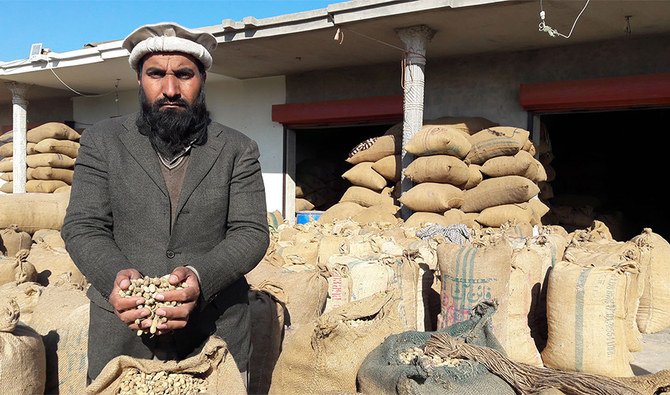

ISLAMABAD: Pakistani peanut farmers are raking in big profits, as demand has increased manifold with the onset of winter and supply remains disrupted by bans on import from India.
Feroze Khan, 54, a peanut grower in Chakwal district, Punjab province, has sold his harvest from merely 10 acres of land for Rs950,000 ($6,133) in the local market.
“We are getting good rates for our produce after almost a decade,” he told Arab News on Sunday. “Peanut is a cash crop for us and helps bear all our necessary expenses during the year.”
He said he is planning to send his eldest son to Australia for education, thanks to a good amount of money earned from the crop. “We solely depend on our agricultural produce, and plan marriages and education of our children, and other necessary expenses accordingly,” he added.
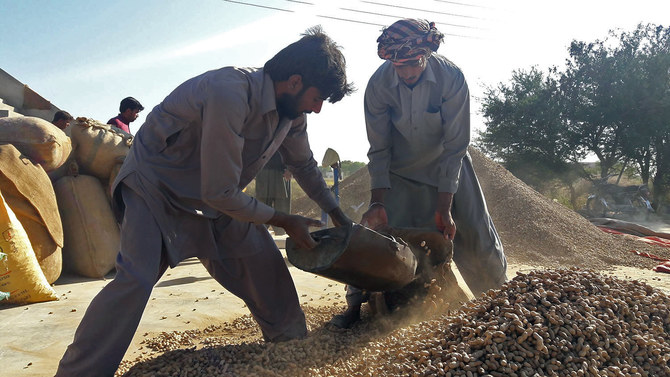
Laborers fill sacks with peanuts at a grain market in Chakwal district, Punjab province on Dec. 1, 2019. (AN photo by Aamir Saeed)
Wholesale dealers are now buying the dry fruit from farmers at Rs6,500 ($42) to Rs7,000 ($46) per 40 kilograms and then sell it for between Rs10,000 ($65) and Rs14,000 ($91), depending on the variety. In previous years, the rate never went beyond Rs3,500 ($22), which growers and dealers say was due to huge and cheap peanut imports from neighboring India.
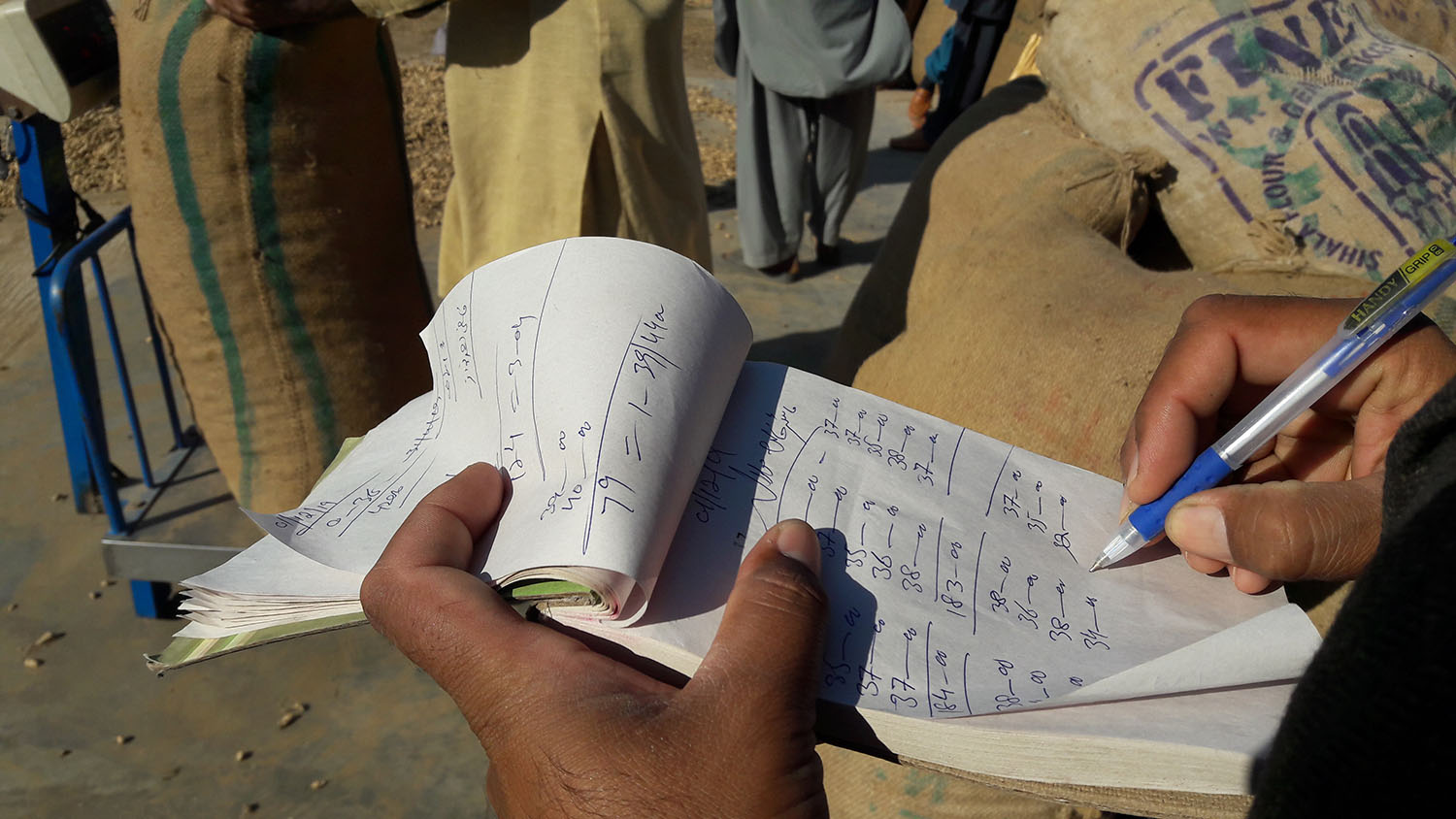
Muhammad Imran makes notes in his cash memo. (AN photo by Aamir Saeed)
The harvesting season begins in early November and runs through the second week of December.
Pakistan suspended its bilateral trade with India in August in response to New Delhi’s attempted annexation of the disputed territory of Kashmir. The move has resulted in a shortage and sharp upsurge of various vegetables, fruits and dry fruits, including the peanut.
Pakistan produces peanuts mainly in its rain-fed districts of Chakwal, Jhelum, Attock and Rawalpindi. The dry fruit is eaten roasted in the winter, and is used in different confectionery items and traditional dishes.

Peanuts are spread open to dry under the sun at the Chakwal market. (AN photo by Aamir Saeed)
The area under groundnut crop is 81,500 hectares with annual production of 91,400 tons, according to the Pakistan Agricultural Research Council (PARC). It is a very important source of oil and protein. Peanut oil, which contains about 22 percent of linoleic acid and 61 percent of oleic acid, and is considered one of the best vegetable oils for human consumption.
Ashiq Hussain, a wholesale dealer of the peanut in Chakwal, said he was unable to meet demand from his domestic customers amid the current shortage.
“The farmers are earning huge profits this year, and it is also good for our national economy,” he told Arab News on Monday. “The import of peanut kernel from India used to damage our growers’ profits and the local economy, but this year the trend is different.”
Hussain said that Pakistani peanut is exported in a “very limited” quantity to Middle Eastern countries, including Saudi Arabia and United Arab Emirates due to its low quality. “We have to improve the quality of our peanut kernel to earn foreign exchange,” he said.
Peanut farmers have demanded that the government fix the rate of their produce to ensure a good income for them, and provide quality seed that is resistant to extreme weather conditions. Currently, groundnut seed is not produced commercially. The PARC produces a limited quantity of pure seed of improved varieties, but its timely distribution to growers remains a challenge.
“We have been cultivating the same peanut seed at least for the last 50 years,” Durez Khan, a peanut grower in Chakwal, told Arab News on Sunday, “and that’s why our per acre yield is very low compared with countries like China and the US.”


