

Renault-Nissan to reboot alliance

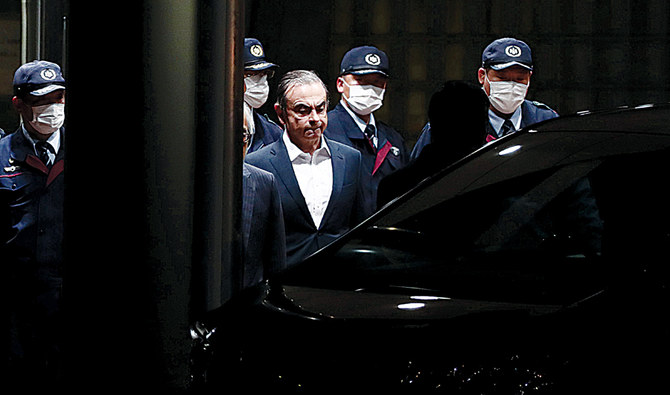
Former Nissan boss Carlos Ghosn leaves jail after being granted bail in April. (AFP)
Updated 29 November 2019
Follow

Renault-Nissan to reboot alliance

  • French carmaker sets out to repair relations following arrest of former chairman Carlos Ghosn

PARIS: Renault, Nissan and Mitsubishi plan to appoint a general secretary at the helm of their partnership to boost cooperation and reboot joint operations after the departure of former alliance supremo Carlos Ghosn.

France’s Renault is trying to repair relations with its Japanese partners after they were shaken by Ghosn’s arrest in Tokyo a year ago on financial misconduct charges, which the alliance’s founder denies.

The scandal disrupted efforts to roll out industrial projects together and find cost savings — increasingly vital as global auto demand falters — as Renault and Nissan shook up their teams in an effort to stabilize their business.

“This alliance executive will be key for coordinating and facilitating several major alliance projects that are to be launched to accelerate business efficiencies for the respective companies,” the groups said in a joint statement.

A source close to Renault said the future general secretary had already been recruited, describing him as francophone, but declined to give more details.

The new head of the three-pronged partnership will report to the Alliance Operating Board and the group CEOs in a departure from the structure in which Ghosn was an all-powerful figure.

Set up in April, the new Alliance Operating Board is a key element of a revamped corporate governance structure set in motion by Renault and alliance president Jean-Dominique Senard, who arrived at the French carmaker in January.

The Alliance Operating Board alternates its monthly meetings between France and Japan.

A source at Renault said that a future common platform for electric vehicles will be one of the alliance board’s key targets.

Renault is also looking for a new CEO. Financial chief Clotilde Delbos has taken on the job on an interim basis.


European gas prices soar almost 50% as Iran conflict halts Qatar LNG output

Updated 6 sec ago
Follow

European gas prices soar almost 50% as Iran conflict halts Qatar LNG output

  • Analysts warn prolonged disruption could push prices higher
  • Some shipments of oil, LNG through Strait of Hormuz suspended
  • Benchmark Asian LNG price up almost 39 percent

LONDON: ​Benchmark Dutch and British wholesale gas prices soared by almost 50 percent on Monday, after major liquefied natural gas exporter Qatar Energy said it had halted production due to attacks in the Middle East.

Qatar, soon to cement its role as the world’s second largest LNG exporter after the US, plays a major role in balancing both Asian and European markets’ demand of LNG.

Most tanker owners, oil majors and ‌trading houses ‌have suspended crude oil, fuel and liquefied natural ​gas shipments ‌via ⁠the ​Strait of ⁠Hormuz, trade sources said, after Tehran warned ships against moving through the waterway.

Europe has increased imports of LNG over the past few years as it seeks to phase out Russian gas following Russia’s invasion of Ukraine.

Around 20 percent of the world’s LNG transits through the Strait of Hormuz and a prolonged suspension or full closure would increase global competition for other ⁠sources of the gas, driving up prices internationally.

“Disruptions to ‌LNG flows would reignite competition between ‌Asia and Europe for available cargoes,” said ​Massimo Di Odoardo, vice president, gas ‌and LNG research at Wood Mackenzie.

The Dutch front-month contract at the ‌TTF hub, seen as a benchmark price for Europe, was up €14.56 at €46.52 per megawatt hour, or around $15.92/mmBtu, by 12:55 p.m. GMT, ICE data showed.

Prices were already some 25 percent higher earlier in the day but extended gains ‌after QatarEnergy’s production halt.

Benchmark Asian LNG prices jumped almost 39 percent on Monday morning with the S&P Global ⁠Energy Japan-Korea-Marker, widely used ⁠as an Asian LNG benchmark, at $15.068 per million British thermal units, Platts data showed.

“If LNG/gas markets start to price in an extended period of losses to Qatari LNG supply, TTF could potentially spike to 80-100 euros/MWh ($28-35/mmBtu),” Warren Patterson, head of commodities strategy at ING, said. The British April contract was up 40.83 pence at 119.40 pence per therm, ICE data showed.

Europe is also relying on LNG imports to help fill its gas storage sites which have been depleted over the winter and are currently around 30 percent full, the latest data from Gas Infrastructure ​Europe showed. In the European carbon ​market, the benchmark contract was down €1.10 at €69.17 a tonne