VATICAN CITY: Pope Francis named a respected senior Bank of Italy official on Wednesday to head the Vatican’s financial regulator, following unprecedented police raids on the organization as part of an investigation into the purchase of luxury London real estate.
Carmelo Barbagallo, 63, former head of supervision at Italy’s central bank, succeeds Swiss lawyer Rene Bruelhart as head of the Vatican’s Financial Information Authority (AIF).
Bruelhart left last week after five years in the post when the pope did not renew his mandate.
Vatican police entered the offices of the AIF and of the Secretariat of State — the administrative heart of the Catholic Church — on Oct. 1, as part of their investigation of an investment the Secretariat had made in London real estate.
The officers, operating under a search warrant secured by the Vatican’s own prosecutor, seized documents, computers and cellphones during the raids.
The head of the Secretariat, Cardinal Pietro Parolin, said last month the property deal had not been transparent and promised to shed light on it. The AIF board has said it did nothing wrong when it looked over the property investment.
The raids prompted concerns in the international financial community about the AIF’s ability to keep confidential documents secure.
The Toronto-based Egmont Group of financial intelligence units, an informal organization with about 165 members, then suspended the AIF from using its secure communications network.
Two of the five members of the AIF board resigned to protest against what they saw as a weakening of the AIF’s independence as a result of the raids.
Bruelhart, who had presided over the board, is a former vice-chair of Egmont. Egmont’s acceptance of the Vatican six years ago was seen as a major step forward in cleaning up the Vatican’s negative image following years of scandals.
The pope’s choice of Barbagallo, a 40-year Bank of Italy veteran, appeared to be an attempt to assuage fears of instability in the AIF.
“I intend to reassure the international system of financial information that all cooperation will be given in full respect of the best international standards,” Barbagallo said in a statement.
Pope Francis said at the weekend the Vatican was looking forward to a scheduled evaluation next year by Moneyval, a monitoring body of the Council of Europe which has recently given the Vatican’s financial reforms mostly positive reviews.
Five Vatican employees remain suspended, including AIF director Tommaso di Ruzza. Domenico Giani, Vatican security chief and the pope’s bodyguard, resigned later over the leak of a document related to the investigation.


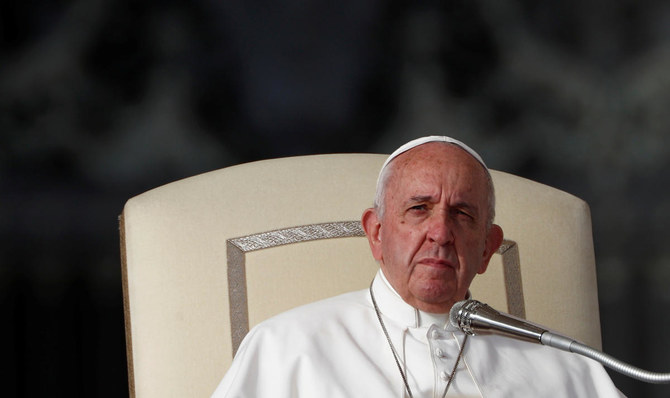
Pope names new financial regulator chief following police raid
Pope names new financial regulator chief following police raid

- Carmelo Barbagallo, 63, former head of supervision at Italy’s central bank, succeeds Swiss lawyer Rene Bruelhart


Ahead of strikes, Trump was told Iran attack is high risk, high reward
- Experts caution that the unfolding conflict could take dangerous turns and the first official said the Pentagon’s planning did not appear to guarantee the outcome of any conflict
WASHINGTON: Ahead of the US attack on Iran, President Donald Trump received briefings that not only delivered blunt assessments about the risk of major US casualties but also touted the prospect of a geopolitical shift in the Middle East in favor of US interests, a US official told Reuters. The launch of what the Pentagon called Operation Epic Fury on Saturday plunged the Middle East into a new and unpredictable conflict. The US and Israeli militaries struck sites across Iran, triggering retaliatory Iranian attacks against Israel and nearby Gulf Arab countries.
The official, who spoke on condition of anonymity, said the briefers described the operation to the president as a high-risk, high-reward scenario that could present a once-in-a-generation opportunity for change in the region.
HIGHLIGHTS
• Trump briefings included risks, opportunities in Middle East
• Diplomatic efforts with Iran fail to avert military confrontation
• Iran vows retaliation, targets US and Israeli interests
Trump himself appeared to echo that sentiment when he acknowledged the stakes at the onset of the operation, saying “the lives of courageous American heroes may be lost.”
“But we’re doing this not for now, we’re doing this for the future, and it is a noble mission,” Trump said in a video address announcing the start of major combat operations.
“For 47 years, the Iranian regime has chanted death to America and waged an unending campaign of bloodshed and mass murder ... We’re not gonna put up with it any longer.”
The briefings from Trump’s national security team help explain how the president decided to pursue arguably the riskiest US military operation since the invasion of Iraq in 2003.
Ahead of the strikes, Trump received multiple briefings from officials, including CIA Director John Ratcliffe, US General Dan Caine, the chairman of the Joint Chiefs of Staff, US Secretary of State Marco Rubio and Defense Secretary Pete Hegseth.
On Thursday, Admiral Brad Cooper, who leads US forces in the Middle East as the head of Central Command, flew to Washington to join discussions in the White House Situation Room.
A second US official said that before the strikes, the White House had been briefed on risks associated with operations against Iran, including retaliatory strikes on multiple US bases in the region by Iranian missiles that could overwhelm defenses, as well as Iranian proxies attacking US troops in Iraq and Syria.
The official said that despite the massive military buildup by the United States, there were limits to the air defense systems that had been rushed into the region.
Experts caution that the unfolding conflict could take dangerous turns and the first official said the Pentagon’s planning did not appear to guarantee the outcome of any conflict.
Trump called on Iranians to topple the government but that is easier said than done, said Nicole Grajewski with the Carnegie Endowment for International Peace.
“The Iranian opposition is pretty fragmented. It’s unclear what the population is willing to do in terms of rising up,” Grajewski said.
Both US officials requested anonymity due to the sensitivity of the internal discussions.
The White House did not immediately respond to requests for comment. The Pentagon declined to comment.
TRUMP’S SWEEPING GOALS
In the weeks leading up to the attack, Trump ordered a major military buildup in the Middle East. Reuters reported military planning to carry out a sustained campaign against Iran, if that is what the president chose. Plans included targeting individual officials, officials said.
An Israeli official said Iran’s Supreme Leader Ayatollah Ali Khamenei and President Masoud Pezeshkian were both targeted but the result of the strikes was unclear. Speaking on Saturday, Israeli Prime Minister Benjamin Netanyahu said there were many signs indicating that Khamenei “is no longer” and called on Iranians to “take to the streets to finish the job.”
Trump made clear on Saturday that his objectives in Iran were sweeping, saying he would end the threat posed by Tehran to the United States and give Iranians a chance to topple their rulers. To accomplish this, he outlined plans to lay waste to much of Iran’s military as well as deny it the ability to build a nuclear weapon. Iran denies seeking a nuclear weapon.
“We are going to destroy their missiles and raze their missile industry to the ground... We’re going to annihilate their navy,” he said. “We’re going to ensure that the region’s terrorist proxies can no longer destabilize the region or the world and attack our forces.”
Trump’s decision demonstrates an increasing risk appetite, far greater than when he ordered US special operations forces into Venezuela last month to seize that country’s president in an audacious raid.
The unfolding campaign against Iran is also riskier than when Trump ordered US forces to bomb Iran’s nuclear sites in June.
Iran’s Revolutionary Guards threatened all US bases and interests in the region and said Iran’s retaliation would continue until “the enemy is decisively defeated.”
Experts warn that Iran has many options for retaliation, including missile strikes but also drones and cyber warfare.
Daniel Shapiro, a former senior Pentagon official for Middle East issues, said that despite the US and Israeli strikes, Tehran would still be capable of causing some pain.
“Iran has many more ballistic missiles that can reach US bases than the US has interceptors ... some Iranian weapons will get through,” said Shapiro, also a former US ambassador to Israel. “(The strikes are) a major gamble.”


