JEDDAH: After almost four months of Indian lockdown in Kashmir, is there anything the government of Azad Jammu and Kashmir (AJK) has done for the Kashmiris on the other side of the Line of Control? How should the international community act? Arab News asks Masood Khan, the president of AJK.
The people of Jammu and Kashmir prefer a political solution, not a military one. They do not want a war between India and Pakistan “because it would be devastating for the entire region,” Khan said, adding that his efforts have been focused on advocacy at the UN, among US and UK lawmakers, members of the European Parliament, and especially among the leaders of the Organization of Islamic Cooperation (OIC).
“I have come to the Gulf region many times, particularly to Jeddah where we have been working with the OIC to put pressure on India to lift the curfew and lockdown, to stop molesting women, stop treating them as spoils of war, stop harassing and prosecuting people. As you know, there are 13,000 boys who have been abducted and they have been put in jails in India, and their mothers do not know where the boys have gone,” he said.
According to Khan, Kashmir’s economy has also been ruined, as this year’s apple and saffron crops have not been sold, and the region has incurred losses of billions of dollars.
The situation in Kashmir has strained Pakistan-India relations and there is no chance for normalization, according to Khan, until India “reverses the illegal steps that it took Aug. 5 and Oct. 31” and “stops besieging the entire territory of Jammu and Kashmir.”
On Aug. 5, the government of India revoked the special status granted under Article 370 of the Indian constitution to Jammu and Kashmir. The move was followed by a swift annexation of Kashmir, with tens of thousands of Indian troops deployed, phone and Internet networks shut down, and the state’s public figures detained. On Oct. 31, Kashmir was formally taken under direct federal control and split into two federal territories – Jammu and Kashmir, and Ladakh – bringing an end to its semi-autonomous rule since 1947.
Calling the Kashmir situation “an unfinished agenda of the UN Security Council,” Khan argued “the dispute is an international, not a bilateral matter.”
“There are four parties to the dispute – Pakistan, India, the people of Jammu and Kashmir, and the UN, the guarantor for the implementation of the Security Council’s resolutions that had given the people of Jammu and Kashmir the right to decide and determine their political future,” he said, adding that the council passed resolutions, but has not implemented them.
While he said there is a need to explore new avenues for negotiation, arbitration, regional initiatives and making good use of the UN secretary general’s office by appointing a special envoy, he also suggested that additional measures can be taken under Article 6 of the UN charter, if there is no cooperation from the Indian side.
Article 6 says that a member of the United Nations who has persistently violated the charter’s principles may be expelled from the organization by the General Assembly upon the recommendation of the Security Council.
Commenting on responses from the Muslim world, Khan said there are “still some expectations.”
“The OIC has several times expressed full solidarity with the people of Jammu and Kashmir, condemning India, asking it to reverse all the steps it had taken. We are satisfied with the OIC stance. We also understand that many powerful nations with the OIC have strong economic ties with India. These countries have also given generous help to Pakistan and Azad Kashmir in times of difficulty,” he said.
The expectations toward these powerful nations, he explained, are related to their influence in India, as “India would probably not listen to some of the western countries, but they would definitely listen to the leadership of the Gulf region.”


President AJK says high hopes from OIC, Gulf states to break India’s Kashmir lockdown
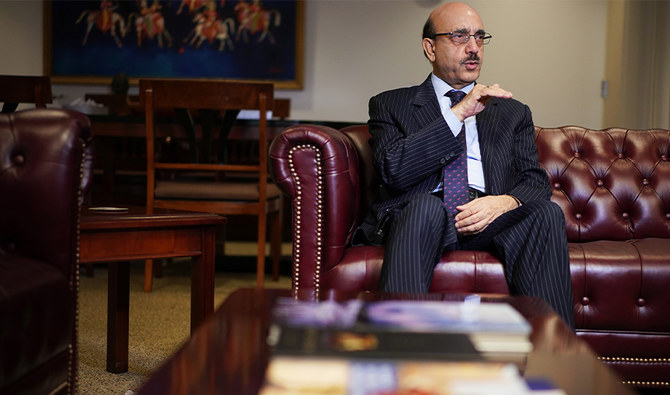
President AJK says high hopes from OIC, Gulf states to break India’s Kashmir lockdown

- Azad Jammu and Kashmir president tells Arab News how the international community should act
- Masood Khan suggest India would listen to the leadership of the Gulf region

Pakistan PM leaves for Saudi Arabia on brief visit as Middle East crisis rages on
- The visit comes at a time of increased volatility in the region, following US-Israeli strikes on Iran and Tehran’s counterattacks
- Sharif and Crown Prince Mohammed will discuss the ongoing tensions, regional security and bilateral relations, Sharif’s office says
ISLAMABAD: Pakistan’s Prime Minister Shehbaz Sharif on Thursday departed for Saudi Arabia on a brief, hours-long visit, his office said, amid an ongoing conflict in the Middle East.
The visit comes at a time of increased volatility in the region, following Unites States-Israeli strikes on Iran and Tehran’s counterattacks on US bases in several Gulf countries as well as commercial and oil infrastructure, raising the spectre of a wider war.
Sharif, expected to discuss regional security and diplomatic coordination with Saudi leaders, is visiting the Kingdom on the invitation of Crown Prince Mohammed bin Salman, according to the prime minister’s office.
“Sharif will meet His Highness Prince Mohammed bin Salman,” the former’s office said.
“The meeting between the two leaders will discuss the ongoing tensions in the region, the regional security situation and the bilateral relations between the two countries.”
The development came a day after Bloomberg, citing comments from Sharif’s spokesperson, reported that Pakistan is ready to support Saudi Arabia “no matter what” as tensions escalate across the Middle East following Iranian strikes on Gulf states.
Mosharraf Zaidi told Bloomberg TV Islamabad would come to Riyadh’s aid whenever required, emphasizing the longstanding security partnership between the two countries, which was further strengthened by a mutual defense pact signed in September last year.
There was “no question we might, we will” come to Saudi Arabia’s aid “no matter what and no matter when,” Zaidi said.
“Both countries, even before the defense agreement, have always operated on the principle of being there for the other,” he added.
Pakistan and Saudi Arabia have historically maintained close military and strategic ties, and the new agreement elevated their security cooperation at a time of heightened regional instability.
Zaidi said Pakistan was also working diplomatically to prevent the conflict from expanding further across the region.


