

Leaders descend on Beijing for Bloomberg problem-solving forum

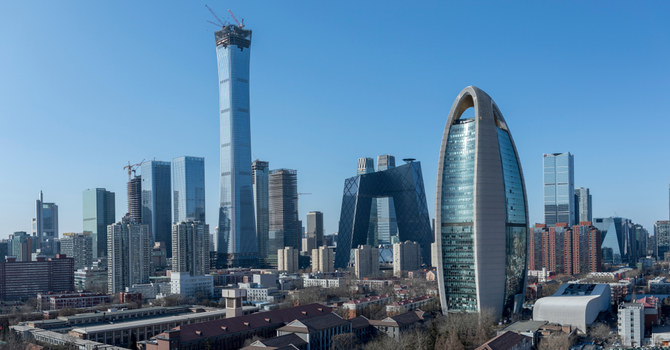
Thought leaders from the business world and the global political scene are descending on the Chinese capital Beijing for the New Economy Forum. (Shutterstock)
Updated 21 November 2019
Follow

Leaders descend on Beijing for Bloomberg problem-solving forum

  • The two-day event aims to encourage solutions from the private sector to some of the big challenges the global economy faces today
  • Some 500 senior leaders will attend the gathering, of which about 200 will come from Chinese institutions

Thought leaders from the business world and the global political scene are descending on the Chinese capital Beijing for the New Economy Forum (NEF) run by the information and media giant Bloomberg.

The two-day event aims to encourage solutions from the private sector to some of the big challenges the global economy faces today — trade, climate change, technology and financial volatility. It will also prioritize issues of inclusion, urbanization and governance.

Justin Smith, chief executive officer of Bloomberg Media, told Arab News — which is a media partner for the event — that some 500 delegates would attend the forum, with about 200 coming from institutions within China.

“The reason we’re bringing people together is to produce a platform for discussion between people who represent the new global economy. There is a whole new class of people from Asia, the Middle East, Africa and Latin America who are not represented well in the ‘legacy gatherings’ that take place, which are typically more American and European oriented.

“The idea is to enable people at a principle level — chief executives, ministers, leaders — to have substantive conversations to find solutions to global problems and help mitigate the big issues the world faces. This is not just a talking shop,” he said.

Some 500 senior leaders will attend the gathering, of which about 200 will come from Chinese institutions. “There will be a big Chinese involvement, but this is because of how important China is in the global economy. This really is a one-of-a-kind gathering,” Smith said.

The opening keynote will be delivered by a senior member of the leadership of the Peoples Republic, whose identity has not been officially disclosed amid tight security at the conference venue outside Beijing city center.

While the issue of trade wars between China and the US will be a big issue at the gathering, Smith said that it was not the most important one. “This is not a US-China gathering — it is a global gathering located in Beijing,” he said.

Americans attending the event include former secretary of state Henry Kissinger, as well as Hank Paulson, who was Treasury secretary during the global financial crisis, and Janet Yellen, former chair of the US Federal Reserve.

There is a significant delegation from the Middle East, including Saudi business leader Lubna Olayan, as well as executives and policy-makers from other Arabian Gulf countries.

“The Middle East’s role in the new economy is critical. It has increasingly deep ties with China, but also has strong links with Europe and the West. They are in between western capitalism and state capitalism,” Smith said.


GLOBAL MARKETS-Shares skid as oil blasts past $100 after Iran strikes Gulf shipping

Updated 7 sec ago
Follow

GLOBAL MARKETS-Shares skid as oil blasts past $100 after Iran strikes Gulf shipping

SYDNEY: Shares in Asia fell broadly on Thursday as oil prices roared 9 percent past $100 a barrel on reports of more ships struck in Gulf waters and terminal shutdowns — a jump that could rapidly stoke inflation and push global borrowing costs higher.

Investors took little comfort from the International Energy Agency’s plan to release 400 million barrels of oil from its reserves, the largest such move in its history. As part of that, the US said it would release 172 million barrels of oil from next week.

Brent crude futures jumped 9.2 percent to $100.37 a barrel, extending a rise of more than 4 percent overnight. US crude futures surged 8.1 percent to $94.26 a barrel.

Shares slid, with MSCI’s broadest index of Asia-Pacific shares outside Japan falling 1.5 percent, while the Nikkei dropped 1.4 percent.

Chinese blue-chips lost 0.6 percent and Hong Kong’s Hang Seng index skidded 1.2 percent.

Both S&P 500 futures and Nasdaq futures fell 0.9 percent. EUROSTOXX 50 futures were down 0.8 percent and DAX futures lost 1 percent.

Two fuel tankers in Iraqi waters had been struck by explosive-laden Iranian boats, Iraqi security officials said early on Thursday, while an Iraqi official told state media that its oil ports “have completely stopped operations.”

Bloomberg reported that Oman has evacuated all vessels from its key oil export terminal at Mina Al Fahal as a precautionary measure.

“The market remains very concerned in terms of what’s going on in the Strait of Hormuz, and basically, information that we are getting over the last 24 hours is not a good reading,” said Rodrigo Catril, a senior FX strategist at NAB.

“It sort of reemphasizes the view that we should be worried about this and the risk is oil prices are going to get higher from here rather than coming down.”

Iran had earlier stepped up attacks on merchant ships in the Strait of Hormuz, raising the number of ships struck in the region since fighting began to at least 16. Tehran has warned the world to get ready for oil at $200 a barrel.

Throwing more uncertainty into the air, US President Donald Trump on Wednesday declared the war on Iran has been won but he will stay in the fight to finish the job.

INFLATION RISKS

US data showed the consumer price index rose 0.3 percent in February, in line with forecasts and above January’s 0.2 percent increase. The report, however, was not regarded as particularly relevant given that the Iran war has started to fuel inflation.

In bond markets, the risk of rising inflation outweighed safe-haven considerations to shove yields higher globally. Yields on 10-year Treasury notes rose 3 basis points to 4.2374 percent on Thursday, having jumped 7 bps overnight.

Fed funds futures extended their slide as investors feared higher inflation would make it harder for the Federal Reserve to ease policy. Markets are just wagering one more rate cut from the Fed this year. 

The danger of energy-driven inflation has led markets to wager the next move in rates from the European Central Bank could be up, possibly as early as June. 

Nervous investors sought the liquidity of dollars while shunning currencies from countries that are net energy importers, including Japan and much of Europe.

The euro slipped 0.2 percent to $1.1539, after closing at the weakest level since November last year. The dollar inched up 0.1 percent to 159.12 yen, the strongest level since January when reported rate checks from the US Fed spooked yen bears.

The risk-sensitive Australian dollar lost 0.4 percent to $0.7122, having hit a more than three-year high of $0.7188 on Wednesday as bets for an imminent rate hike from its central bank grew.
