


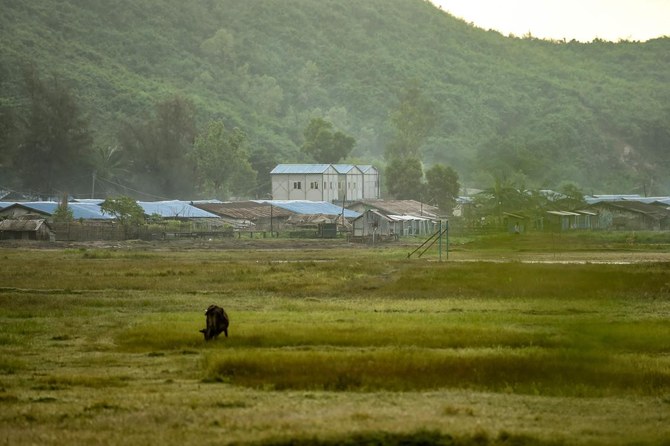

KYAUKPHYU, Myanmar: Htoo Maung sits down to lunch, sharing a bowl of traditional noodle soup with old friends, an ordinary act that has become extraordinary in Myanmar’s Rakhine state — because he is Muslim, and they are Buddhist.
They used to live side by side as neighbors.
But now he can only visit them under a strict curfew enforced by armed guards before he must return to the muddy camp where he and the rest of Kyaukphyu town’s Muslims have been confined for seven years.
In 2012 inter-communal unrest swept through swathes of western Myanmar, including Htoo Maung’s home town, after allegations spread that a Buddhist woman had been raped by Muslim men.
Mobs ransacked homes and police rounded up Muslims for their “own safety” to sites that would later be turned into camps.
More than 200 died, tens of thousands were displaced and the stage was set for the bloody purge of hundreds of thousands of Rohingya Muslims in northern Rakhine five years later.
Many fear the enduring deep sectarian suspicions and religious divisions are irrevocable and authorities claim any attempt to reintegrate communities could trigger new unrest.
But some Muslims in Kyaukphyu have managed to maintain a cautious relationship with Buddhist friends, raising hopes that old communal bonds may not be completely severed.
“The people from the town didn’t attack us,” Htoo Maung says, suggesting outsiders were to blame.
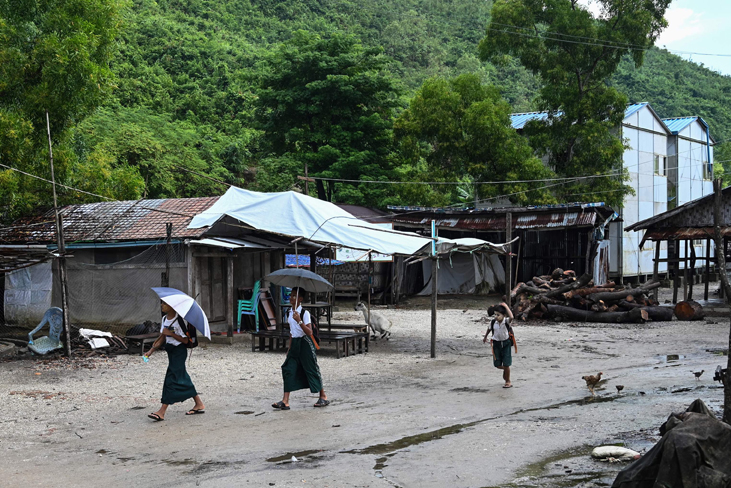
Students are seen in Kyauktalone camp in Kyaukphyu, Rakhine state, where Muslim residents have been forced to live for seven years after the inter-communal unrest tore apart the town. (AFP / Ye Aung Thu)
Kyaukphyu ethnic Rakhine MP Kyaw Than insists his town is ready to welcome the Muslims back, but can only do so with the government’s green light.
“Everyone in the camp is a citizen,” he says, decrying the “lack of humanity” shown to the town’s Muslim population.
But there is no forgetting the new social order.
Htoo Maung, whose name has been changed to protect his identity, and the other Muslims from the camp are only permitted to visit town for two hours at a time under the chaperone of weapon-wielding police.
He is bereft at the loss of his old life.
“I feel so sad — I never imagined this could happen.” Htoo Maung tells AFP, as he looks at the overgrown patch of land where his house once stood.
He adds: “We are not illegal.”
He and many others in the camp are Kaman Muslims. Unlike the Rohingya, they are an officially recognized minority in Buddhist-majority Myanmar.
But their status did little to help them as the unrest spread.
Before the attacks, some were teachers, lawyers and judges, while others fished or drove ox carts transporting cargo and people between the shore and the wooden boats that moor off the working beach.
Those jobs in the town are now exclusively carried out by ethnic Rakhine Buddhists, who have also taken over any still-intact homes of Muslims.
Saw Pu Chay leads a women’s rights group in a downtown building that served as a mosque before 2012.
Cavities in the wall where Islamic symbols were gouged out stand testament to the 2012 violence.
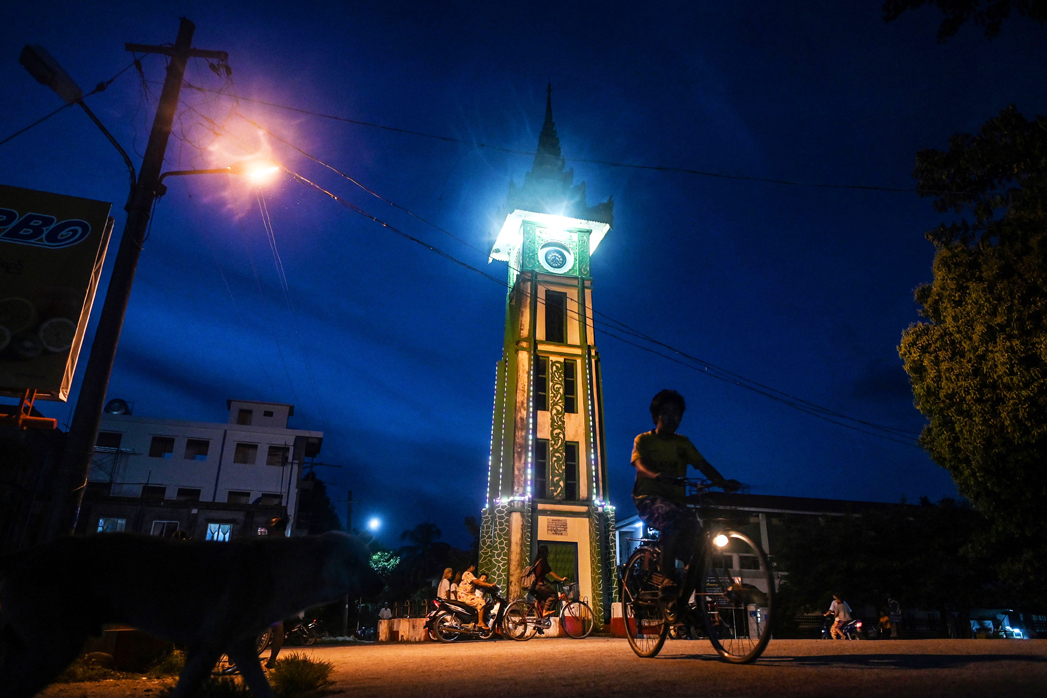
This photo taken on October 2, 2019 shows people riding past the town's clock tower in Kyaukphyu, Rakhine state, where Muslim residents have been forced to live in a camp for seven years in a camp after the inter-communal unrest tore apart the town. (AFP / Ye Aung Thu)
The 53-year-old defends using the building, saying local Muslim friends sometimes stop by to see her on their way from the camp to the market.
“I know them well as we’ve lived alongside them since we were young. They’ve lived here for generations,” she says, while making it clear she considers the Rohingya further north as unwelcome outsiders.
Kyaukphyu camp residents are desperate for a chance to rebuild their lives.
“It’s just like a prison,” says camp leader Phyu Chay of his current ‘home’, adding: “There are no jobs and we struggle to get hold of proper medication.”
Some 130,000 Muslims, the vast majority Rohingya, are languishing in various camps in central Rakhine.
Hundreds of thousands more fare little better, trapped in villages with virtually no freedom of movement.
Amnesty International brands the “institutionalized system of segregation and discrimination” so severe it constitutes “apartheid.”
They continue to lack access to education, health care and work — a situation Amnesty’s Laura Haigh describes as both “unacceptable and criminal.”
Many have been forced to accept a controversial National Verification Card (NVC), a limbo status offering few rights until holders “prove” their claim to full citizenship.
Rights groups condemn the NVC as a discriminatory tool foisted on many Muslims — particularly Rohingya — who they say should already be treated as full citizens.
Few have successfully negotiated the convoluted bureaucratic path to obtain full ID.
Authorities did not respond to requests for comment.
Under international pressure, the government has announced it will close all the camps.
But in the current plan, those “freed” would not be allowed to return to their former homes.
Instead they would be resettled in new accommodation close to the former camps with continuing heavy restrictions on movement.
The UN, NGOs and rights groups fear the strategy simply “risks entrenching segregation” and urge the government to grant Rakhine’s Muslims the full freedoms they deserve.
Phyu Chay says: “All our human rights have been violated.”


