

Pakistan posts current account surplus for the first time since 2015

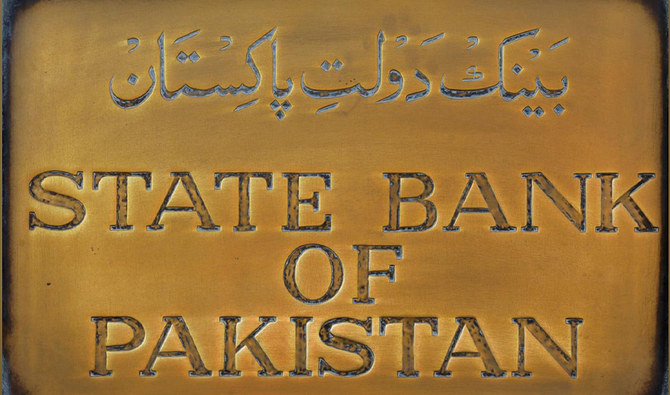
A brass plaque of the State Bank of Pakistan is seen outside of its wall in Karachi, Pakistan December 5, 2018. (REUTERS/File Photo)
Updated 20 November 2019
Follow

Pakistan posts current account surplus for the first time since 2015

  • PM Khan says economy going in the right direction as economic reforms bear fruit
  • Experts believe current account deficit is expected to settle around $5 billion against budgetary expectations of $7-8 billion

KARACHI: Pakistan posted current account surplus after four long years, data released by the State Bank of Pakistan (SBP) showed on Tuesday, as the country’s measures to discourage imports started bearing fruit.

According to the SBP, the external account recorded a current account surplus of $99 million in October 2019.

Prime Minister Imran Khan has already said the country’s financial situation is moving in the right direction.

Previously, Pakistan had posted the current account surplus back in March 2015.

Khan also reiterated his claim about the health of Pakistan’s economy in a Twitter post on Tuesday, saying: “Pak economy finally heading in the right direction as more of our economic reforms bear fruit: Pak’s current account turned into a surplus in Oct 2019, for the first time in 4 yrs. The current account balance was +$99 mn in Oct 2019 compared to -$284 mn in Sept 2019 & -$1,280 mn in Oct 2018.”

He added: “For the first 4 months of our fiscal year our current account deficit has fallen by 73.5% compared to the same period last fiscal yr. Our exports of goods & services in Oct 2019 rose 20% over the previous month and 9.6% over Oct 2018. I congratulate our exporters & encourage them to do more.”

When Prime Minister Khan’s administration assumed the country’s political power back in 2018, Pakistan had posted its highest current account deficit of $19.89 billion in fiscal year FY18 that was reduced to $13.83 billion with a 30 percent reduction in FY19.

Experts maintain this owed to the government’s decision to cut down the import of luxury items.

The country’s cumulative current account deficit declined by 74 percent during the first four months of the current fiscal year between July and October (4MFY20) to $1.47 billion against the $5.56 billion recorded during the same period of the last fiscal year (4MFY19).

The balance of payments turned positive due to the decline of 21 percent of the total imports along with a 10 percent increase in the total exports on year on year (YoY) basis.

The four-month current account deceit is 1.6 percent of the country’s Gross Domestic Product (GDP) which was 5.5 percent during the same period of the last fiscal year (FY19).

Financial analysts expect the current account deficit of the country to cool down at about $5 billion.

“This year, the current account deficit is expected to settle at about $5 billion versus the earlier budgetary expectations of $7-8 billion,” Khurram Schehzad, senior financial analyst and CEO of Alpha Beta Core, a financial advisory firm, told Arab News.

However, economists also expressed concern over the substantial drop in the imports “of mainly capital goods” which, they said, was “leading to the closure of industries or deindustrialization,” in the words of Dr. Shahida Wizarat.

“If the trade deficit is reducing on the back of diminishing raw material or capital good imports that have become more expensive due to the devaluation of Pakistani rupee, it means the industries are closing down in the country. This also happened in the 1990s. There is no reason to celebrate trade deficit reduction in such a context,” she added.

Experts also called for import substitution through localization of industries driven by indigenous factors.

“It is about time we thought of economic growth that should be driven by indigenous factors by encouraging export-oriented investments and reducing the cost of doing business, starting with the reduction in interest rate,” Schehzad commented.

The country’s central bank is scheduled to announce its monetary policy on Friday.


Former spy chief Faiz Hameed appeals conviction by Pakistan military court

Updated 11 sec ago
Follow

Former spy chief Faiz Hameed appeals conviction by Pakistan military court

  • The ex-ISI chief was sentenced to 14 years in prison over engagement in political activities, misuse of authority
  • His conviction is highly unusual in a country where the military has ruled for almost half of its 78-year history

ISLAMABAD: Pakistan’s former intelligence chief Lt. Gen. (retired) Faiz Hameed has appealed his sentencing to 14 years in prison by a Pakistani military court, Hameed’s lawyer said on Sunday. 

Hameed was arrested in Aug. 2024 amid accusations he was involved in land grabbing and coercive seizures of property belonging to the owner of the Top City housing development near Islamabad. At the time, the military said multiple violations of the Pakistan Army Act after his retirement had also been established, prompting court martial proceedings.

On Dec. 11, Pakistan’s military announced that Hameed was found guilty of engaging in political activities, violating the Official Secrets Act and misusing authority and government resources as the chief of the Inter-Services Intelligence (ISI) agency.

“We have filed an appeal against the sentence handed down to Lt. Gen. Faiz Hameed by the military courts. The appeal was submitted to the Registrar Court of Appeals, AG Branch, Chief of Army Staff,” Hameed’s counsel Mian Ali Ashfaq told Arab News, without providing further details.

Hameed served as the ISI director-general from 2019 to 2021. His conviction is highly unusual in a country where the military has ruled for almost half of its history and continues to exert significant influence during civilian rule.

The Inter-Services Public Relations (ISPR), the military’s media wing, had said that Hameed was tried on four charges relating to political interference, breaches of the Official Secrets Act, misuse of authority and causing “wrongful loss to persons.”

“After lengthy and laborious legal proceedings, accused has been found guilty on all charges and sentenced to 14 years rigorous imprisonment by the Court which has been promulgated on 11 December 2025,” the ISPR said on Dec. 11.

Hameed was widely seen as close to Imran Khan when he was the prime minister and after his removal in a no-trust vote in 2022.

The military had previously accused Hameed of helping engineer political unrest during violent clashes on May 9, 2023, when Khan supporters rioted nationwide after his brief arrest on graft charges. Protesters were accused of torching government and military buildings “at the behest of and in collusion with vested political interests.” Khan, jailed since August 2023 on charges he says are politically motivated, denies ordering the attacks.

In its Dec. 11 statement, the military said the trial against Hameed complied with all legal requirements, adding that the former spy chief was given full rights, including the ability to choose his defense team, and retained the right to appeal “at the relevant forum.”

The ISPR also said his alleged role in “fomenting vested political agitation and instability in cahoots with political elements” was being handled separately, leading to speculation about more inquiries and legal cases.

Hameed, who retired in Dec. 2022, has long been a polarizing figure. The ruling Pakistan Muslim League-Nawaz (PML-N) also accuses him of helping engineer the 2017 removal of former premier Nawaz Sharif through court cases. Hameed denied the allegations.

“This is a landmark decision and I think the rule of law and accountability mechanism has been strengthened,” Information Minister Attaullah Tarar, who belongs to the PMLN-N, had told a Pakistani broadcaster after the announcement of the verdict against Hameed.