

Israel intercepts incoming rocket fire from Syria

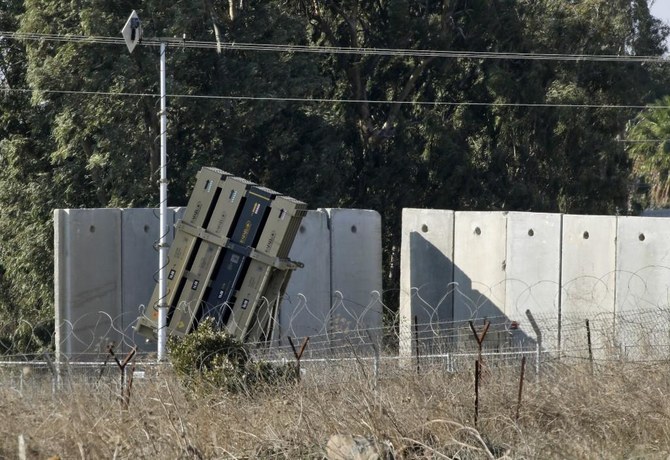
A battery of Israel’s Iron Dome defense system deployed at the Israeli-occupied Golan Heights on November 12, 2019. (AFP)
Updated 19 November 2019
Follow

Israel intercepts incoming rocket fire from Syria

  • Missile defense system shot down four rockets fired from Syria toward Israel early on Tuesday
  • ‘No hits on Israeli communities were identified’

JERUSALEM: Israel’s anti-missile defense system intercepted four rockets fired from neighboring Syria on Tuesday, the army said.

“No hits on Israeli communities were identified,” the army added in a WhatsApp message.

Meanwhile, blasts were heard close to Damascus airport in the Syrian capital, the official SANA news agency reported on Tuesday morning.

Around 450 rockets were fired into Israel last week from the Gaza Strip in the aftermath of a military operation against an Islamic Jihad commander, according to the Israeli army, but no rockets were reported to have been fired from Syria.

Baha Abu Al-Ata, who Israel blamed for recent rocket fire into its territory, was killed in a strike on his home in Gaza City.

A cease-fire between Israel and the Islamic Jihad was agreed after 50 hours of clashes, but the deal remains precarious.

On the same day as strikes killed Ata, Syrian state media reported that an Israeli strike hit the home of another Islamic Jihad militant, killing his son and another person.

Islamic Jihad accused Israel of being behind the strike in Damascus. The Israeli army refused to comment.

Juhayman: 40 years on
On the anniversary of the 1979 attack on Makkah's Grand Mosque, Arab News tells the full story of an unthinkable event that shocked the Islamic world and cast a shadow over Saudi society for decades

Enter


keywords


In major policy shift on Syria, UN Security Council lifts sanctions on Hayat Tahrir Al-Sham

Updated 28 February 2026
Follow

In major policy shift on Syria, UN Security Council lifts sanctions on Hayat Tahrir Al-Sham

  • Move reflects evolving Syrian political landscape in the post-Assad era, ending a global freeze on assets, travel ban and arms embargo

NEW YORK CITY: The UN Security Council on Friday removed Al-Nusra Front, the militant group that evolved into Hayat Tahrir Al-Sham, from its so-called Daesh and Al-Qaeda Sanctions List.

The move signals a major shift in international policy toward Syria’s evolving political landscape in the post-Assad era, and ends a global freeze on assets, travel ban and arms embargo that have been imposed on the group since 2014.

Al-Nusra Front and Hayat Tahrir Al-Sham were led by Ahmad Al-Sharaa, formerly Abu Mohammed Al-Julani, who is now Syria’s president and was a leading figure in the offensive that toppled the Assad regime.

The consensus decision by the Security Council’s sanctions committee was announced by the UK, which holds the presidency of the Security Council this month and was acting in the absence of the chair of the committee. It followed a request by the new Syrian authorities to delist “Al-Nusrah Front for the People of the Levant.”

The decision means measures that were applied to Hayat Tahrir Al-Sham under Security Council Resolution 2734, adopted in 2024, no longer apply. As a result, UN member states are notrequired to freeze the group’s funds, restrict the movement of its representatives, or block the supply or transfer of arms and related materiel.

Al-Nusra Front was added to the sanctions list for its ties to Al-Qaeda and involvement in the financing and execution of militant activities during the war in Syria. The UN initially continued to treat the group’s successor organization, Hayat Tahrir Al-Sham, as a listed alias.

Al-Sharaa has said the group severed all prior transnational jihadist links and is now solely focused on local Syrian matters.